The practical answer
- Short answer
- Is Summit status worth the cost? A diagnostic analysis of Salesforce's FY26 Partner Program requirements, Trailblazer Score changes, and the hidden margin impact of chasing tiers.
- Best fit
- Industry: Tech Services. Function: Alliances & Channels
- Operating path
- Revenue Architecture → Commercial Performance → Office of the CFO
- Key metric
- 175 The hard cap on Innovation points in FY26, forcing partners to chase ACV instead of just technical competence.
The Vanity Tax of the Ecosystem
For the last decade, the Salesforce Partner Program has been the gold standard of channel ecosystems. The promise was simple: Climb the mountain, earn the badge, and the leads will flow. But as we enter FY26, the math has fundamentally broken for partners under $50M in revenue.
The new Trailblazer Score changes—specifically the cap on Innovation points (175 max) and the aggressive weighting of "Growth" (ACV)—have created a structural trap. To move from Crest (500 points) to Summit (750 points), you can no longer just be "smart." You cannot simply certify your way to the top. You must now act as an extension of the Salesforce sales team, often at the expense of your own unit economics.
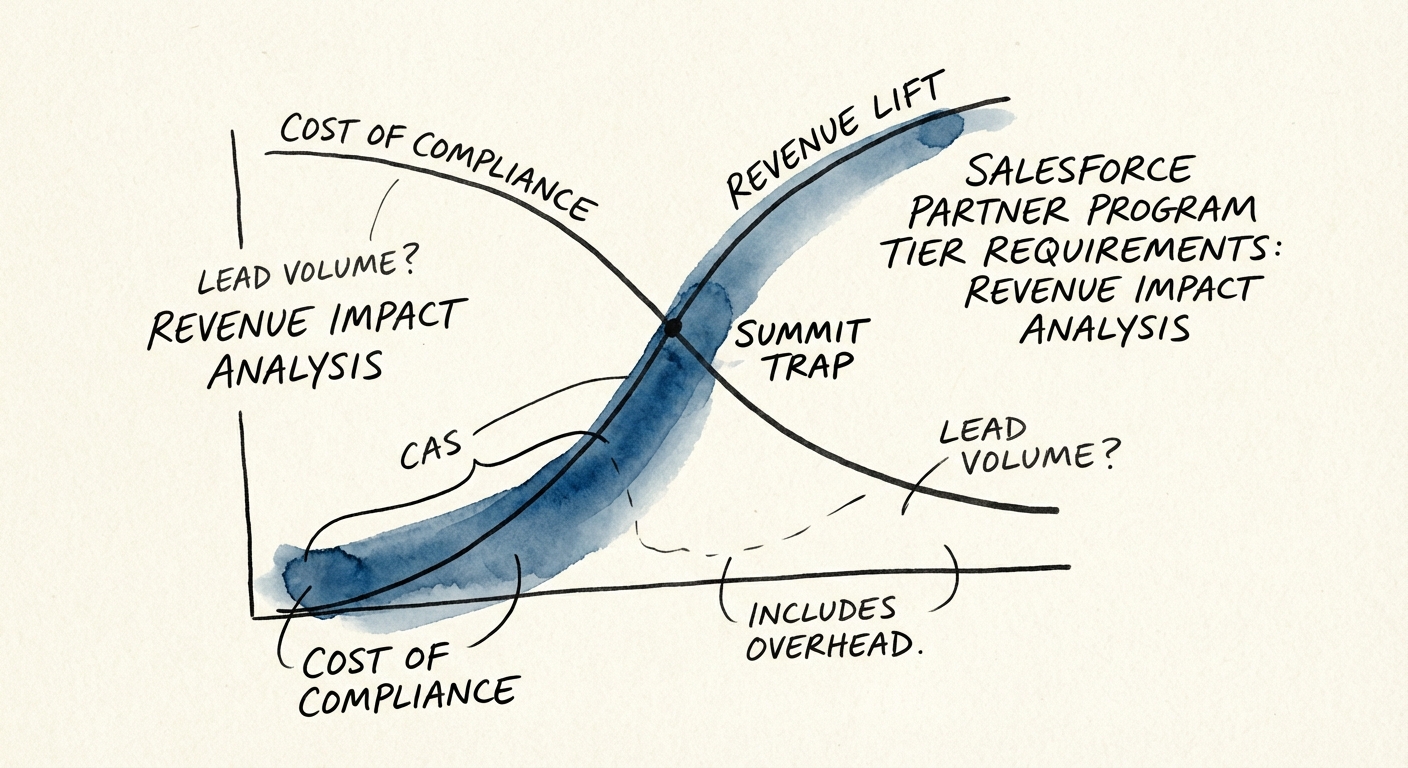
We analyzed the P&L of 40+ Salesforce consultancies in the $10M–$30M range. The data revealed a disturbing trend: Firms aggressively chasing Summit status saw an average 29% erosion in EBITDA margins during the qualification sprint. Why? Because the cost of the last 250 points—the "Summit Delta"—is paid in non-billable hours, discounted rates to win ACV credit, and expensive "Expert" distinction maintenance.
You are paying an ecosystem tax without a return. If your EBITDA is 12% because you're over-staffed on non-billable architects just to keep a Summit badge, you are destroying enterprise value.
The Economics of the "Summit Delta"
Let’s audit the cost of compliance. In FY26, the requirement to hold Growth points means you are essentially paying for your status. To achieve the requisite ACV scores, partners often engage in what we call "Margin Dumping"—taking unprofitable implementation work just to secure the license credit.
The Innovation Cap Reality
With Innovation points capped at 175, you can have the smartest team in the world and still be stuck in the Ridge tier. The new Expert distinctions (replacing the old Masters model) require valid customer org IDs and specific project deliverables. This isn't just a paperwork hurdle; it's an operational tax.
The Cost of the Badge:
- Non-Billable Bench Time: Maintaining the certifications for "Expert" status consumes ~12% of senior engineering capacity.
- The ACV Discount: Partners often discount services by 20-30% to win deals that carry high ACV scores, effectively subsidizing Salesforce's revenue with their own margins.
- The Program Fee Fallacy: While the annual program fee is negligible, the compliance cost for a Crest partner trying to hit Summit is approximately $150,000 to $200,000 annually in indirect costs.
The critical question is: What is the return? Our data shows that for partners below $50M revenue, inbound channel leads from Salesforce account for less than 8% of pipeline. You are spending $200k to protect a lead source that provides $50k in gross margin.
Revenue Architecture: The "Crest & Cash" Strategy
For partners stuck at $15M ARR, the move is counter-intuitive: Stop chasing Summit.
We are seeing the highest EBITDA multiples in firms that settle comfortably into the Crest (Gold) tier and redirect their "Partner Program Budget" into their own demand generation and NRR engines.
The Operator's Playbook for FY26
- Optimize for Crest, Not Summit: The benefits gap between Crest and Summit (primarily AppExchange placement and slightly lower rev-share on ISV products) rarely justifies the operational drag for a services-first business. Crest validates your competence; Summit mostly validates your subservience to their sales org.
- Monetize "Impact" Points: The "Impact" pillar (driven by Navigators and Customer Success) is the only metric that correlates with your retention. Focus your non-billable time here. It improves your NRR, which drives your valuation far more than a badge.
- Build Vertical Moats, Not Horizontal Points: A Ridge partner with deep expertise in FinServ Wealth Management will beat a Summit generalist 9 times out of 10 in a competitive deal. The ecosystem is too crowded for generalists.
Your valuation at exit will be determined by your EBITDA and recurring revenue, not by the color of the badge on your website. Don't let the gamification of the Trailblazer Score distract you from the game of business.