The practical answer
- Short answer
- Stop chasing 3% resell margins. Here is the operator's guide to building high-margin GCP Managed Services revenue, targeting the 2026 Partner Network changes and 12x exit multiples.
- Best fit
- Industry: Cloud Consulting. Function: Operations
- Operating path
- Revenue Architecture → Commercial Performance → Office of the CFO
- Key metric
- 12x Target EBITDA multiple for Specialist GCP MSPs (vs. 4x for Generalists).
The 'Resell + Project' Trap: Why You Are Stuck at 4x EBITDA
If you are a Google Cloud Partner generating $10M–$50M in revenue, you are likely running on a treadmill that is speeding up while your margins slow down. The classic "Resell + Projects" model—where you resell Workspace or GCP consumption for a slim margin and make your real money on one-off migrations—is broken. In 2025, resell margins on cloud marketplaces have standardized around 3%, and Google Workspace renewal margins have compressed to ~12%. You cannot scale a service business on single-digit gross margins.
This is what I call the Generalist Hamster Wheel. You are chasing new logos just to replace the project revenue that rolls off every month. In the eyes of a Private Equity buyer, this revenue is low-quality. It is unpredictable, non-recurring, and highly dependent on "heroic" sales efforts. That is why generalist IT consultancies trade at 4x–6x EBITDA. You are taking on 100% of the delivery risk for 3% of the platform spend.
The 2026 Forcing Function
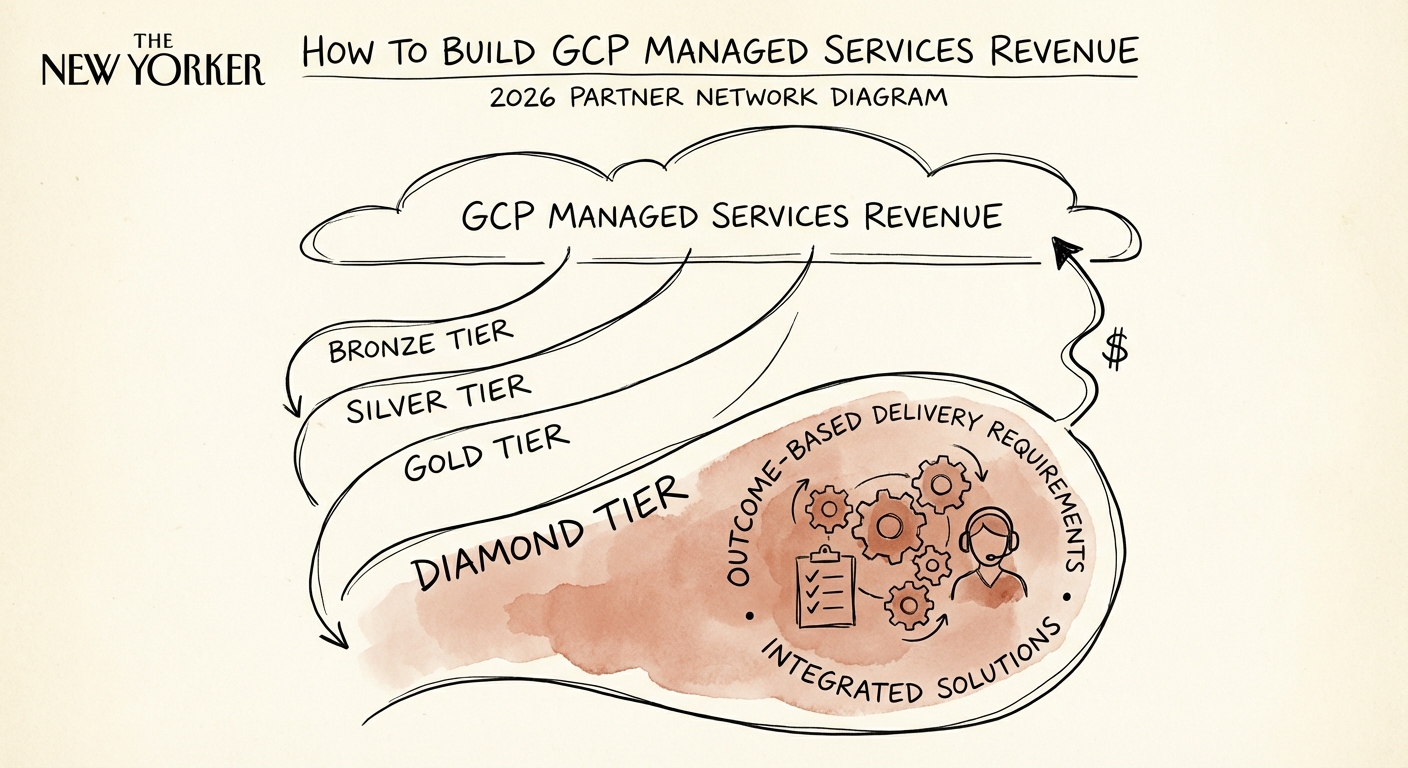
Google Cloud is not making this easier. With the launch of the new Google Cloud Partner Network (GCPN) in Q1 2026, the ecosystem is shifting from "activity-based" (how many certs do you have?) to "outcome-based" (did the customer actually succeed?). The new Diamond Tier requires exceptional, verified customer outcomes. The "paper tiger" partners who hoarded certifications without building deep technical capabilities will be downgraded. If you don't pivot to a true Managed Services Provider (MSP) model now, you won't just miss the exit window—you might lose your badge.
You cannot scale a service business on single-digit gross margins. If you are living project-to-project, you are buying your revenue every January 1st.
Defining 'True' GCP Managed Services (It's Not Just Helpdesk)
To break the 4x valuation ceiling and target the 10x–12x EBITDA multiples commanded by specialist MSPs, you must redefine what "Managed Services" means. It is no longer about Tier 1 support tickets or password resets. It is about Continuous Optimization.
Your clients don't want to pay you to watch their dashboard; they want you to pay for the outcome of that dashboard. Successful GCP MSPs in 2026 are productizing three specific layers of value:
- FinOps as a Service: Don't just resell the consumption; optimize it. Use tools like Looker to build custom billing dashboards that save the client 15% while you charge a fixed monthly fee. You are selling cost certainty, not just billing rebilling.
- DataOps & BigQuery Management: The "Lift and Shift" era is over. The new money is in data. A "Diamond" tier MSP manages the data pipeline performance, ensuring BigQuery queries are optimized and costs are controlled. This moves you from the IT budget to the LOB (Line of Business) budget, which is 5x larger.
- SecOps & Compliance: With the rise of SOC 2 requirements and threat vectors, offering a "Security Landing Zone" management service is the stickiest revenue you can build. If you secure their perimeter, you never get churned.
The Unit Economics of the Pivot
The goal is to shift your revenue mix. A healthy founder-led business should aim for 50% Managed Services, 30% Project, and 20% Resell. Why? Because Managed Services gross margins should target 45%–60%, whereas Resell is ~12% and Projects often bleed margin due to scope creep. By productizing your IP—your scripts, your dashboards, your automation—you decouple revenue from headcount. That is the definition of scale.
The Valuation Bridge: From 4x to 12x
Why do PE firms pay 12x for one $20M shop and 4x for another? It ultimately comes down to Revenue Quality. In due diligence, we look for "The Rule of 70": Investors want to see 70% of revenue as recurring (MRR/ARR). If you are living project-to-project, you are buying your revenue every January 1st. If you are an MSP, you start the year 70% of the way to your target.
To build this, you must stop selling "hours" and start selling "outcomes." Structure your contracts as 12-to-36-month agreements with auto-renew clauses. Bundle the low-margin license with the high-margin managed service into a single SKU. This protects you from margin compression on the resale side because the client sees a single value price.
Actionable Next Steps for 2026
- Audit Your Revenue Mix: If Resell + Project > 80% of revenue, you are in the danger zone. Set a 24-month goal to get Managed Services to 50%.
- Pick a Lane (Specialization): You cannot be a "Generalist MSP." You must be the "Retail Data MSP" or the "FinTech Security MSP." The new GCPN competency framework rewards depth (Product/Industry) over breadth.
- Productize Your Delivery: Document your standard operating procedures (SOPs). If your "Managed Service" relies on your best engineer logging in manually, it's not a business; it's a job. Automate the first 80% of remediation.
The market is bifurcating. On one side, low-margin generalist resellers. On the other, high-margin specialist MSPs. The choice you make in your Revenue Architecture today determines which side of the multiple you fall on.