
The practical answer
- Short answer
- ServiceNow's OneGov agreement creates a federal modernization opening for partners. See how to pursue the market without overbuilding the FedRAMP path.
- Best fit
- Industry: B2B SaaS & Services. Function: Sales & Partnerships
- Operating path
- GTM Execution → Commercial Performance → Performance Improvement
- Key metric
- 70% Published discount on ServiceNow ITSM Pro and Pro Plus bundle upgrades under the GSA OneGov agreement.
The Signal: OneGov Creates a Federal Modernization Opening
ServiceNow did more than discount software; it created a broader federal adoption path. The recently announced "OneGov" agreement with the GSA, offering up to 70% discounts on ITSM Pro and Pro Plus bundles through 2028, isn't a race to the bottom; it is a volume play designed to expand federal adoption. For a Series B or C founder, this signals a massive implementation gap. ServiceNow has set a target of $1 billion in AI Annual Contract Value (ACV) by 2026. They cannot deploy that alone. The services opportunity sits in configuration, workflow design, integration, security, and change management.
The opportunity isn't in reselling the license—margins there are razor-thin under the new GSA schedule. The opportunity is in the services drag. Federal agencies are buying AI-enhanced workflows to hit a mandated 30% efficiency target. Agencies can access the platform, but many still need cleared talent to configure "Agentic AI" within a secure environment. That is your entry point.
The GSA 'OneGov' deal isn't a discount coupon; it's a market-clearing mechanism. ServiceNow created a market opening, but partners still need a disciplined federal route to capture it.
The Barrier: The FedRAMP Moat
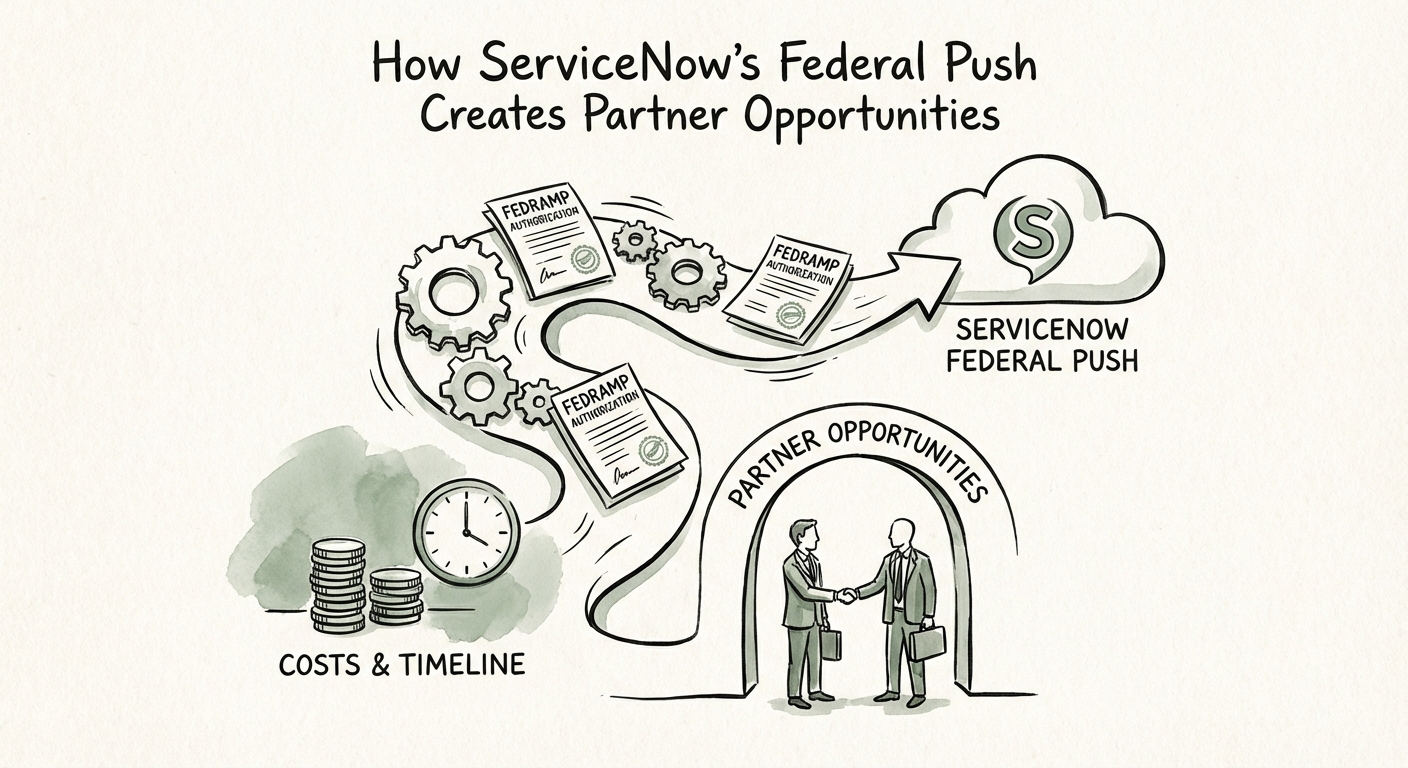
Here is where many commercial partners misjudge the market. You see the revenue potential and think you can "dip a toe" into federal. You can't. The barrier to entry is the Authority to Operate (ATO), specifically FedRAMP authorization.
Let’s look at the unit economics of a direct entry:
- Cost: A FedRAMP Moderate authorization can require substantial spend in direct costs (consultants, 3PAO assessments, engineering time).
- Time: The median timeline is 18 to 24 months. That is two years of burn without a dollar of revenue.
- Maintenance: Continuous monitoring (ConMon) adds recurring operating cost.
If you are doing under $50M in revenue, you need to be very deliberate before building this capability yourself. Standard B2B sales cycles are already lengthening; adding a federal compliance layer can stretch your time-to-close to 14+ months.
However, the "OneGov" deal changes the physics. Because the core platform is already authorized, your role as a partner changes. You don't need to be the cloud provider; you need to be the specialized implementation partner. The strategy for 2026 isn't to build your own FedRAMP stack—it's to draft behind the Primes (Booz Allen, Leidos, GDIT) who have the contract vehicles but lack your specific technical IP.
The Playbook: How to Draft, Not Drift
To capture this market without damaging your EBITDA margin, you must pivot your GTM strategy from "Selling to Government" to "Selling to the Winners."
1. The Sub-Contractor Pivot
Stop responding to RFPs on SAM.gov. By the time it's public, the winner is already chosen. Instead, identify the holders of the ServiceNow OneGov task orders. These Primes are desperate for "AI-native" delivery capacity. ServiceNow partners with specific AI and workflow credentials can support primes that need specialized capacity.
2. The "Drafting" Vehicle
If you have a SaaS product built on NOW, do not build your own FedRAMP instance yet. Utilize a "Platform-as-a-Service" distributor like Carahsoft or a specialized FedRAMP hosting partner who can wrap your application in their existing ATO. This cuts your time-to-market from 24 months to 6 months and shifts the cost from CapEx to OpEx.
3. Security as a Differentiator
While you might skip the full FedRAMP audit, you cannot skip security hygiene. Agencies are now mandating CMMC and classified-level security standards even for sub-contractors. Getting your own house in order (SOC 2 Type II, NIST 800-171) is the table stakes to even sign a teaming agreement with a Prime.