
The practical answer
- Short answer
- ServiceNow customizations are not assets; they are liabilities. Learn how to quantify 'Franken-Now' technical debt and adjust EBITDA before you sign the LOI.
- Best fit
- Industry: Private Equity / Technology. Function: IT Operations / Due Diligence
- Operating path
- Technical Debt → Turnaround & Restructuring → Transaction Advisory Services
- Key metric
- 470 Average hours required to build and stabilize a custom ServiceNow integration vs. OOTB configuration.
The Asset That Is Actually a Liability
In the CIM (Confidential Information Memorandum), the target company’s founders will list their ServiceNow implementation as a crown jewel. They will describe a "highly tailored" workflow engine that perfectly matches their unique business processes. To a Private Equity investor, "highly tailored" should sound like an alarm bell. In the ecosystem, we call this "Franken-Now": an instance so heavily customized that it can no longer accept vendor upgrades without weeks of expensive remediation.
The math is brutal. Standard Out-of-the-Box (OOTB) configurations allow for seamless, automated upgrades twice a year. Custom integrations, however, take an average of 470 hours to build and stabilize compared to standard connectors. When you acquire a firm with a "Franken-Now" instance, you aren't just buying software; you are inheriting a permanent headcount requirement. You will need expensive external consultants or high-salary internal developers just to keep the lights on. This is not "CapEx" investment; it is a hidden drag on your operating margins that founders successfully disguised as innovation.
You think you're buying a digital workflow engine. You're actually buying a pile of JavaScript spaghetti that costs $500k a year just to keep from collapsing.
The 5-Minute 'Skipped Record' Diagnostic
You don't need an engineering background to flag a high-risk implementation. You just need to ask for one specific number during due diligence: The Skipped Record Count.
When ServiceNow upgrades an instance (e.g., from Washington DC to Xanadu), it attempts to update all core files. If it encounters a file that the customer has customized, it skips the update to prevent breaking the customization. A healthy, standard instance might have fewer than 1,000 skipped records. A "Franken-Now" instance often has 5,000 to 20,000+.
The Red Flag Checklist
- Skipped Records > 1,000: Indicates heavy customization that blocks new features.
- Upgrade Cycle Time > 4 Weeks: If it takes them a month to test an upgrade, their code is brittle.
- DOM Manipulation: Any use of direct "Document Object Model" coding is a major stability risk.
- Custom Tables > 50: ServiceNow charges significantly more for custom tables. High custom table counts indicate a looming contract renegotiation where your licensing costs could jump 20-30%.
If you find these markers, you are looking at a Technical Debt remediation project costing $250k–$500k in the first year post-close. That implies a direct dollar-for-dollar reduction in the enterprise value.
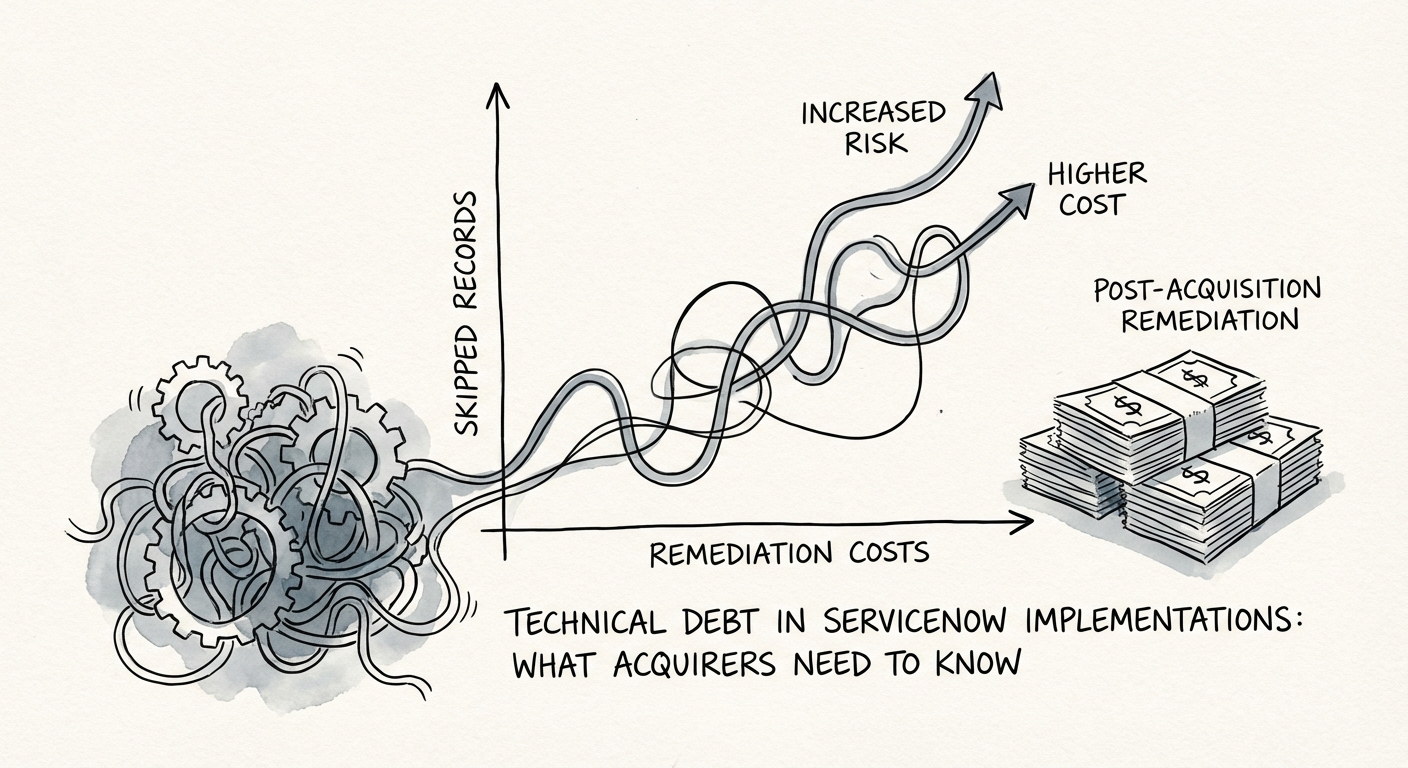
Quantifying the Risk for the Investment Committee
Technical debt in ServiceNow is not abstract; it is a future cash flow liability. If the target company cannot upgrade, they cannot use the new AI capabilities (like Now Assist) that drive the productivity gains you modeled in your value creation plan. Furthermore, 31% of acquired codebases contain critical technical debt that materially impacts valuation, according to recent M&A benchmarks.
The Fix: The 'Code Freeze' Clause
Do not let the founders deploy "one last feature" before closing. We see this constantly: a well-intentioned massive deployment two weeks before the wire that breaks the production environment. Insert a clause requiring a code freeze on the ServiceNow platform 30 days prior to close, barring critical security patches. Post-close, budget for a "Reversion to Baseline" initiative. Your first 100-day plan shouldn't be adding new features; it should be deleting the custom code that is holding the platform stuck.