
The practical answer
- Short answer
- Most founders price an SOP by the eight hours it costs to write. The real ROI math runs the other direction. Here is how to calculate it and which procedures actually pay back.
- Best fit
- Industry: Technology & Services. Function: Operations & Delivery
- Operating path
- Process Documentation → Operational Excellence → Transaction Execution Services
- Key metric
- 30% Increase in onboarding timelines due to lack of standard process documentation.
The eight-hour objection is the wrong unit of measurement
Here is the exact sentence I hear from founder-CEOs when I suggest writing down how their company actually works: "I don't have eight hours to spend documenting a deployment when I could spend eight hours shipping." It sounds like a rational trade. It is not, because it prices the SOP by its cost and never gets around to pricing it by its yield. The eight hours is the only number these founders run. The other side of the ledger stays invisible.
So let's make it visible. Say your senior architect spends the better part of a Tuesday writing one genuinely usable runbook for your client-deployment sequence. Loaded, that morning costs you somewhere around $800. Now count what it replaces. The same architect was fielding roughly four hours a week of "how do we handle this client's staging config" questions from the two engineers hired last quarter, because the answer lived in his head and nowhere else. Four hours a week is 200-plus hours a year of senior capacity bled out one Slack thread at a time. The $800 morning doesn't compete with shipping. It competes with that recurring tax, and the tax wins by an order of magnitude.
This isn't a niche problem in a tech-services shop where every engagement feels bespoke. McKinsey's research on knowledge-worker productivity found that people spend close to 1.8 hours of every workday just searching for the information they need to do their jobs. In a firm where the "information" is the undocumented way your team configures, deploys, and hands off, that search time isn't a rounding error. IDC has put the cost of operational inefficiency at up to 30% of annual revenue, and the single largest contributor in a growing services business is the gap between what your best people know and what your written process can reproduce. The founders who "move too fast to document" are the ones paying the highest tax to find out what they already know.
Stop pricing an SOP by the morning it costs you to write. Price it by the number of times you'll otherwise answer the same Slack question for the next two years.
Run the math, then run it again for the half-life
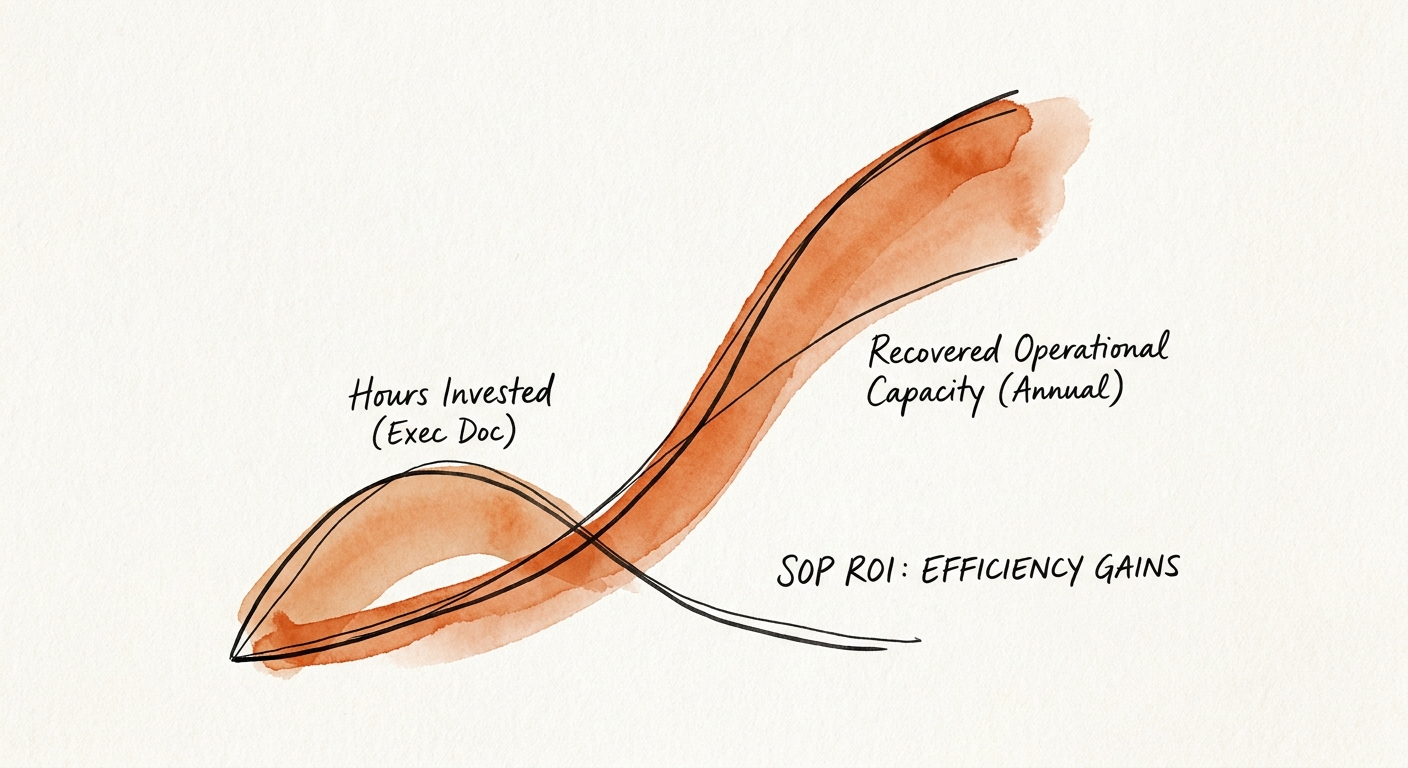
The year-one return on a single well-built SOP is almost insulting in how lopsided it is. Eight hours in at roughly $800. If the procedure recovers just two hours of senior rework and unblocking per week, that's around 104 hours of capacity back over the year. On the dollars, you spent $800 to recover something north of $10,000 in fully loaded senior time. That's the headline number, and on the happy path it holds up.
But the math founders actually need to run is the one almost nobody does, and it's where SOP ROI separates from every other process-documentation pitch: the half-life. A runbook for a stable workflow decays slowly and pays for years. A runbook for a workflow you're still re-architecting every quarter is stale before the ink dries, and re-documenting it eats the savings. So the real decision isn't "should we write SOPs" - it's which workflows are stable enough to be worth freezing in writing. Document the wrong twenty processes and you've created a maintenance liability that lies to your new hires. Document the right twenty - the ones that haven't structurally changed in a year and won't next year - and you compound the return every onboarding cycle.
That onboarding cycle is where the yield shows up first and most legibly. Gartner's onboarding research ties the absence of standardized documentation to materially longer ramp times and slower time-to-productivity for new hires - the difference between a new engineer shadowing a "hero" for six weeks and one who works a checklist on day three. And the drag isn't only at the front door. Bain's work on the cost of complexity shows how unmanaged operational complexity quietly erodes profit margins over time; every undocumented exception is a small private decision someone has to re-litigate from scratch. A good SOP doesn't just save the two hours. It collapses the decision so it never has to be made twice. That's the difference between a checklist and a runbook worth maintaining - and it's the distinction we build into the Founder Extraction Checklist: 30 Processes to Document Before Exit, which forces you to rank by stability and frequency before you write a word.
The number that dwarfs the Tuesday math
Everything above is the internal case, and it's enough to justify the work on its own. But for a founder-CEO who intends to sell, the SOP ledger has a second column that makes the hours-saved math look like loose change. When a buyer evaluates your company, they are not buying your revenue - they are buying its transferability. The question on the other side of the table is brutally simple: if we remove you and your two best architects, does the EBITDA survive? If the answer lives in three people's heads, the answer is no, and the discount that follows is not a rounding error.
I sat in a diligence process for a roughly $25M ARR services firm whose entire delivery model ran through three "hero" architects who had never written down how they did anything. The buyer's opening position was a 30% cut to enterprise value, and they were right to take it. KPMG's deal-advisory framework treats exactly this kind of key-person reliance as a flagged risk that routinely carries a 15-to-20% valuation penalty, and PwC's integration research shows how often projected synergies evaporate after close when the operational knowledge never transfers. We paused the deal and spent 90 days converting the three architects' brains into verifiable procedures - architecture review, client handover, QA gates - the documentation we'd told them to write for two years and they hadn't. The discount came off the table. The same SOP that saves a senior engineer two hours on a Tuesday is the artifact that decides whether you're a platform-grade business or a discounted bolt-on.
So run the calculation honestly this week. Pick your three highest-frequency, most-stable workflows - the ones a new hire asks about constantly and that haven't changed in a year. Time one person writing one of them. Then count the recurring hours it eliminates and, if exit is anywhere on your horizon, the key-person risk it retires. That single comparison usually settles the argument. If you want the structural version of why buyers pay up for it, the mechanics are in The Transferability Premium: Why Acquirers Pay 2x More for Documented Processes, and the broader move from heads-only knowledge to a business that runs without you is mapped in From Tribal Knowledge to Turnkey.