
The practical answer
- Short answer
- How UiPath partners can double their exit multiples by pivoting from pure services to Marketplace-led IP strategies. Valuation benchmarks and ISV playbooks.
- Best fit
- Industry: Intelligent Automation / RPA. Function: Product Strategy & Corporate Development
- Operating path
- Exit Readiness → Operational Excellence → Transaction Advisory Services
- Key metric
- 2.5x Valuation premium for partners with >30% IP revenue mix compared to pure service generalists.
The "Billable Bot" Trap: Why Service Revenue Hits a Ceiling
For the past five years, the UiPath ecosystem has been a gold rush for professional services firms. As enterprises scrambled to deploy automation, partners with certified developers could essentially print money, charging $150 to $250 per hour for implementation. However, the market has matured. The "low-hanging fruit" of simple task automation is gone, and the sheer volume of certified talent has compressed bill rates. For founders of $10M to $50M RPA consultancies, this presents a dangerous valuation reality: you are trading on EBITDA, not revenue.
Private equity firms evaluating RPA consultancies in 2026 categorize them into two buckets: "Staffing" and "Solutions." Staffing firms—those that primarily sell hours—are currently trading at 5x to 7x Adjusted EBITDA. They are viewed as low-moat businesses with high customer concentration and retention risks. If your "bot" breaks when the underlying application updates, the customer might churn. If your lead architect leaves, the account might follow.
The "Billable Bot" model also suffers from linear scaling constraints. To double revenue, you must roughly double headcount. This drags down margins (typically capping out at 20-25% EBITDA) and increases the operational complexity of the business. In due diligence, we often see these firms struggle with what we call the "Project Treadmill"—the constant need to hunt for net-new logos just to replace completed implementations, leading to unpredictable revenue consistency.
The difference between a 6x and a 12x multiple in the automation space isn't usually growth rate—it's revenue quality. Buyers pay a premium for 'Build Once, Sell Twice' assets over 'Bill Once, Bill Again' services.
The Marketplace Pivot: From "Custom Projects" to "IP Assets"
The smartest UiPath partners are using their service engagements as funded R&D labs. Instead of building a custom invoice processing bot for Client A and starting from scratch for Client B, they are abstracting the common logic into reusable IP and listing it on the UiPath Marketplace. This is not just a lead generation strategy; it is a valuation engineering strategy. By formalizing your code into a Marketplace listing (even if it is a free connector or a paid vertical solution), you shift the buyer's perception from "Service Provider" to "Technology Partner."
Consider the "IP Attachment Rate." This is the percentage of your service engagements that utilize your proprietary pre-built assets. PE buyers love this metric because it drives margin expansion (you build once, sell many times) and stickiness (the customer relies on your code, not just UiPath's platform). A partner with a 40% IP Attachment Rate can command multiples closer to 10x-14x EBITDA, bridging the gap between service shops and pure-play ISVs.
The "Forward" Ecosystem Effect
With UiPath's push into "Agentic Automation" and the "Forward" ecosystem, the definition of a partner is bifurcating. There are the UiPath Services Network (USN) partners, who are elite implementers, and the Technology Partners, who build software. The arbitrage opportunity lies in being both. By listing a certified solution on the Marketplace—whether it's a connector for a niche ERP or a specific industry workflow—you validate your IP's transferability. This "product" revenue, even if it's currently small, signals to acquirers that the business has escaped the linear constraints of the billable hour.
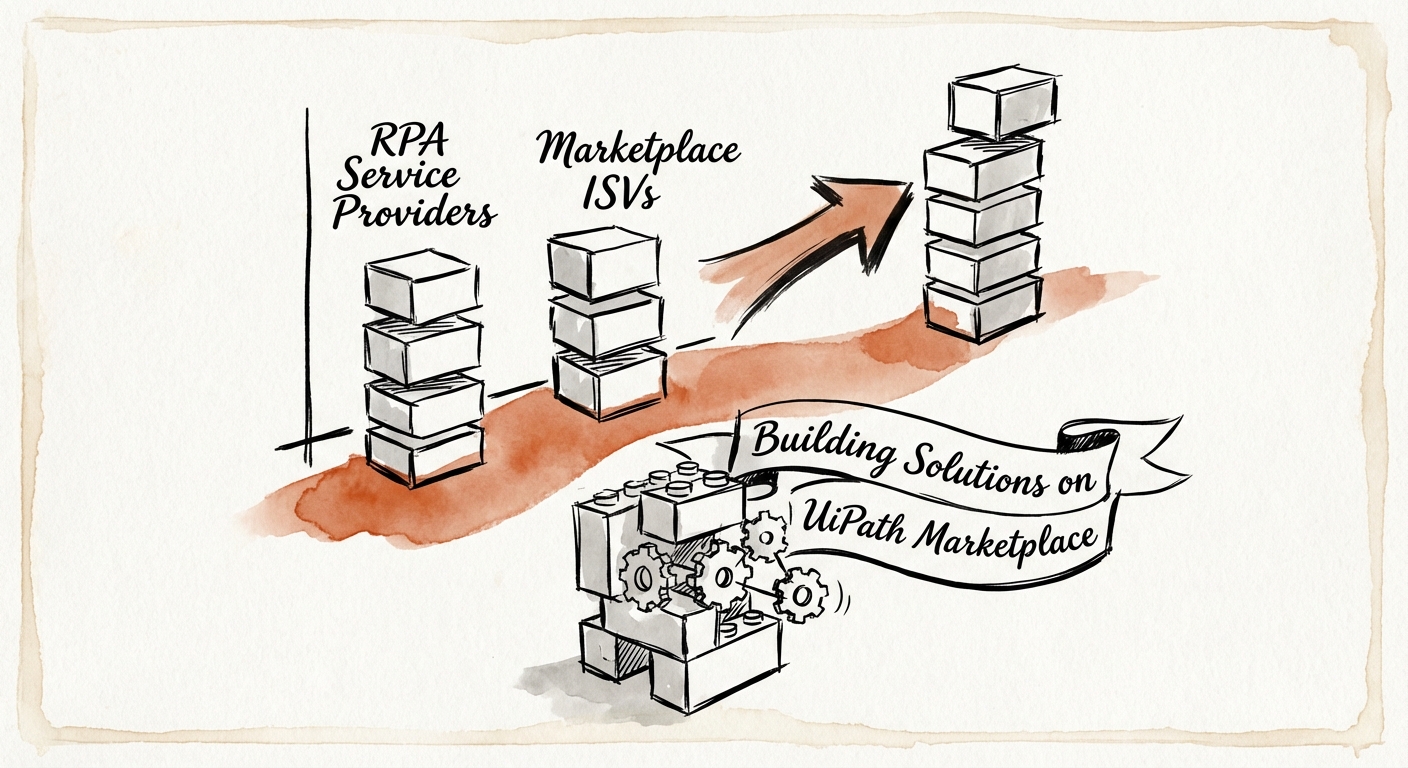
The Exit Math: Valuing the "Hybrid" RPA Firm
The valuation impact of this pivot is mathematical, not theoretical. Let's compare two hypothetical UiPath partners, both generating $20M in revenue.
Firm A (The Body Shop): $20M Revenue, 100% Services. 15% EBITDA Margin ($3M). Valuation at 6x EBITDA = $18M Enterprise Value. The founder takes home less than 1x revenue.
Firm B (The Solution Shop): $20M Revenue, 80% Services / 20% IP (Licensing + Maintenance). Because of the higher-margin IP, their blended EBITDA Margin is 25% ($5M). More importantly, because they own proprietary assets listed on the Marketplace, they command a "Platform Premium." Valuation at 12x EBITDA = $60M Enterprise Value. By converting just 20% of revenue to IP-based sources, Firm B triples its exit value.
For founders looking to exit in the next 18-24 months, the playbook is clear: stop treating the UiPath Marketplace as a marketing afterthought. Treat it as your product catalog. Audit your last 50 projects. Identify the repetitive code blocks. Package them. List them. The goal isn't necessarily to become a pure ISV overnight; it is to demonstrate enough "Product DNA" to convince a private equity buyer that you are a platform for growth, not just a bucket of hours.