
The practical answer
- Short answer
- Two $30M Adobe partners. One sells 8x EBITDA, one sells 13x. The difference isn't size or Platinum status — it's what your AEP retainer actually does.
- Best fit
- Industry: Professional Services. Function: Revenue Strategy
- Operating path
- Unit Economics → Commercial Performance → Transaction Advisory Services
- Key metric
- 5x Average EBITDA multiple for Adobe partners with >70% project-based revenue (Implementation focus).
Two firms walk into the same data room
Picture two Adobe Solution Partners, both around $30M in revenue, both with the Platinum badge, both heavy in Adobe Experience Manager. On paper, a banker would slot them in the same comp set. In the actual data room, one cleared north of 13x EBITDA and the other couldn't get a real bid above 8x — and the founder of the second firm spent the back half of his diligence calls explaining why his "recurring" line wasn't what the buyer thought it was.
The thing that separated them wasn't tier status, headcount, or even gross margin. It was a single question every acquirer now asks about Adobe partners: when you walk into a renewal, are you re-selling a project, or are you defending a number the client can't afford to lose?
Here's the trap the Adobe Solution Partner Program quietly builds into your P&L. The badge math rewards net-new license bookings, footprint expansion across Commerce, Marketo, and AEM, and the kind of complex multi-cloud implementations that earn specializations. So you staff a hunting org: pre-sales engineers, solution architects, a 12-month AEM delivery bench. You get very good at landing the whale and standing up the platform. And every January 1st, you wake up owing the same revenue all over again.
That's the part the comps punish. Fixed-bid AEM work is famous for scope creep that quietly walks a 45-point gross margin down to the mid-20s by go-live. One missed RFP dents a whole quarter. And because the work ends when the platform ships, your backlog is a treadmill, not an asset. Buyers have a word for a firm that re-wins its number every year against a brand-name skillset: a staffing agency with an Adobe logo — and they price it like one.
If a client can fire you and their conversion rate doesn't move, you were never running their growth — you were just keeping their AEM instance from falling over. That gap is the entire valuation gap.
The three retainers buyers can tell apart in one phone call
Most partners I talk to insist they already have recurring revenue. "We've got managed services. We've got post-go-live retainers." Then diligence opens the contracts and finds three completely different animals wearing the same word. Acquirers grade them on a brutal little spectrum, and you should grade your own book the same way before anyone else does.
The keep-it-alive retainer (sticky, but cheap)
Fifty hours a month so AEM doesn't fall over and Magento gets patched. It's genuinely sticky — clients rarely churn out of "don't let the site die." But it's commoditized, low-margin, and any competent shop can replace you. It props up retention without moving the multiple much. Useful floor, not a story.
The bucket-of-hours retainer (the one that quietly hurts you)
This is the dangerous one, because it looks like the good kind. The client pre-buys hours and burns them on whatever lands that week — "swap this hero banner," "spin up a landing page for the Q3 launch." You booked it as recurring. It behaves like unpredictable project work in a trench coat. It wrecks your utilization forecasting because you can't staff against a workload you can't see, and a sharp buyer will reclassify it out of your recurring line the moment they read the SOW. You don't get credit for it. In a competitive process, you may get penalized for trying to pass it off.
The optimization program (the line that actually moves the number)
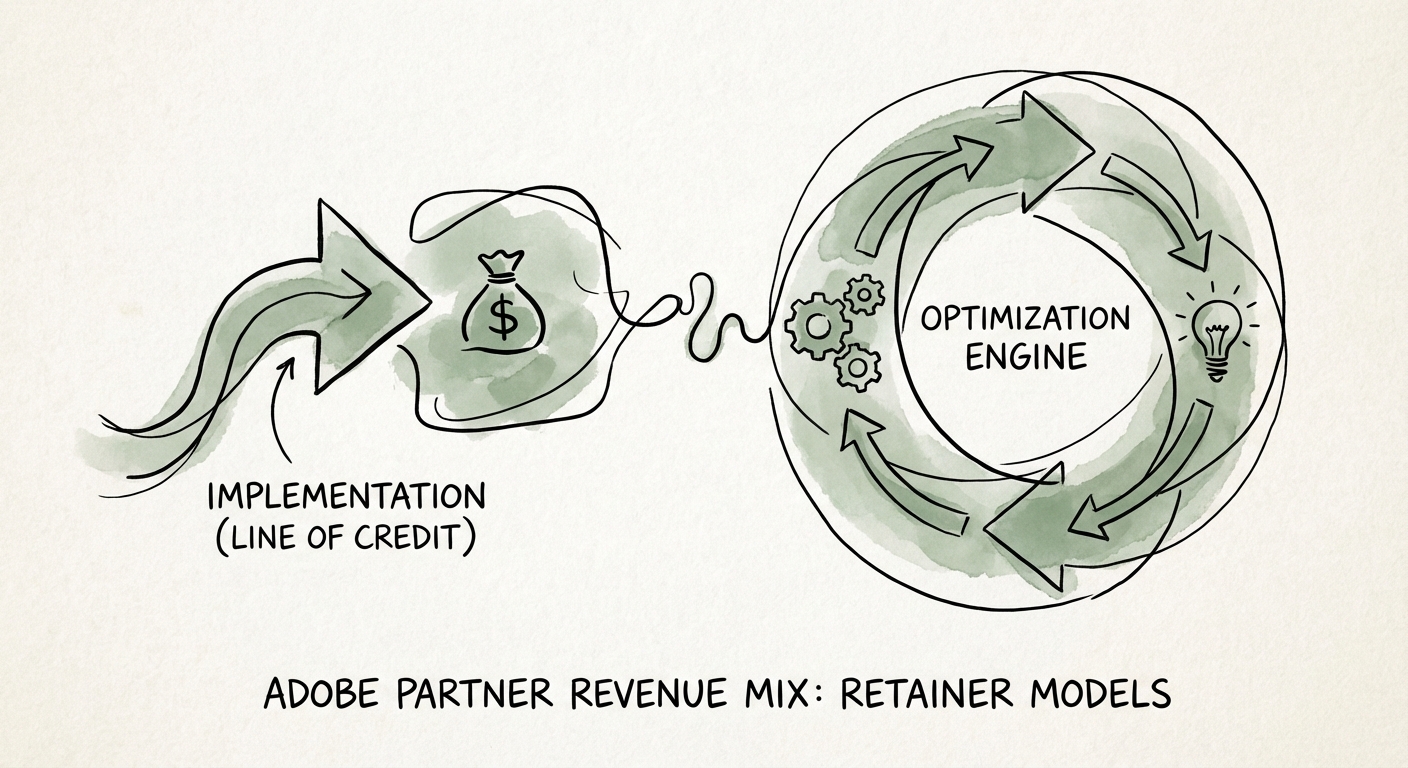
Now you're not selling hours — you're selling an outcome the client can see in their own dashboards. This is the work that lives after the platform is stood up: running A/B tests in Adobe Target, orchestrating journeys in Adobe Journey Optimizer, refining audiences in Real-Time CDP. Your team is embedded in the client's revenue engine, and the proof is uncomfortable for them: if they fire you, conversion and engagement numbers drift the wrong way within a quarter, and somebody internal has to explain why. That is the revenue buyers underwrite like SaaS, because it churns like SaaS — slowly, and only with consequences. As the DXP market keeps proving, the platform license is table stakes; the durable value sits in who runs the optimization loop on top of it.
The 18-month shift from builder to grower
Say your mix today is the classic implementation-shop split — roughly 80% build, 20% everything-after. You will not get the premium multiple at that ratio, full stop. The realistic target before you run a process is closer to 50/50, and the good news is you can get there without touching your Adobe tier, because optimization work still consumes plenty of license footprint. Three moves do most of the lifting.
Reprice the language before you reprice the contract
Stop selling "managed services" or "support hours." Those words signal cost center, and they invite the bucket-of-hours structure that buyers discount. Sell a named program with a committed cadence — a defined number of experiments shipped, journeys launched, and segments activated per quarter, tied to metrics the client already reports up the chain. Standardizing that cadence is what lets you push the margin back up while the perceived value goes the other direction.
Make AEP activation the wedge, not the implementation
The move off third-party cookies onto first-party data is your opening, because the AEP implementation is the part that ends — the activation is the part that never does. Position the firm as the team that turns the platform into pipeline, not the team that installs it. An AEM build has a go-live date on the calendar. A Real-Time CDP activation program has no natural finish line, and that's exactly the asset you're trying to manufacture.
Re-rig sales comp so hunters chase the back end
Right now your sellers are almost certainly paid on total contract value of the implementation — so they optimize for the big-bang launch and treat the retainer as an afterthought. Flip it. Put an accelerator on the first year of the optimization program, rich enough that closing a multi-year growth engagement is worth more to the rep than landing one more six-month build. You get the behavior you pay for, and what you want them paid to do is manufacture annuities.
If you want to pressure-test where your own book actually sits before a banker does it for you, start by re-reading your top ten "recurring" contracts and sorting each into one of the three buckets above — keep-alive, bucket-of-hours, or true optimization. The percentage that lands in the third bucket is, to a rough approximation, the only revenue a serious buyer is going to underwrite at the premium. Everything else is a starting point, not a story. For more on how revenue quality drives services-firm value, see our work on the AEP partner valuation premium.