
The practical answer
- Short answer
- Two Shopify Plus agencies, same $10M revenue, enterprise values $10M apart. The variable isn't size — it's project vs. retainer mix. Here's the math and the fix.
- Best fit
- Industry: Ecommerce Technology Services. Function: Revenue Strategy
- Operating path
- Unit Economics → Commercial Performance → Transaction Advisory Services
- Key metric
- 0.5x Revenue multiple for project-heavy agencies (Launch Factories).
The December You Should Be Afraid Of
Picture two Shopify Plus agencies. Both cleared $10M in revenue last year. Both have the Plus partner badge, a wall of replatforming case studies, and a founder who can still close a $200K build over a single discovery call. From the outside they are twins. Then a buyer walks in, and one of them is worth roughly twice the other. The difference isn't headcount, awards, or even margin. It's what happens in December.
The first agency — call it the build shop — spends December terrified. Three of its big launches went live in Q3, the implementation teams are rolling off, and the pipeline for Q1 is a spreadsheet of "warm" intros. Every dollar of next year's revenue has to be re-won from a standing start. The second agency spends December reviewing renewal terms, because 60% of next year is already contracted: Klaviyo flow management, monthly CRO sprints, Recharge and subscription tuning, the BFCM post-mortem that rolls straight into Q1 roadmap planning. One agency sells projects. The other sells the relationship that outlives the project.
Shopify's own partner incentives spent years pushing the first model — the badge, the referral fees, the leaderboard recognition all reward new builds and migrations. So a generation of partners optimized for the launch and treated everything after go-live as an afterthought. That instinct is exactly what caps the exit. A buyer doesn't see a platform when they look at a build shop. They see a staffing firm that happens to know Liquid, priced on its worst quarter rather than its best one — because project revenue is lumpy, and lumpy revenue gets valued at the floor.
Private equity doesn't buy launches. It buys the thing that keeps the store running after launch. If you have to re-sell your whole revenue base every January, you don't own an agency — you own a job with a payroll attached.
The Math: 0.5x Revenue vs. 1.5x Revenue
This isn't a soft "recurring is nicer" argument. It's arithmetic, and the spread is brutal. Per digital-agency valuation benchmarks, project-based revenue tends to clear around 0.3x–0.6x revenue (roughly 4x–6x EBITDA), while contracted retainer revenue is valued closer to 1.0x–1.5x revenue — and for specialized commerce partners that can stretch toward 10x–12x EBITDA. The e-commerce multiple data tells the same story from the buyer's side: predictability is the thing they pay for. Run the same $10M top line through both lenses and the enterprise values come out more than $10M apart. The revenue is identical. The quality of the revenue is not.
The hidden lever underneath the multiple is net revenue retention. A pure build shop has an effective NRR of zero — January 1 resets the counter, and the whole machine exists to replace last year's revenue before it can grow. A retainer-led partner with healthy customer success metrics can run NRR north of 110%, expanding inside existing accounts without winning a single new logo. That matters because a buyer — especially a PE buyer — can layer debt onto predictable cash flow. Contracted retention is what makes the deal financeable, and financeable is what bids the multiple up.
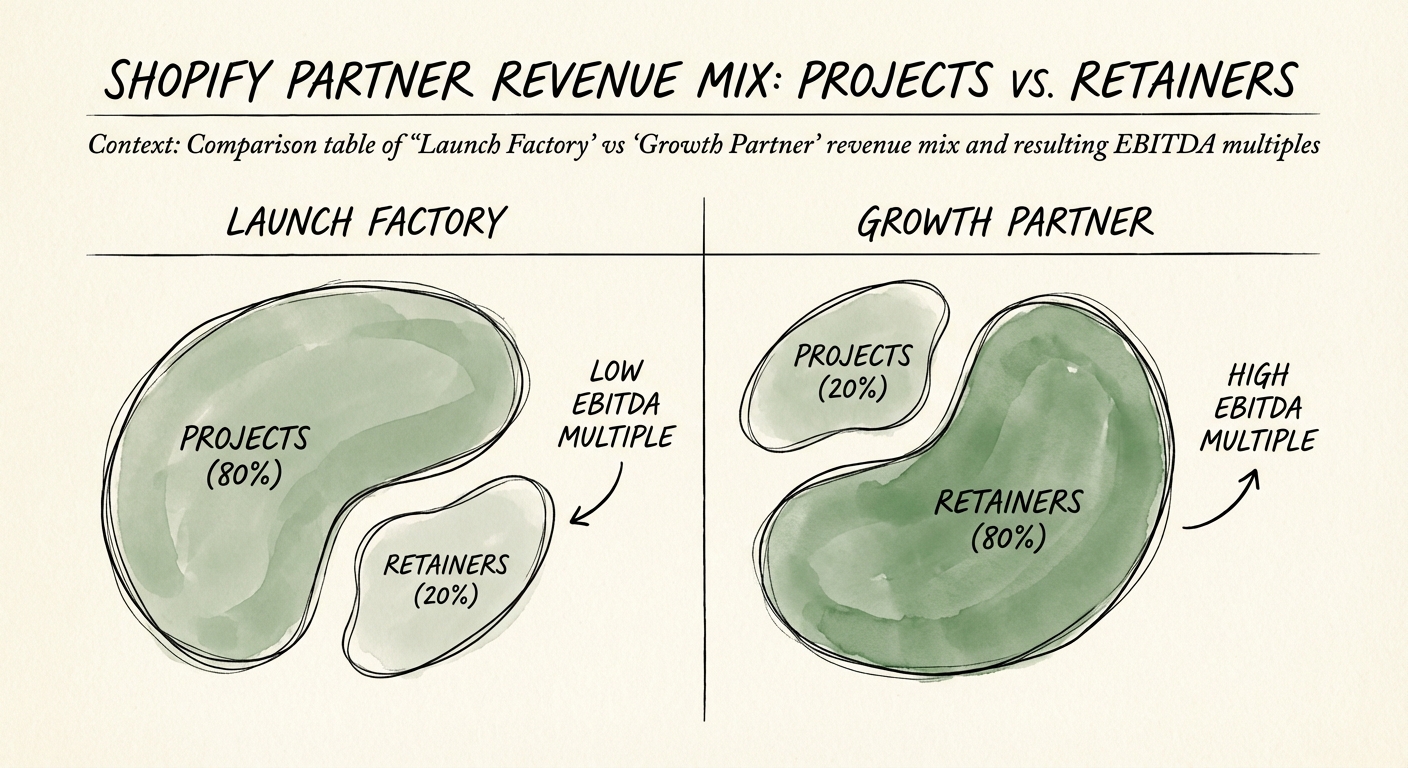
When we work with Plus partners on exit readiness, the number we keep coming back to is a mix in the neighborhood of 60% retainer to 40% project. Enough project work to prove you can still hunt and win, enough recurring revenue to prove you can keep and grow what you win. Below about 30% retainer, the label changes whether you like it or not: you're a development shop, not a commerce consultancy, and you'll be priced as one. The fastest way to find out which side of that line you're on is to ask what survives if your two biggest builds get pushed a quarter.
How to Move the Mix Without Torching Cash Flow
Going from 80% projects to 60% retainers isn't a contract template change — it's a change to what you sell, who delivers it, and how your sales team gets paid. The resources that ship a $150K replatform are not the resources that run a $10K/month optimization program, and pretending otherwise is how partners burn out their best builders on babysitting work. Three moves, in order:
Stop selling "hours banks." A retainer billed as a block of hours is a commodity, and the client will treat it like one — they'll watch the meter and cut it the first slow quarter. Sell outcomes instead. As Shopify's own guidance on service retainers argues, the durable engagements are scoped around results, not timesheets. Build a few named tracks a merchant can actually point to in a board deck: a CRO program (monthly test backlog, wins shipped, revenue-per-session reported), a lifecycle track (managed Klaviyo and Attentive flows, segmentation, deliverability), and platform stewardship (owning the Recharge, Yotpo, and Loop configs so the merchant never has to think about them again).
Re-point your sales comp. Most agency reps are paid on initial booking value, which trains them to maximize the build and walk away from the tail — the exact behavior that's killing your multiple. Flip it. Pay a smaller commission on the build and a larger one on the first year of recurring revenue it generates. Your hunters will start selling the asset you actually want to own.
Put the retainer in the original SOW. The mistake is trying to upsell the retainer after launch, when the merchant's budget is spent and the relationship is at its most fragile. The partners with the best exits frame the build as Phase 1 of a 24-month roadmap and contractually attach a 12-month optimization program before a single line of code ships. That one structural change converts a one-time revenue spike into an annuity — and over a couple of years, it's the difference between the December you dread and the one you spend reviewing renewals. If you're scoping a build this quarter, that's the place to start Monday.