
The practical answer
- Short answer
- Are you a 'Reseller' or a 'Strategic Partner'? Why Atlassian partners with >50% Services Gross Profit trade at 12x multiples while resale-heavy firms stall at 5x.
- Best fit
- Industry: Professional Services. Function: Finance
- Operating path
- Unit Economics → Commercial Performance → Transaction Advisory Services
- Key metric
- 12x EBITDA multiple for partners with >60% Services Gross Profit contribution.
The Revenue Illusion: Why $50M Isn't Always $50M
In the Atlassian ecosystem, top-line revenue is a vanity metric that often deceives founders, boards, and potential acquirers. Because Atlassian licenses are high-ticket items—often costing enterprise clients hundreds of thousands annually—partners can easily inflate their revenue figures by acting as a pass-through entity. A partner booking $50M in revenue might look like a market leader, but if $42M of that is low-margin license resale, the underlying business is fragile.
The "Pass-Through" Valuation Penalty
Private equity firms and strategic acquirers strip out pass-through revenue during Quality of Earnings (QofE) analysis. They don't pay 12x multiples on revenue that flows through your bank account to Sydney. They pay for the value you add.
We categorize Atlassian Partners into three buckets based on Gross Profit Contribution (GPC), not revenue:
- The Fulfillment Shop: >70% of Gross Profit comes from License Resale. These firms are viewed as commodities. Customers switch for a 2% discount. Valuation hovers around 4x-6x EBITDA.
- The Hybrid Partner: 40-60% of Gross Profit comes from Services/IP. This indicates sticky relationships where license renewals are tied to ongoing delivery. Valuation climbs to 8x-10x EBITDA.
- The Strategic Consultancy: >70% of Gross Profit comes from Services and Marketplace IP. Licenses are merely an enablement tool for high-margin transformation work. These firms command 12x-15x EBITDA.
The trap for founders is celebrating a $5M renewal contract that only drops $600k (12%) to the bottom line, while neglecting the $500k services deal that would have dropped $250k (50%).
Revenue is vanity, profit is sanity, but revenue mix is reality. A $50M partner with 90% resale revenue is worth less than a $10M partner with 90% services revenue.
The Margin Cliff: Data Center vs. Cloud Economics
The shift from Server/Data Center to Cloud is not just a technical migration; it is a business model shock. Historically, partners enjoyed healthy margins on perpetual license renewals with minimal effort. The Cloud model compresses these margins and shifts the value driver to consumption and complexity.
The New Unit Economics of Cloud
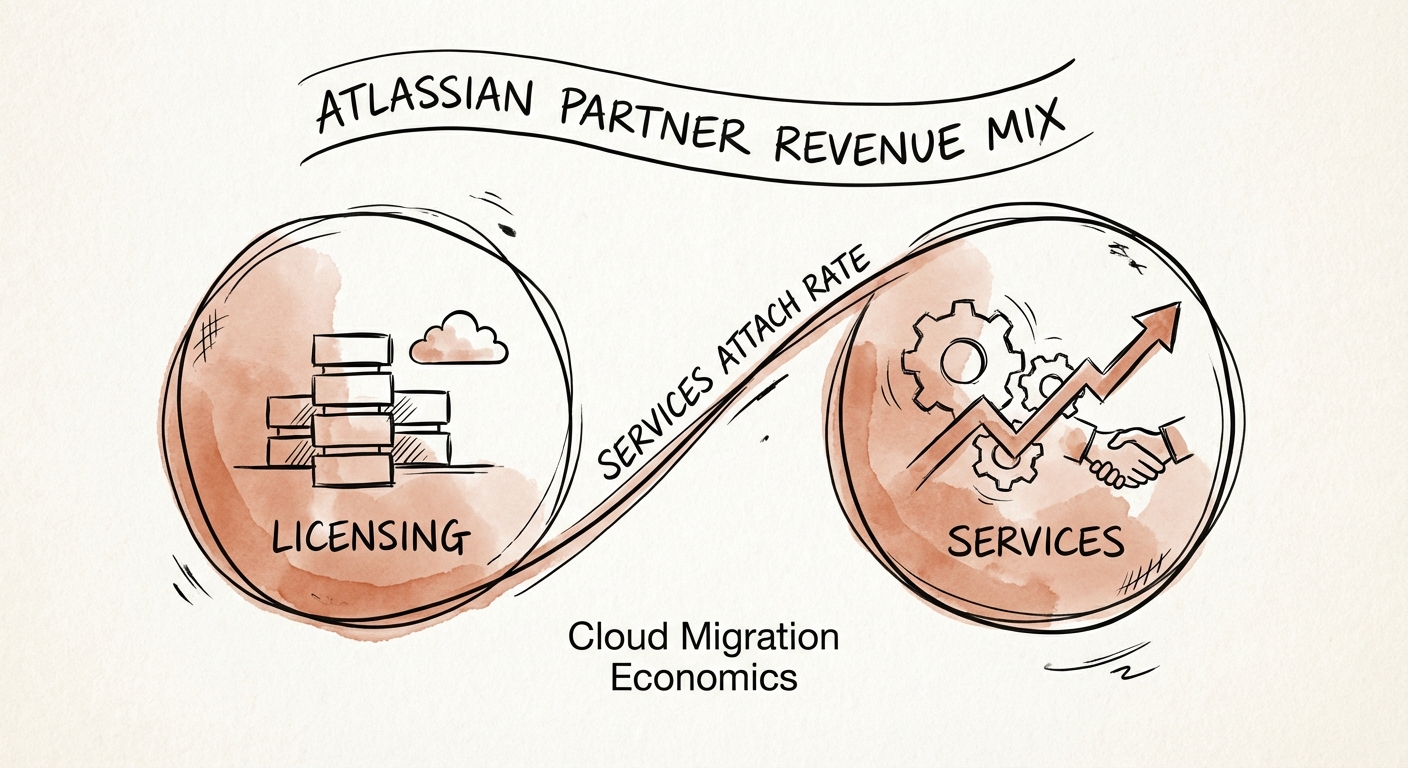
Atlassian's push to end Server support and the upcoming Data Center sunset (sales ending 2026, support 2029) forces partners to pivot. In the Cloud era, the "License Resale" margin is often tiered and capped. The real economic engine is the Service Attach Rate.
Benchmarks for Best-in-Class Partners:
- Migration Ratio: For every $1 of Cloud License sold in a migration deal, top partners attach $1.50 - $3.00 of services (assessment, migration, governance, enablement).
- Managed Services Attach: Strategic partners convert 30% of migration projects into long-term "Cloud Governance" managed services contracts, priced at 20-30% of the annual license spend.
- Marketplace Leverage: Elite partners don't just resell apps; they build them. A proprietary app on the Atlassian Marketplace generates ~85% Gross Margin compared to the ~15% margin on reselling someone else's plugin.
If your business model relies on the "Easy Renewals" of the past decade, you are holding a melting ice cube. Acquirers know that the "License Only" customer is the highest churn risk in the ecosystem.
Escaping the Reseller Trap: The "Services-First" Pivot
To maximize exit value, you must re-architect your P&L before you go to market. The goal is to prove that you own the customer relationship, not just the transaction.
3 Strategic Moves to Fix Your Revenue Mix
- 1. The "Governance Wrap": Stop selling bare licenses. Bundle every license renewal with a mandatory "Quarterly Health Check" or "Governance Retainer." Even a small recurring service fee shifts the narrative from "Vendor" to "Partner."
- 2. Vertical Specialization over Volume: Generalist partners compete on margin (giving away points to win the deal). Specialists (e.g., "Agile for Life Sciences" or "ITSM for FinTech") compete on expertise. Specialists consistently trade at a 3-turn premium over volume resellers.
- 3. IP as a Valuation Multiplier: Develop micro-IP—connectors, specific workflow templates, or training portals—that you bundle with your services. This creates "Technical Lock-In" that is far more defensible than a license contract.
The PE Buyer's Perspective: When we evaluate an Atlassian partner, we ask one question: "If Atlassian Direct Sales took this account tomorrow, would the customer fight to keep you?" If the answer is no, your multiple is 5x. If the answer is yes (because you run their ITSM workflows, manage their governance, and built their integrations), your multiple is 12x.