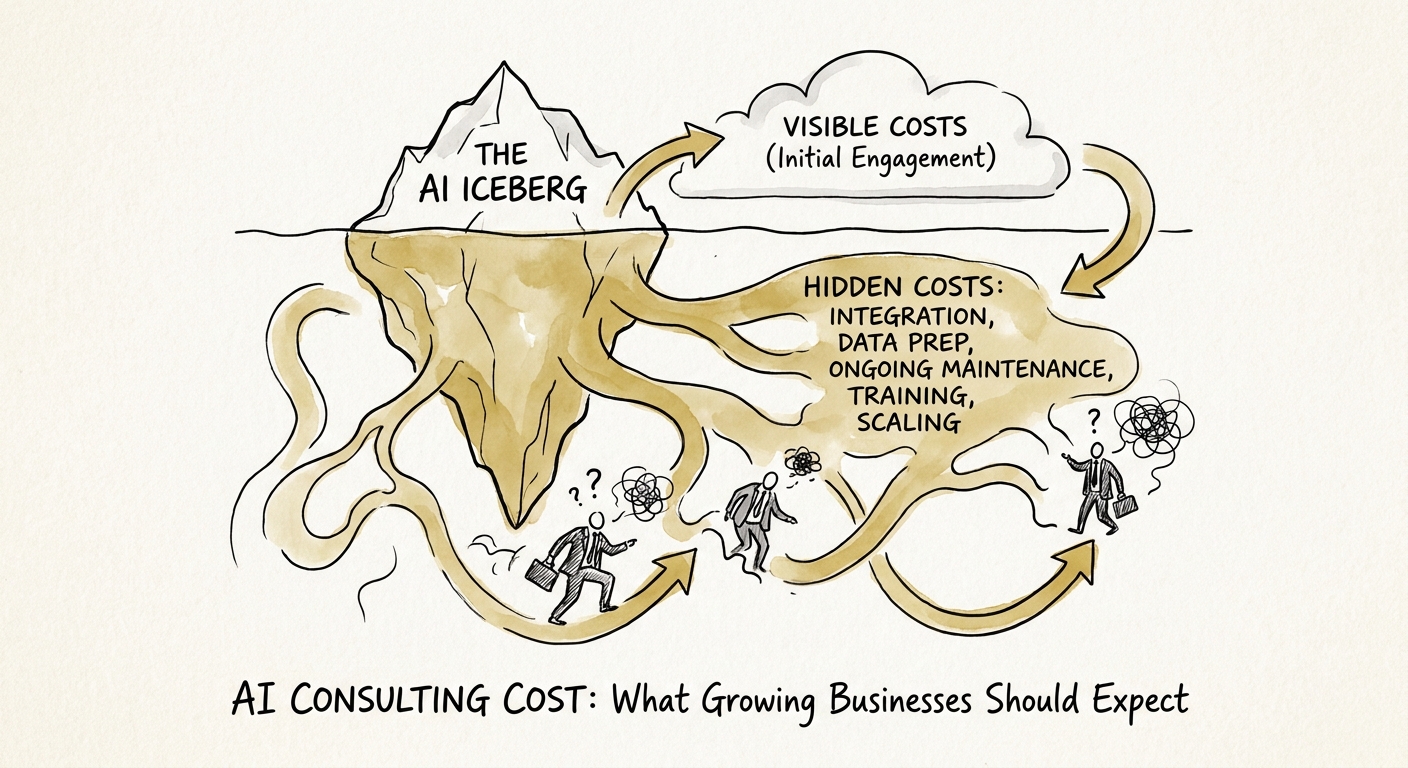
The same project, quoted at $40K and $200K
You ask three firms to help you "implement AI." One comes back at $40K, one at $120K, one at $200K. None of them are lying. They're scoping different jobs and calling them the same thing. The cheap one is selling you a tool rollout and a training day. The expensive one has quietly priced in the data cleanup, the access review, and the six weeks of change management that the cheap one assumes you'll do yourself — or never do, which is why it stalls.
So the cost question is not "is this consultant expensive." It's "what work is hidden under the word implementation." McKinsey's State of AI 2025 is blunt about where value actually comes from: it tracks to workflow redesign and transformation discipline, not to standing up a tool and hoping. The firms that price low usually price low by leaving out the redesign — the part that makes the tool worth anything.
IBM's Institute for Business Value frames the same gap as a capability problem: useful AI rests on data, operating model, adoption, and measurement. Read any consulting estimate against those four. A serious quote breaks the number into diagnostic, data access, workflow integration, security review, training, and benefits tracking as separate lines. A vague quote rolls all six into one fee — which is how a $40K engagement becomes a $40K lesson in why it didn't work.
The line item nobody quotes — until it bites
Here's the cost that gets skipped, then shows up as an incident. The moment you point an AI assistant at your environment, it inherits your permissions. Microsoft's documentation on Copilot's data protection architecture spells out the mechanism: the assistant can surface whatever the user already has access to — and in most growing companies, that's a lot more than anyone realizes. Say a 90-person services firm has a SharePoint folder where someone dropped the comp spreadsheet in 2022 with "anyone in the company can view." For two years nobody stumbled on it. Now an AI assistant summarizes it on request, to anyone who asks the right question.
That's why a real engagement prices the controls before the build, not as a compliance afterthought. If the scope of work never mentions your SharePoint, Teams, CRM exports, finance files, or role-based access, the firm hasn't priced the risk — it has handed it to you. The NIST AI Risk Management Framework gives a usable sequence to demand in the statement of work: map the context, measure the failure modes, manage the controls, and put a name next to each one. Owners, not "the team."
And the controls can't live in a policy PDF. PwC's 2025 Responsible AI survey found the persistent failure is the gap between written policy and the people actually shipping the rollout. When you read a quote, look for who governs the thing after go-live. If the answer is silence, you've found a cost that didn't make it onto the page — and it's usually the one that ends up most expensive.
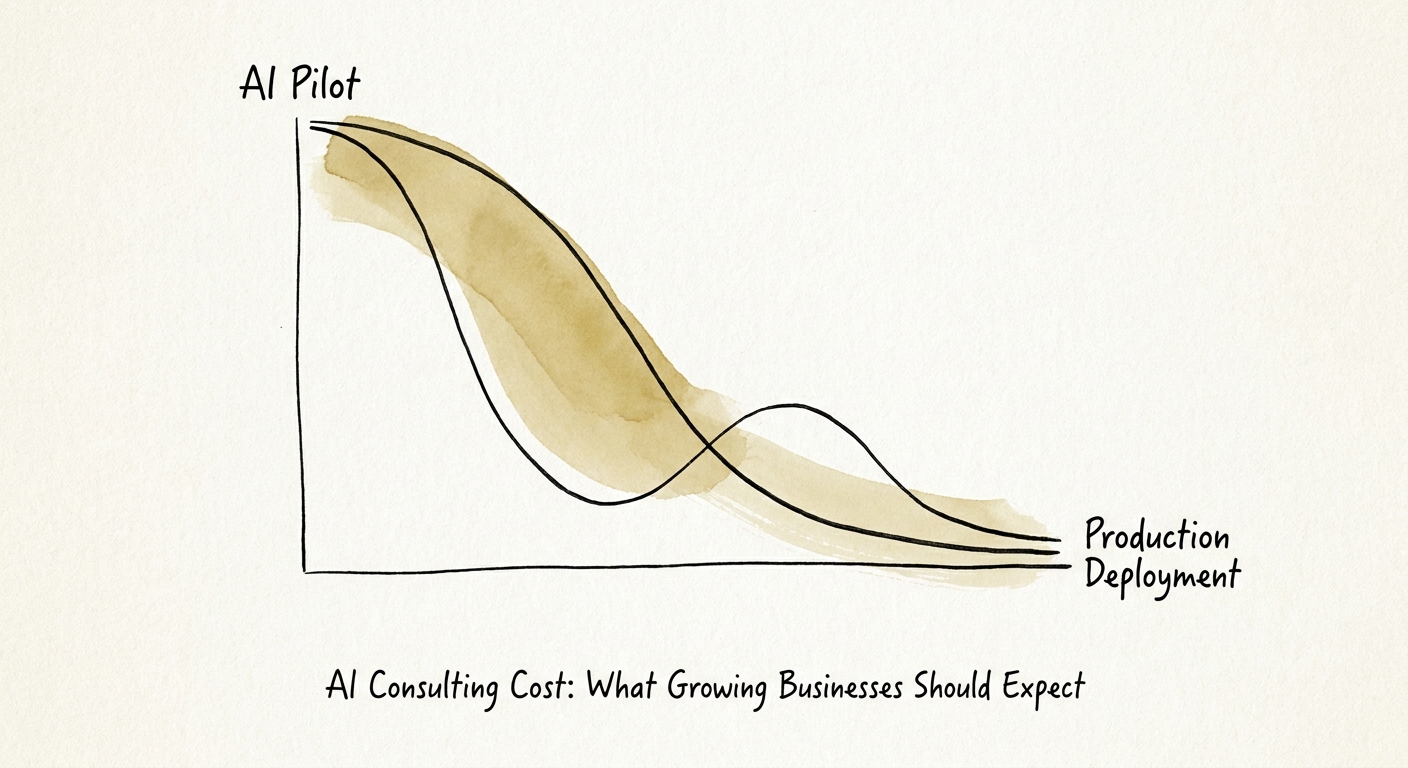
Buy proof of one workflow, not a transformation
For a middle-market technology company, the smartest first check is small on purpose. Don't fund "AI transformation." Fund proof that one workflow gets measurably better under governed conditions — and structure the engagement so you can stop after it. Bain's research on agentic AI transformation makes the case that the ambitious stuff depends on foundation work done first; skip the foundation and the broad rollout collapses under its own weight.
So a well-scoped first engagement delivers four concrete things: a ranked backlog of use cases (so you know what's next and what it's worth), one workflow actually running with controls in place, a baseline measurement you took before the change, and a stop-or-scale decision at the end with the numbers to defend it. That's roughly a 90-day shape, and it should clear three gates before any larger spend — proven workflow value, sorted data access, and a named adoption owner. Everything past that is a separate decision you make with evidence, not a leap of faith you make with a quote.
If you want to pressure-test a number before you sign it, start with the AI Opportunity Score to rank where the value actually sits, run the AI ROI Calculator to set the baseline you'll measure against, and use Human Renaissance's AI transformation services to turn the spend into an operating case your finance, operations, and technology leads can each inspect line by line. The goal Monday: walk into the next vendor call knowing exactly which six things the price should cover.