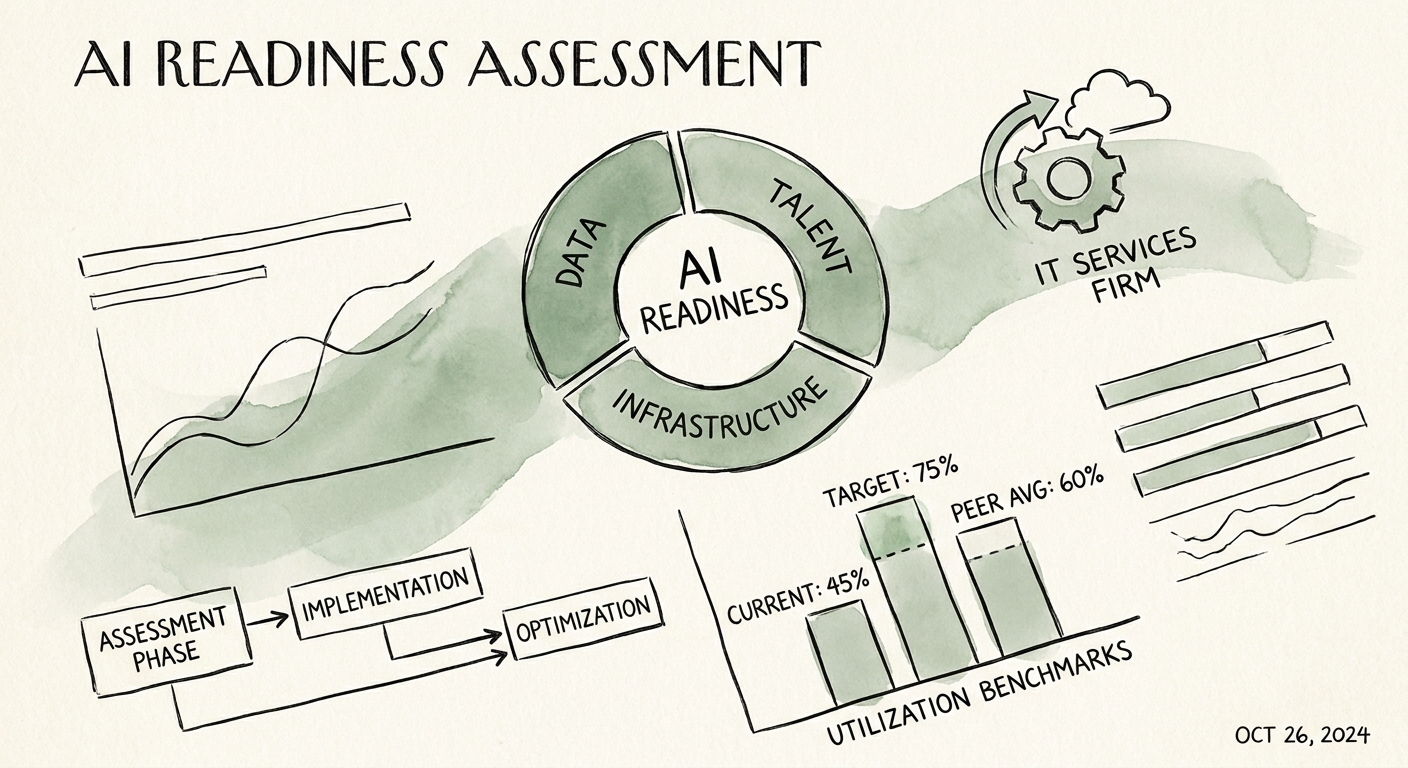
The readiness signal hides in your reassignment rate, not your model
Picture a 150-person IT services shop on a Tuesday: roughly a dozen technicians dispatched, a service coordinator triaging the board, and a PSA queue where about one ticket in five gets reassigned at least once because it landed on the wrong tech or the wrong priority. That reassignment rate is your real AI readiness score. A vendor will tell you the model can auto-triage tickets. It can. But it triages off the same category tags, asset records, and resolution notes your humans already half-trust, and at 150 people you have enough volume that a 5% mis-tag rate becomes hundreds of wrong routes a month.
The adoption pressure is real and you're feeling it from clients and your own board. The U.S. Census AI business adoption analysis and Deloitte State of AI in the Enterprise 2026 both show services firms your size moving from experiments to operating use. But pressure is not readiness. Before you license anything, pull last quarter's board and answer one question: when a ticket gets reassigned, is it because the customer's situation changed, or because the original routing was wrong? If it's the second, AI will route wrong faster and at scale.
What most MSPs get wrong: they pilot the model, not the handoff
The common mistake is to flip on AI triage across every board at once and judge it by how clever the suggestions look. That's the demo, not the operation. The handoffs are where a 150-person firm actually lives — tier-1 to tier-2, coordinator to field tech, ticket to SLA clock to client portal update — and that's where bad context compounds. The OECD SME AI adoption report describes exactly this gap: firms in your band adopt tools faster than they fix the workflows the tools depend on.
So pick one board — say, your managed-endpoint queue — and instrument four numbers for two weeks before AI touches it: median ticket age, reassignment rate, how many times a tech searches the knowledge base before resolving, and how many SLA exceptions a manager catches versus how many slip. Now turn AI on for that one board only and watch whether those same four numbers move. If reassignments drop and tech KB lookups shorten, you have signal. If the coordinator now spends her morning correcting AI routes instead of doing them herself, you've moved the work, not removed it. Tools like the AI Opportunity Score and the AI ROI Calculator are worth running once those four numbers have a named owner who reports them weekly — not before.
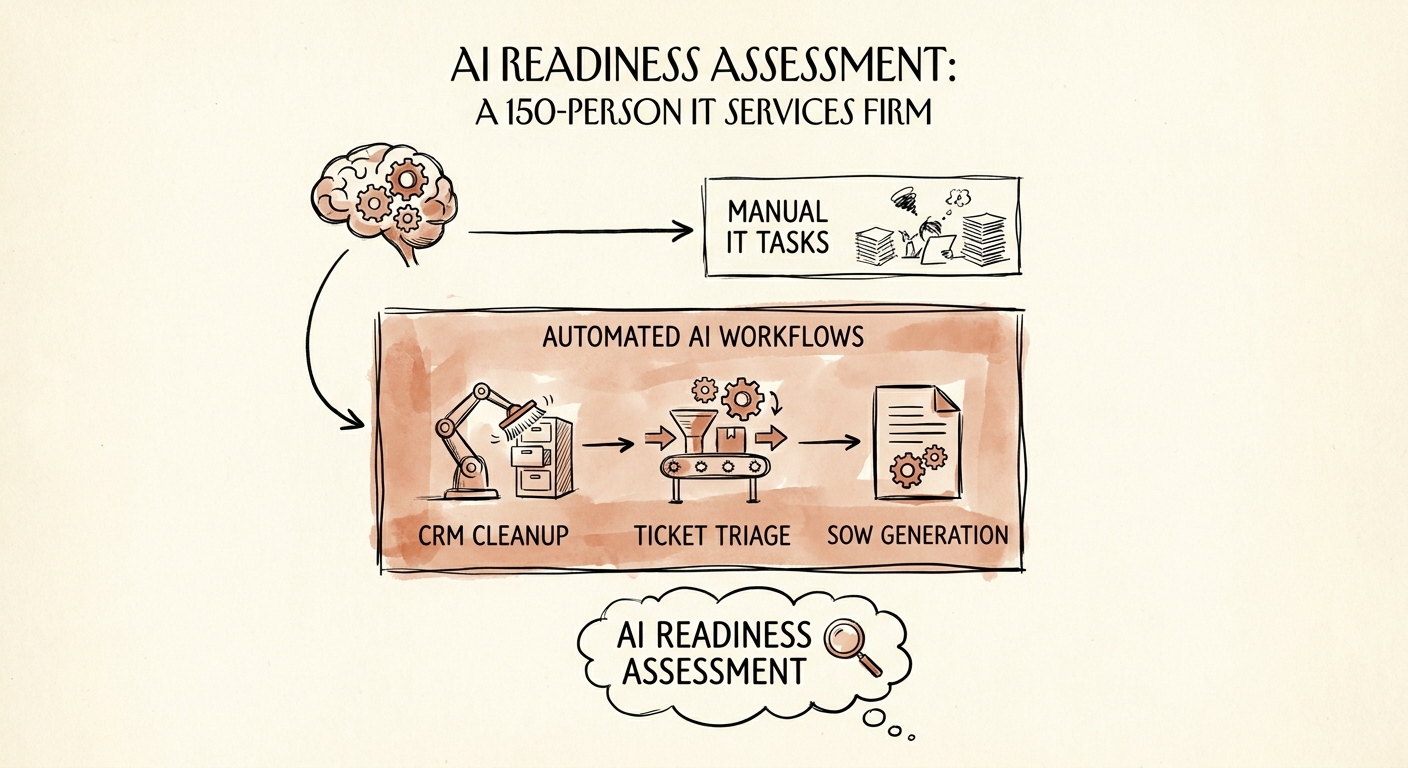
Govern the PSA, RMM, and client data before it becomes a breach
Here's the part that gets a 150-person firm in trouble fastest: your AI wants to read across PSA tickets, RMM telemetry, the CRM, and a shared knowledge base — and a chunk of that is your clients' data, not yours. One mis-scoped permission and your triage assistant is summarizing one client's network diagram into another client's ticket. The CISA AI data-security best practices should set how you scope what the model reads from each of those systems, and the NIST AI Risk Management Framework gives you the plain structure for it: name the intended use, the risk, how you'll measure it, and who is accountable when it's wrong.
Make four decisions in writing before you scale past that first board: which system owns the authoritative ticket status, who can approve an escalation the AI proposed, when a customer-impacting action requires a logged human sign-off, and which client records are walled off from model access entirely. Then expand to reporting or knowledge search only after your service manager can show the pilot board improved routing without softening escalation discipline. That proof — not the vendor's slide — is what tells you the next 149 people are ready. Build the sequence into your AI roadmap.
