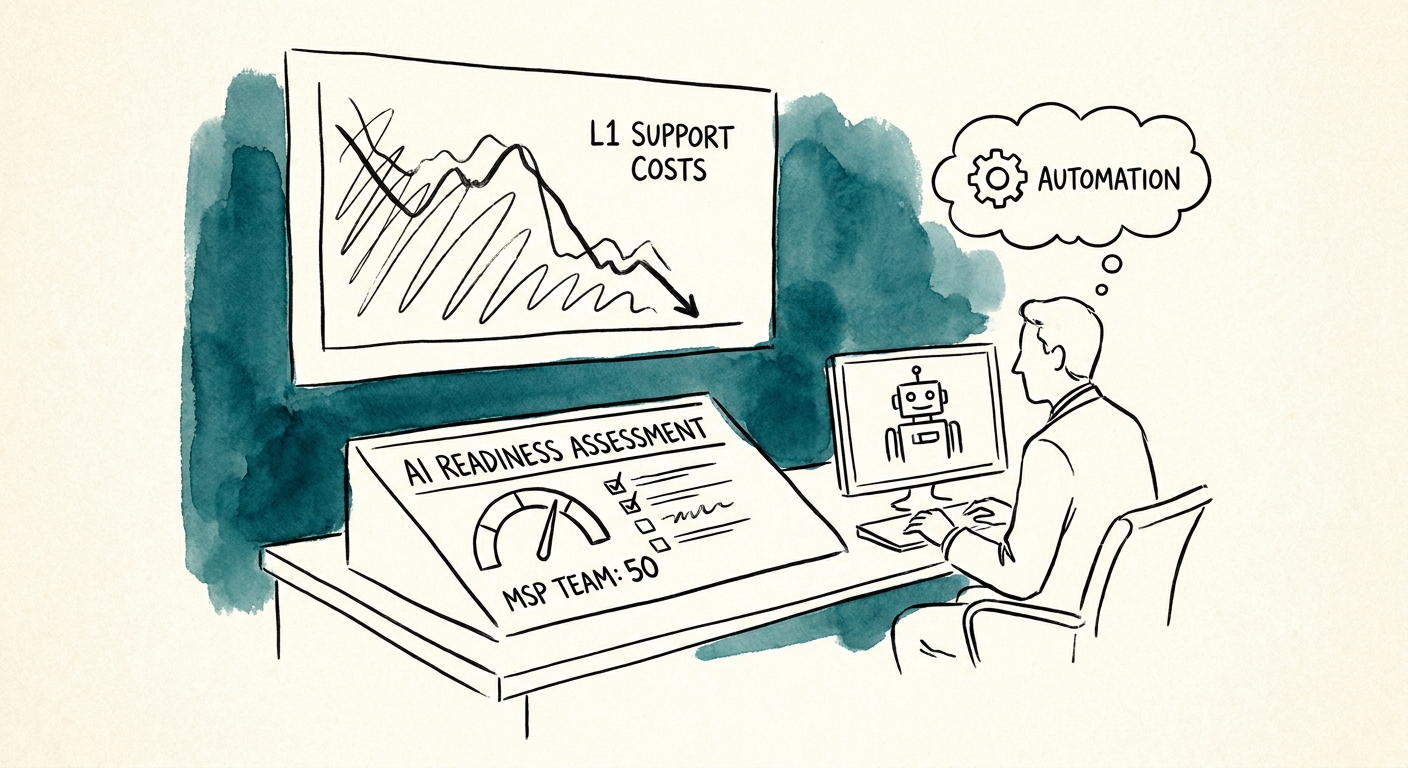
Pull last quarter's tickets before you pull any vendor into a room
Picture a 50-person managed service provider: maybe 30 techs across L1 and L2, a couple of dispatchers, three senior engineers everyone Slacks when a ticket goes sideways, and a PSA full of categories like "Other," "Network Issue," and "Misc." That last detail is the whole story. The honest AI readiness test for this kind of shop isn't "can a model summarize a ticket?" It's "can a model tell a printer-driver ticket from a domain-trust-broken ticket when half the queue is filed under Other?"
The research keeps landing on the same boring, correct answer: define the work, name who owns the source data, and decide what result you're measuring before you expand tooling. The RSM middle-market AI survey, the San Francisco Fed analysis of AI and small businesses, and the OECD report on AI adoption by small and medium-sized enterprises all describe the same discipline from different altitudes. For an MSP, that discipline is concrete: AI readiness is a service-margin question that lives inside your PSA and RMM, not a chatbot you bolt onto the client portal.
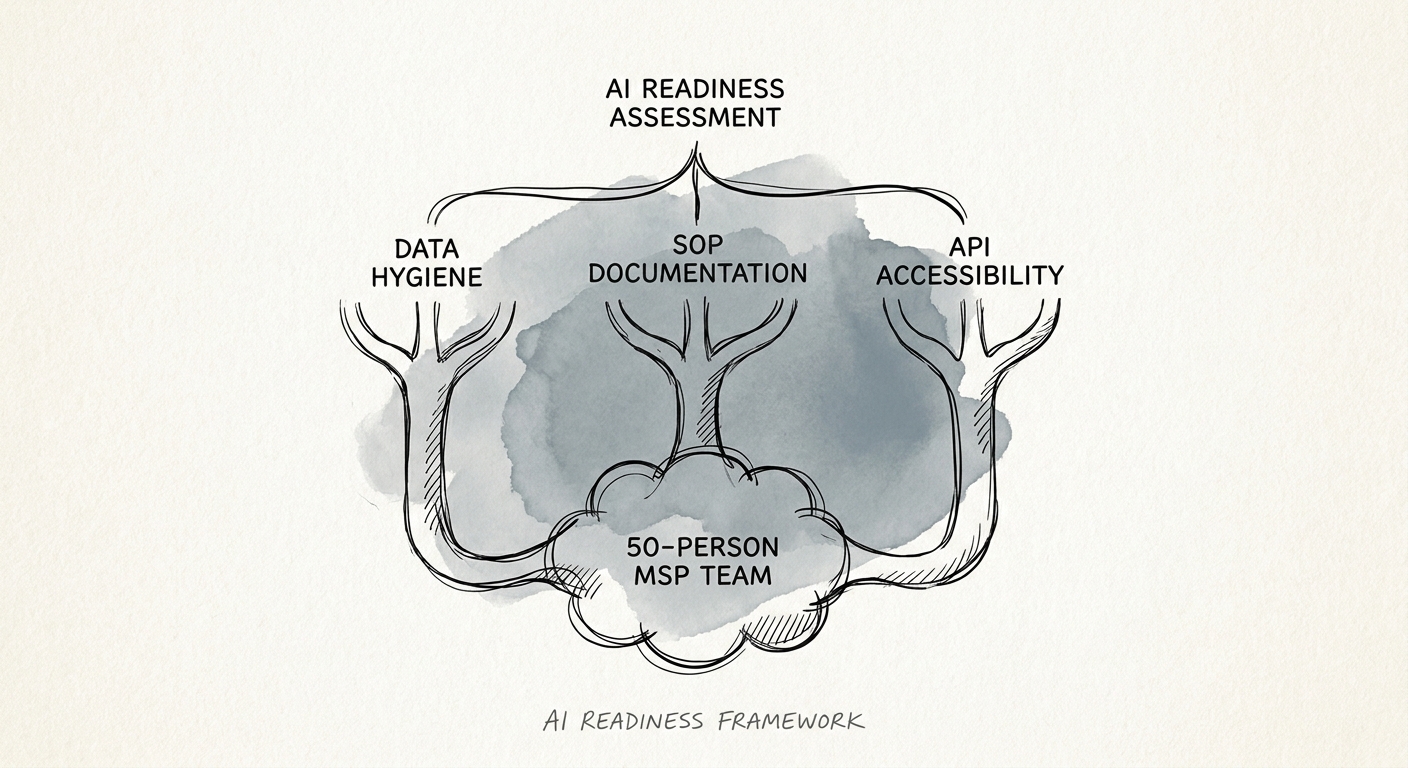
So before the first vendor call, export last quarter's tickets and look at five things: how clean your ticket taxonomy actually is, how often SLA breaches cluster around the same client or category, which queues eat the most technician touches per resolution, where dispatch exceptions pile up, and how many KB articles are older than the tools they describe. If you can't categorize your own past work cleanly, no model will categorize your future work cleanly. Run that gap through the SMB AI readiness assessment so the review stays tied to data quality, ownership, and measurable service value instead of feature lists.
The thing that breaks an MSP rollout is multi-tenancy, not the model
Here's the trap that's specific to your business model and almost nobody else's: you don't run one environment, you run forty. Client A's password-reset policy is not Client B's, and an AI that helpfully suggests the wrong tenant's procedure isn't a quality bug, it's a security incident with a contract attached. A 50-tech shop is big enough to have real tenant-isolation obligations and small enough that one engineer wired most of the integrations from memory. That combination is the actual risk.
This is where the frameworks earn their keep if you translate them down to ticket level. The NIST AI Risk Management Framework becomes a short, unglamorous checklist: for each candidate workflow, map the task, test how it fails, name the human who reviews output, and write down how an escalation gets governed. The CISA AI Data Security Best Practices guidance becomes your rule for what the model is even allowed to read: which client systems are approved sources, what technician permissions carry into the tool, whether output logs are retained per tenant, and what happens when a recommendation hinges on a client-specific policy the model can't know.
Notice what's not on that list: model accuracy. The readiness failures in MSPs are almost always upstream of the model. They're the inconsistent ticket categories, the escalation logic that exists only in your senior techs' heads, the client notes nobody has touched in two years, and the institutional knowledge that walks out the door at 5pm. Fix one workflow's worth of that mess first. Use the 90-day AI implementation plan to pick a single queue, document its review rules, and pilot it with a manager who can actually read the margin line.
Prove it on triage, then watch the headcount curve
The single best first workflow for a 50-person MSP is ticket triage and routing, because it's the one place messy data does the most damage and clean automation pays back fastest. Not diagnostic automation, not auto-remediation, not a client-facing bot. Triage: read the inbound, classify it against your now-cleaned taxonomy, attach the right client context, route it to the right tier, and flag the handful that genuinely need a senior engineer. Vendor-ticket summaries and stale-note cleanup are reasonable runners-up, but triage is where the queue stops backing up at 9am Monday.
Pick one queue and instrument it before you turn anything on, so you have a real before. Track SLA aging on that queue, routing accuracy (how often the AI's tier guess matched where the ticket actually resolved), technician touches per ticket, time-to-first-response, and the gross margin on that service line. The Deloitte State of AI in the Enterprise 2026 findings reinforce the lesson MSPs learn the hard way: value comes from governed, measured workflows in production, not from how impressive the pilot looked in the conference room. If the AI writes prettier tickets but your touches-per-ticket and SLA numbers don't move, the scope is wrong and you stop.
The real prize is the curve every MSP owner watches at exit time: revenue per technician. A 50-person shop that can take on the next ten clients without hiring the next five techs has changed its multiple, not just its Monday. That's the bar the triage pilot has to clear. Before you green-light a second workflow, run the numbers through AI ROI measurement grounded in service operations so "we feel faster" never gets mistaken for margin.