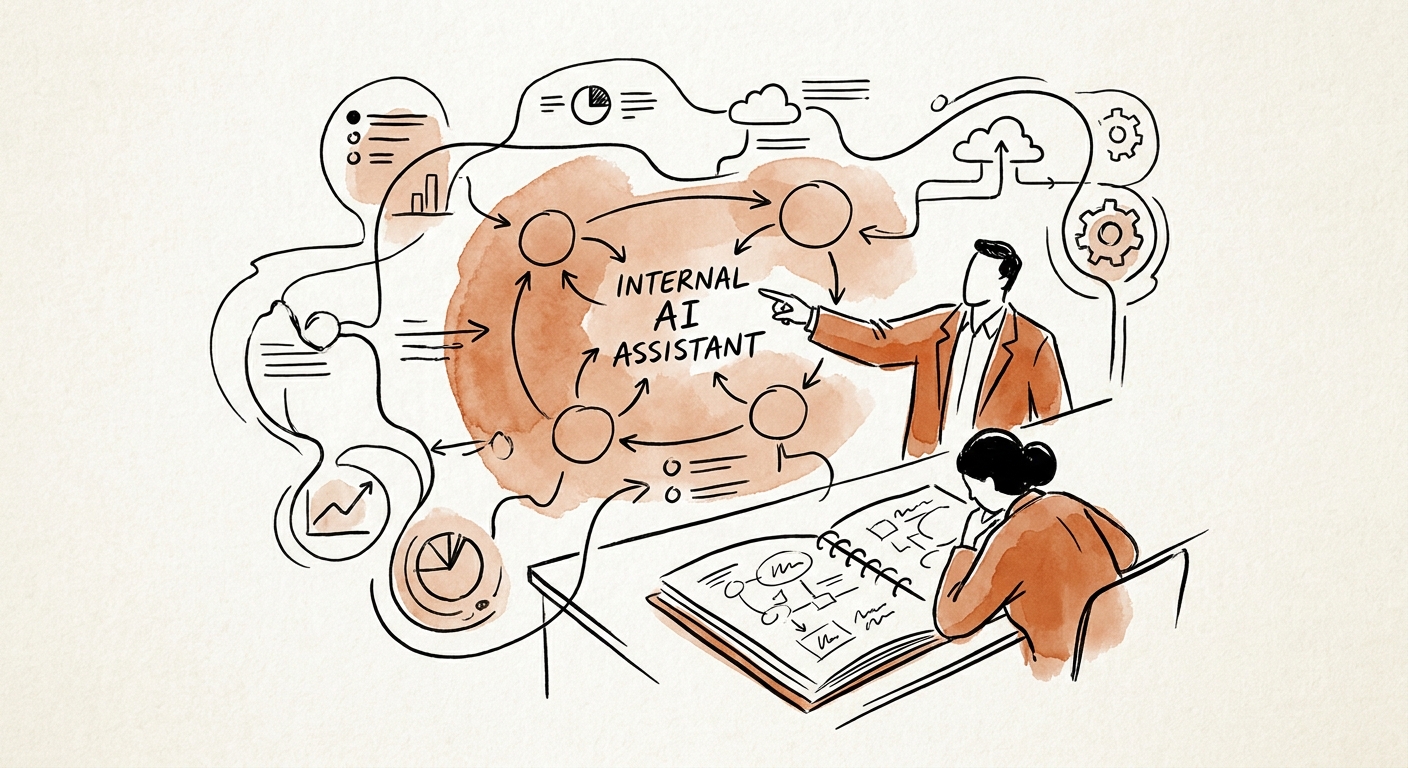
The retired SOP problem
Here's the failure that kills these projects, and it happens in week two. A support rep asks your shiny new assistant, "What's our return window for enterprise accounts?" The assistant answers confidently: 30 days. Except the real answer changed to 45 days in a Slack thread three months ago, and the document the bot retrieved was a 2024 SOP nobody archived. The rep relays "30 days" to a customer. Now the assistant is not a productivity tool. It is a liability with a chat box.
An internal AI knowledge assistant is worth building when it reliably answers the boring, repeated questions your team already wastes hours on: where's the onboarding checklist, which contract template is current, what's the escalation path for a P1, how do I expense a client dinner. The chat interface is the easy 10%. The hard 90% is deciding which documents are authoritative, which are stale, who's allowed to see them, and who owns the correction when the answer is wrong.
For a 40-to-250-person company, the source problem is almost never a technology gap. It's archaeological. You have SOPs from two reorgs ago, tribal knowledge that lives in one person's head, client notes scattered across email and a CRM, product docs that contradict the sales deck, and an HR folder where three policy versions all claim to be final. The San Francisco Fed's small-business AI analysis shows real and growing appetite for this. But appetite doesn't fix a corpus where half the documents lie.
Scope to one library, then break it on purpose
Do not start with "search everything." Start with one library that has a real owner who can say "this document is current and I'll keep it current." Pick the team drowning in repeat questions: support, implementation, finance ops, or HR. Onboarding documents are a great first corpus because they're high-volume, low-risk, and the owner already knows which version is real.
Then design four things before you let anyone log in. One: the approved source boundary, so the bot can only retrieve from documents the owner blessed. Two: access controls, because a comp band or a draft layoff list cannot become visible just because the retrieval layer happened to index it. Three: a display rule that every answer shows its source document and date, so a human can verify in one click. Four: a named reviewer for bad answers, because there will be bad answers and "who fixes this" cannot be nobody.
Now the step most teams skip: build your test set from real questions, then try to break the assistant. Collect 30 to 50 questions your team actually answers each week. Run them and check three things, not one. Did it retrieve the correct, current source? Did it refuse or escalate when the answer genuinely isn't in the corpus, instead of inventing one? Did it handle the ambiguous question ("what's our PTO policy" when policy differs by tenure) by asking or surfacing both, rather than picking one at random? The OECD's SME AI adoption report keeps landing on the same point: smaller firms need operational readiness, not just access to a model. A refusal you can trust is more valuable than a confident answer you can't.
The clear do-not-build-yet signal: no content owner, no access model, no approved library, or no reviewer for wrong answers. If you're missing any of those, you don't have an AI project. You have a documentation cleanup that's been hiding behind one. Gartner expects a large share of agentic AI projects to be canceled by 2027 precisely because teams skip this and ship a chat box on top of chaos.
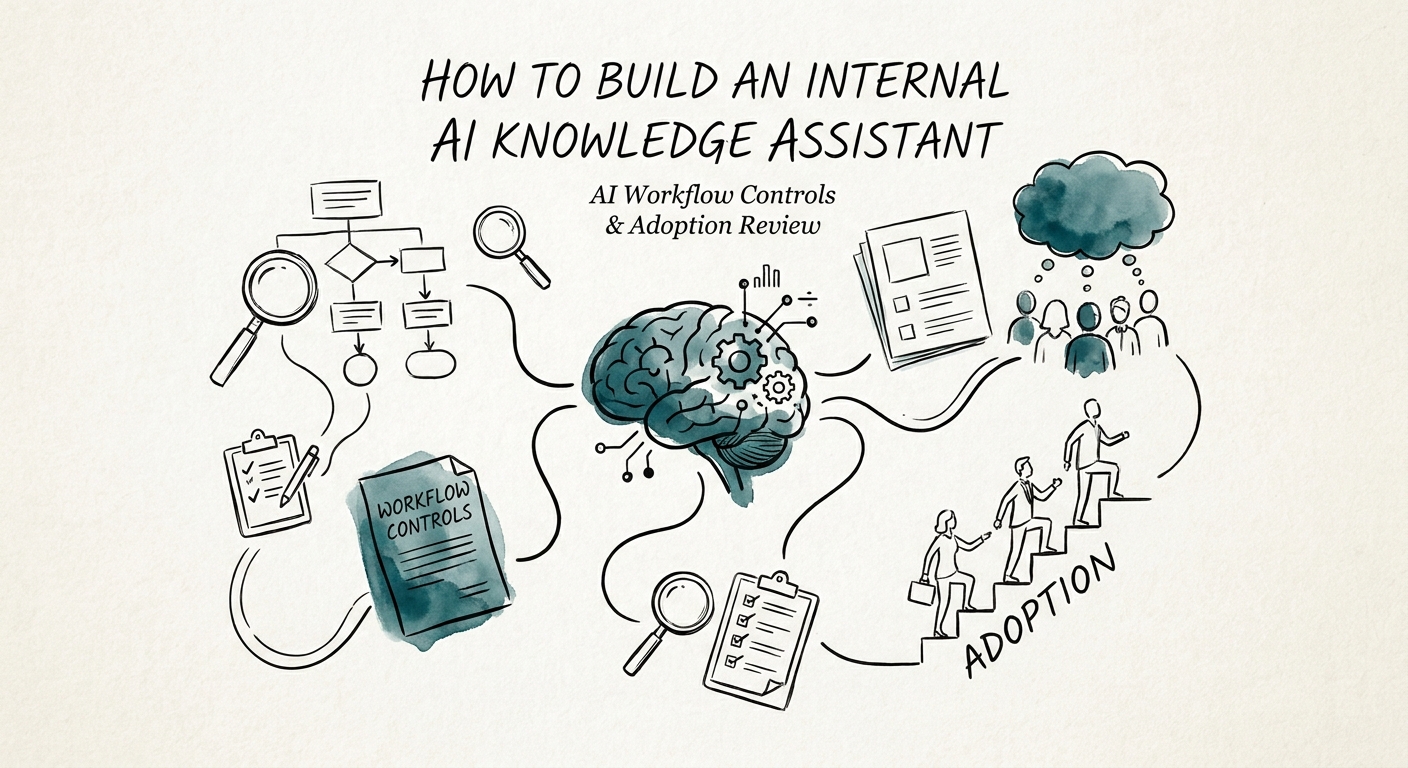
Run it like a product, and let it rat out your docs
Launch narrow, then watch the right dashboard. The vanity metric is "questions answered." The useful metrics are the uncomfortable ones: unanswered questions (your source gaps), unsupported-answer attempts where the bot tried to reach beyond its corpus, the documents flagged as stale by users, and the time-to-correction when an owner pushes a fix. A good assistant doesn't hide your documentation debt. It hands you a ranked list of exactly which SOPs are missing, contradictory, or out of date. That list is worth the project on its own.
This is where operating change actually happens, and where most deployments stall. The Deloitte State of AI report keeps surfacing the gap between teams that use AI and teams that change how they operate because of it. Usage is logging in. Change is a finance ops lead seeing the "unanswered" list shrink month over month because owners are fixing the underlying documents, and a manager noticing new hires stop asking the same five questions in their first week. The RSM middle-market AI survey tracks this same divide between the firms investing and the firms getting measurable return.
Monday, do this: name the one library and its owner, pull 30 real repeat questions, and decide who reviews wrong answers. If you can't fill all three slots, fix the knowledge system first — the conversational layer can wait. When you're ready to build the retrieval and source-control layer, AI Knowledge Systems and RAG is the practical next step. We bring the same discipline that ran a 28,000-user migration with zero downtime: source control and adoption cadence, not a demo that impresses once and gets abandoned in a month. Start there when repeated questions are slowing the team but source trust isn't solved yet.