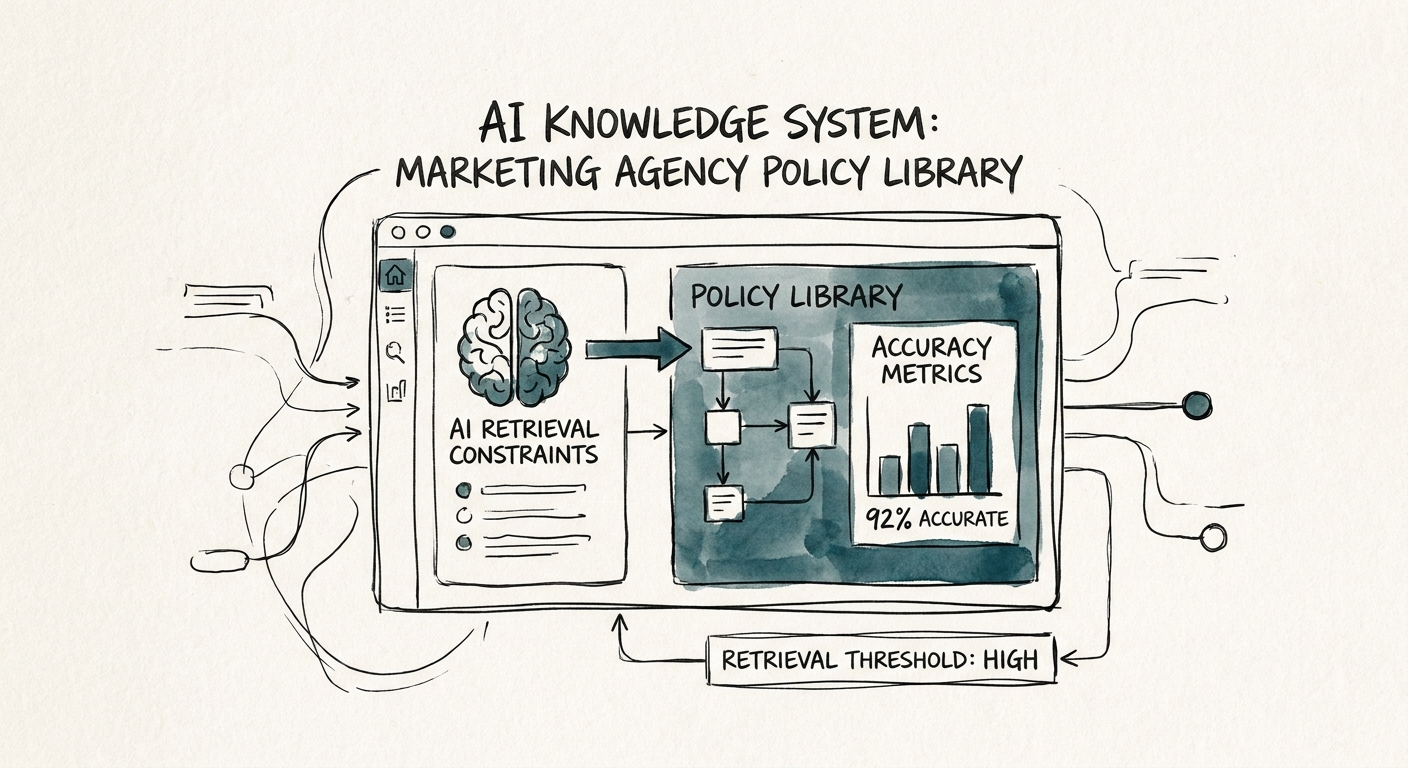
The 6pm question that breaks agencies
It's the night before a launch. A junior writer needs to know whether this client allows competitor mentions in paid social, and whether the legal disclaimer goes in the caption or the creative. They search Slack. They find a thread from a different client. They guess. The post ships. Three days later the account manager is on a call explaining why the brand voice felt off and the disclaimer was wrong.
That is the exact failure an AI knowledge system is supposed to prevent — and the exact failure it will accelerate if you point it at your shared drive and call it done. Agencies don't have one policy library. You have one per client: brand guidelines, tone rules, approval chains, channel restrictions, data-use terms buried in the SOW, and the unwritten "the CMO hates exclamation points" rules that live only in a senior creative's head. The reason this gets hard isn't the model. It's that smaller firms succeed with AI by tying it to one painful workflow, not by boiling the ocean — a pattern reinforced across the RSM middle-market AI survey, the San Francisco Fed analysis of AI and small businesses, and the OECD report on AI adoption by small and medium-sized enterprises.
So the first move isn't building an assistant. It's drawing a map: for one client, what are the canonical policy documents, who owns each one, and which version is current? Say a 25-person agency picks its largest retainer client. The map almost always exposes the real problem before any AI gets involved — three "final" versions of the brand guide, an approval matrix nobody updated since the account lead left, and channel rules that exist only as a verbal agreement. The AI was never going to fix that. But the act of building its source list will.
Client separation is the whole ballgame
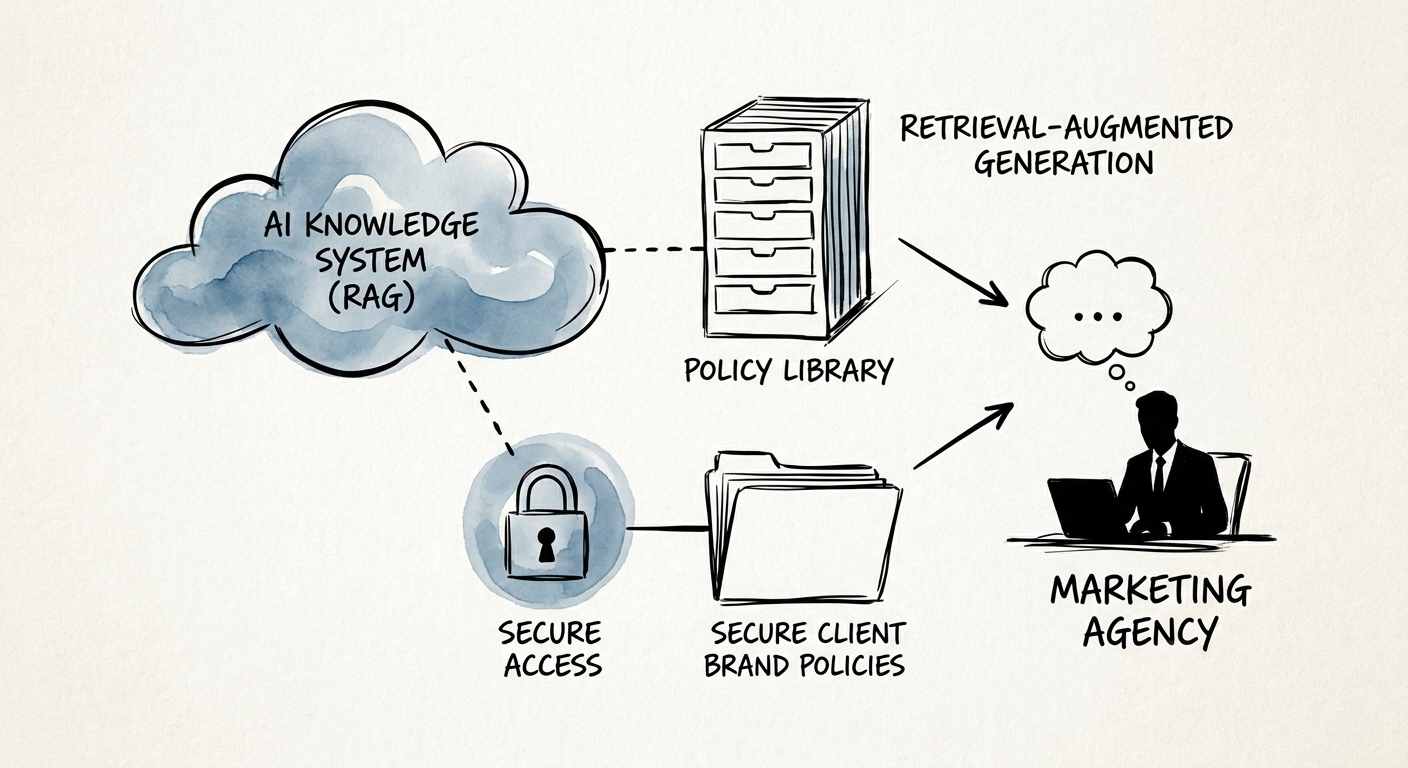
Most knowledge-system advice treats "protect the data" as a compliance checkbox. At an agency it's the product. The single worst outcome isn't a leak — it's an assistant that cheerfully answers a question about Client A using Client B's approved messaging, because both PDFs lived in the same folder. You shipped one client's positioning into another client's campaign. No security incident fired. You just lost a renewal.
That means your permission boundaries have to mirror your client walls, not your org chart. Before you connect a single source, classify the library by client, strip out expired guidelines and old SOWs that no longer govern anything, and decide which answers must cite an approved document rather than a confident paraphrase. The NIST AI Risk Management Framework gives leadership the language to map where these systems can go wrong, and CISA's AI Data Security Best Practices applies the moment the system touches client contracts, customer data, or anything covered by an NDA.
If you're standing this up on tooling you already pay for, hold it to the published controls: Microsoft 365 Copilot privacy and data controls and OpenAI's enterprise privacy commitments both let you verify that client material isn't training a shared model and stays inside the environment you approved. The test to run before you trust it: ask the assistant a Client A question while logged in as someone staffed only on Client B, and confirm it returns nothing rather than a polished guess.
Ship the small version, then count the right things
Resist the demo. The version that survives is narrower than the one that wins the all-hands applause. Pick one client, connect only that client's approved policy set, require a citation in every answer — "per the 2026 brand guide, section 4" — and route anything the system can't source to a named senior reviewer instead of letting it improvise. That citation rule is what separates a knowledge system from a faster way to be confidently wrong.
Then measure things that actually predict whether it's helping: how often the cited source was correct, how many answers the reviewer had to edit, how much time it saved on policy questions per week, and — the metric most teams skip — how many gaps it surfaced. Every "I don't have an approved source for that" is the system handing you a missing brand rule or an out-of-date SOW before it becomes a client problem. That's not a failure of the tool; that's the tool doing operations work for you.
To set the source boundaries cleanly, work through the internal AI knowledge assistant guide, then pressure-test whether your ownership, permissions, and review capacity can actually hold up using the SMB readiness assessment. Get those right for one client and the pattern repeats across your whole book — a system that answers from each client's trusted sources, cites them by name, and tells you exactly where your policies still live in someone's head.