The practical answer
- Short answer
- You budgeted 90 days to replace a PE-backed SaaS CFO. The real number from kickoff to a closed quarter is 198. Here is where the days hide and how to bridge them.
- Best fit
- Industry: B2B SaaS & Tech Services. Function: Finance & Leadership
- Operating path
- Team & Hiring → Operational Excellence → Transaction Execution Services
- Key metric
- 198 Average days from search kickoff to the first closed operational quarter.
You Counted to 90. The Calendar Counted to 198.
Here is the conversation I have had three times in the last two years, almost word for word. A sponsor pulls up the board deck for a $75M ARR SaaS company, points at the CFO succession line, and says: "Search kicks off Monday, we'll have someone in the seat by the quarter close." Then I ask the question that ends the optimism: "In the seat, or actually closing the books and defending the model to the deal committee?" Because those are not the same milestone, and the gap between them is where roughly 198 days go to die.
The "90-day backfill" is not a lie someone tells you. It is a measurement error. People count from kickoff to a start date and stop. But for a private-equity-backed finance chief, the start date is the middle of the story, not the end. Christian & Timbers' 2026 CFO Search Benchmarks put a well-run retained search at 90 to 120 days just to reach offer acceptance — and that assumes a generalist profile. The instant you specify "has carried a pre-IPO SaaS rev-rec migration" or "has run a carve-out integration," your qualified pool collapses and the clock pushes past 120.
The days you forgot to add
Then comes the part boards never model: the candidate you want is a sitting CFO somewhere else. They owe a notice period — 60 to 90 days is now standard for finance chiefs — and a meaningful share of those come with garden leave, which means your future CFO is legally barred from touching a model, a data room, or a forecast until the clock runs out. Stack it up honestly: 120 days to accept, 75 days of notice and leave, then a ramp before they can sign off on a quarter they didn't open. You are not late. You were never on time. The board just measured the wrong leg of the relay.
On that $75M ARR engagement, the deck said 90 days. The candidate's exit obligations added 115. We installed an interim operator inside a week so the open acquisition didn't stall during diligence — because a quarter of silent finance leadership during a live deal window is not a delay, it is a valuation event. If you want the dollar mechanics behind why that gap costs what it costs, the numbers are broken out in The $2.1M Tax: CFO Transition Cost, Severance, and Onboarding Benchmarks.
Nobody lies about the CFO search timeline on purpose. They just count the wrong thing. A start date is not a closed quarter, and garden leave does not care about your board calendar.
Why Throwing Money at the Search Doesn't Buy Speed
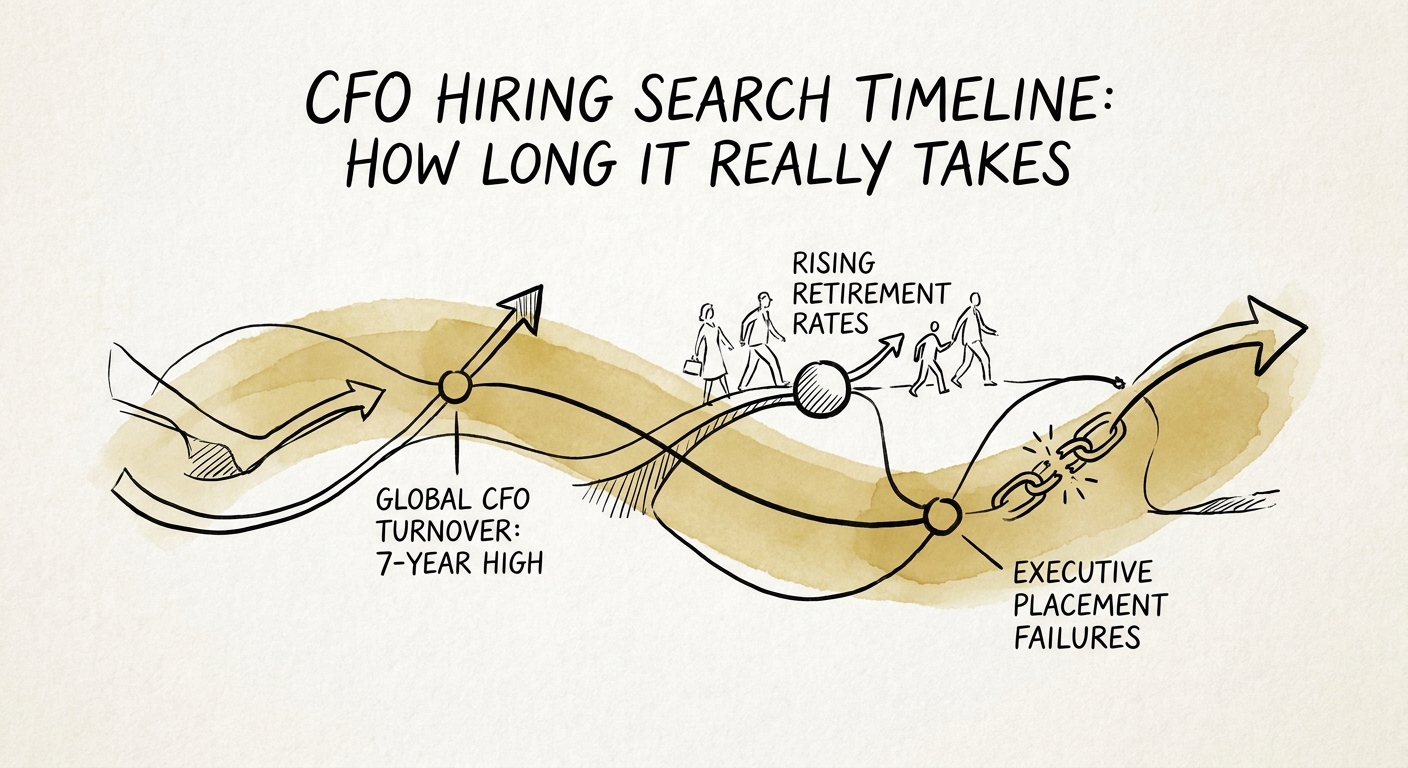
The reflex is to assume a bigger retainer to a bigger firm compresses the timeline. It doesn't, because the constraint isn't recruiter effort — it's supply. Russell Reynolds' 2025 Global CFO Turnover Index recorded global CFO turnover at a seven-year high, with 316 large-cap appointments in a single year. When that many seats open at once, every PE-backed SaaS company is fishing the same shrinking pond on the same weekend. You can outbid on comp; you cannot outbid the calendar.
What makes it worse for a sponsor-backed search specifically: the proven, exit-ready operators are the ones leaving the game. The Russell Reynolds' 2024 CFO Expectations Report found 54% of outgoing CFOs retired or moved exclusively to board seats. Read that as a sponsor: the person who has actually carried a SaaS asset through a sale — the exact résumé you need for a hold period with an exit on the horizon — is statistically more likely to take a board appointment than to run another grind of a finance function for you. So the search firm dips into first-time CFOs and step-up controllers, and now you've bought yourself weeks of additional reference work and assessment to de-risk an unproven operator. That vetting tax is a real chunk of the 198. The competency gaps those step-up candidates have to close are mapped in The New CFO's First 90 Days: A Survival Guide for the 'Operator' Era.
Month four is when boards do the expensive thing
Around day 120, with no signed offer and a board meeting bearing down, the panic compromise arrives: take the candidate who interviews well enough and is available now. This is the single most expensive move in the whole sequence. ECA Partners' CFO Executive Search Data shows more than 40% of senior executive placements fail inside 18 months. Do the arithmetic on a mis-hire: you don't lose a search fee, you lose a year and a half of compounding inside a finite hold period, plus the board trust required to make the next call quickly. A panic hire doesn't shorten the 198 days. It resets the counter to zero and adds eighteen months of damage on top. The honest move is to stop trying to win a foot race you were never positioned for and instead get ruthless about how you run the gap.
Run the Gap as Cleanup, Not as Holding Pattern
The default failure is leaving the seat empty and asking the corporate controller to "hold the fort." A strong controller keeps the lights on — they do not run M&A diligence, defend a 13-week cash model to a deal committee, or rebuild pricing logic under acquisition pressure. So decouple the two clocks entirely. There is a search clock (the firm's 120-day mandate) and there is an operations clock (somebody has to own the finance function tomorrow morning). The day notice is given — or the day you privately decide to upgrade — you fill the operations clock with an interim or fractional CFO. That bridge is the only thing that protects EBITDA while the retainer runs.
But the bridge is not just life support — it is how you make the permanent hire succeed. Kefron's 2025 CFO Transition Insights found 70% of newly appointed CFOs struggle in their first 100 days, almost always because they walked into broken data infrastructure and no financial visibility. So use the 198 days as an aggressive cleanup window. The interim operator's job is concrete: fix the chart of accounts, rebuild the data room, install a disciplined close, and sanitize the historicals so they survive diligence. The goal is that the day your permanent CFO clears garden leave, they inherit a tuned machine instead of an archaeology project. The decision logic for which bridge to use at which revenue band is laid out in Fractional CFO vs. Full-Time CFO: The $10M–$50M Revenue Decision Matrix.
What to do before this Monday's board call
If a CFO transition is anywhere on your horizon, three moves change the outcome. First, restate the timeline in the deck as 198 days to a closed operational quarter, not 90 to a start date — because the number you write down is the number the board plans against. Second, pre-line an interim or fractional operator now, before you need one, so the bridge deploys the day notice lands instead of three panicked weeks later. Third, hand that interim a punch list — chart of accounts, data room, close cadence, clean historicals — so the void becomes the most productive quarter your finance function has in the whole hold period. I've rebuilt these functions three times in 24 months and the pattern doesn't move: the assets that hold their exit multiple are the ones that accepted the math on day one and bridged it, not the ones that kept counting to 90.