
The practical answer
- Short answer
- A "monthly release" is often a two-week freeze plus two weeks of hotfixes. Here are the SaaS deployment frequency benchmarks acquirers actually score.
- Best fit
- Industry: B2B SaaS. Function: Engineering / Technology
- Operating path
- Technical Debt → Turnaround & Restructuring → Transaction Advisory Services
- Key metric
- 22% Reduction in unplanned work and rework for elite-performing DevOps teams.
"We ship monthly" almost always means something worse
The first thing I ask a SaaS engineering org isn't "how often do you deploy" — it's "show me the commit-to-production timestamps for your last quarter." The answer to the first question is a press release. The answer to the second is the truth. At a $40M Series B portfolio company we worked with, the official cadence was "monthly." The git history said something else: a two-week code freeze, a release weekend, then ten business days of rollbacks, hotfixes, and "wait, who merged that" before anyone wrote a new feature again. They weren't deploying monthly. They were deploying roughly half a feature a month and spending the other half recovering.
That gap between the stated cadence and the timestamped cadence is where the money leaks. When teams batch a month of work into one release, every undeployed branch keeps drifting from main. The conflicts compound, the integration burden lands on your most expensive senior engineers, and the time spent untangling it scales with the gap between deploys — not with the size of any single feature. I call the result the Integration Tax, and unlike most taxes, you can stop paying it.
Here's why this is a finance problem and not an engineering hobby: deployment frequency is the cleanest available proxy for how much of your payroll converts into product versus stabilization. Low cadence is a leading indicator of a codebase that survives on manual QA heroics — and acquirers read it that way. Research from McKinsey on Developer Velocity found that top-quartile teams grew revenue four to five times faster than bottom-quartile peers. Cadence isn't just risk hygiene. It's the growth engine, and a diligence team can measure it without ever talking to your CTO.
Show me your last 90 days of deploys and I'll tell you your gross margin trend before I open the P&L. Cadence is the tell. Everything else is a story you're telling about it.
The benchmarks acquirers score you against
The reference grid comes from the DORA State of DevOps Report, which sorts teams into performance tiers by two metrics that matter most here: deployment frequency and lead time for changes. Elite teams deploy on demand — multiple times a day. Low performers deploy somewhere between once a month and once every six months. That's the spread behind the 182x deployment gap between the top and bottom of the field. It is not a rounding error you can hand-wave in a management presentation.
What makes this brutal in diligence is that the two metrics are linked. When your release frequency is low, your lead time for changes balloons — the clock from "feature committed" to "feature in front of a customer" stretches into weeks. So your product team is steering with month-old feedback, which on a SaaS revenue model directly throttles your ability to react to churn signals, expansion opportunities, and competitor moves. The deployment chart is really a chart of how blind your product roadmap is.
The Integration Tax, costed out
Run the mechanics on a bi-weekly cadence. Engineers spend the first ten days writing code and the last four days integrating, resolving conflicts, and manually regression-testing the batch. The Puppet State of DevOps Report found that highly evolved organizations spend roughly 22% less time on unplanned work and rework than mid-tier peers. That 22% isn't abstract — it maps onto those four days at the end of every cycle.
Put a number on it. Say you run 50 engineers at a fully loaded cost of $180K each — a $9M payroll. Reclaiming 22% of that capacity is close to $2M a year you're currently feeding to merge conflicts and manual QA. In a PE-held company trading at a 15x multiple, that recovered margin is worth roughly $30M in enterprise value — created by plumbing, not headcount. This is exactly the kind of operational leak we hunt for when we work through the technology diligence red flags that kill deals, and it's the mechanism behind the release-cadence valuation trap: the discount isn't punitive, it's just the buyer pricing in the stabilization tax they'd inherit.
How to halve the gap between deploys in one quarter
The instinct, when a CTO sees these numbers, is to ask for a six-month pipeline rebuild and a feature freeze. Deny it. A freeze trades a known cadence problem for an unknown roadmap problem, and your customers feel the second one. As I argue in the case against the grand rewrite, you sequence cadence improvements incrementally so cash flow and shipping never stop. You're not rebuilding the pipeline. You're shrinking the batch.
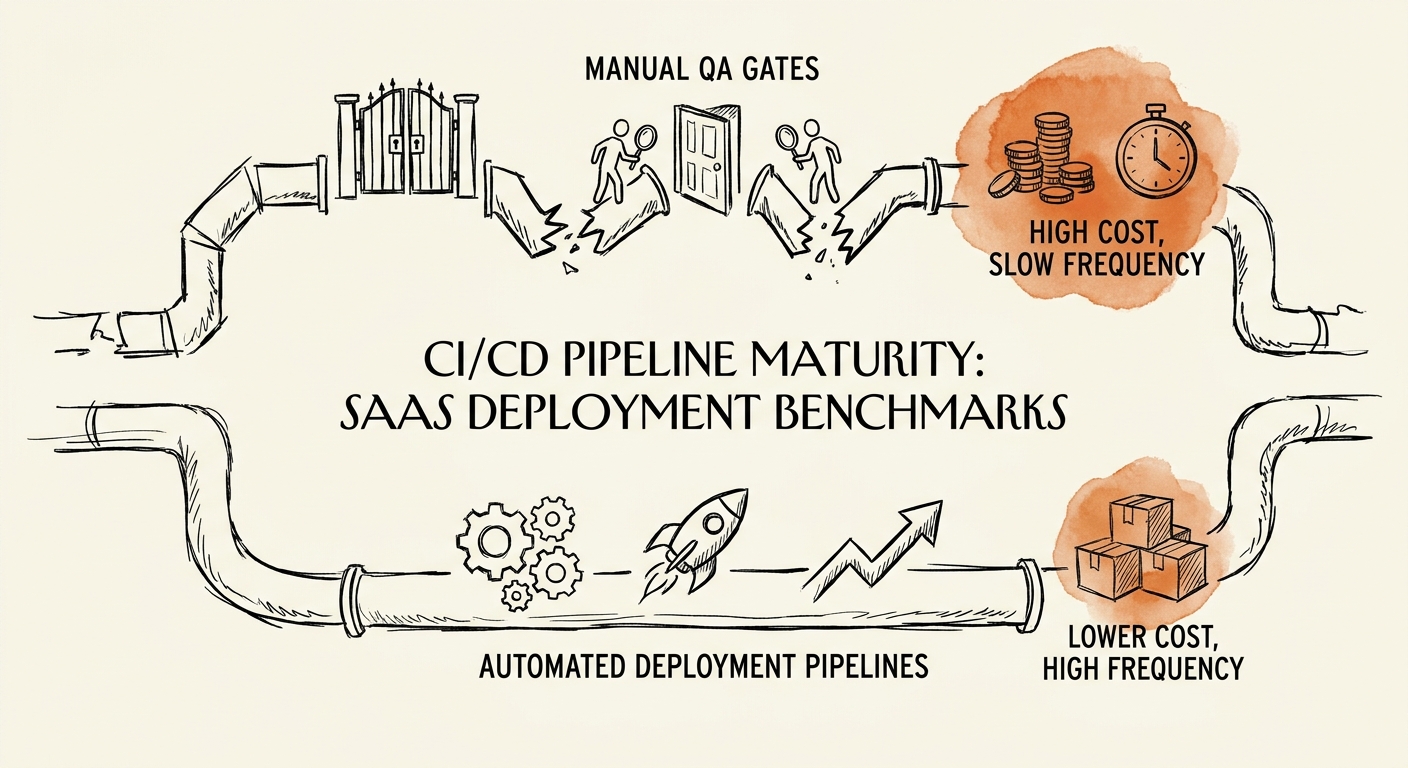
Two changes do most of the work. First, take the human out of the QA gate. You will never deploy daily if a person has to click through the app to bless a release — so the automated test suite has to run on every commit, and the build has to fail itself when coverage drops below the line you set. Second, install feature flags. Decoupling deploy from release is the unlock: code ships to production continuously while unfinished features stay dark behind a flag. That single move makes the "code freeze" obsolete, because there's nothing risky sitting in a queue waiting for a release window.
A realistic 90-day arc
Days 1–30: establish the baseline you should have measured years ago — pull commit-to-production timestamps and compute your real deployment frequency, then stand up CI that blocks any merge to main on a failing build. Days 31–60: bring your staging and production environments under infrastructure-as-code. Environment drift is the quiet killer here — if staging doesn't mirror production byte-for-byte, your green test suite is lying to you, and you'll keep eating release-weekend surprises. Days 61–90: ship to production twice a week behind feature flags until the team has the muscle memory, then push toward daily. As batch sizes shrink, incident severity drops with them — small deploys fail small.
The Monday action is cheap and clarifying: open your deployment logs and write down the actual timestamps for your last ten production releases. Compare the median gap to your team's stated cadence. The size of that gap is the size of the Integration Tax you're paying — and the first dollar of margin you can recover.