
The practical answer
- Short answer
- A single AGPL dependency in a SaaS codebase can force your core IP open-source. Here's how PE sponsors find copyleft exposure before it reprices the deal.
- Best fit
- Industry: B2B SaaS. Function: Engineering / Legal
- Operating path
- Technical Debt → Turnaround & Restructuring → Transaction Advisory Services
- Key metric
- 96% Proportion of commercial codebases containing open-source components, requiring mandatory SCA scanning in due diligence.
Picture the data room a week from wire date. A 60-engineer SaaS company, eight years of recurring revenue, clean Rule of 40, the kind of asset that gets a sponsor excited. Then the software composition scan comes back and there is one line in the dependency manifest that stops the close: an AGPLv3 charting and analytics library, statically pulled into the service that renders the product's flagship dashboard. Not a dev tool. Not a build script. The thing customers pay for.
That single import is why open-source license risk is fundamentally different in SaaS than in any other software acquisition. Founders have been told for a decade that the GPL only "triggers on distribution," and SaaS doesn't distribute—the code never leaves the server, customers just hit an endpoint. That defense is exactly the gap the Affero GPL was written to close. AGPL extends the copyleft obligation to network interaction: if users interact with AGPL-licensed code over a network, the operator must offer the complete corresponding source. There is no shipped binary required to trip it. The act of serving the feature is the trigger.
So the question in diligence is never "do you use open source?" Every modern SaaS codebase does. The 2025 Synopsys Open Source Security and Risk Analysis report found 96% of commercial codebases contain open-source components, and 54% carry active license conflicts. The real questions are narrower and meaner: which copyleft components touch revenue-generating code paths, are they linked into the same process as proprietary logic, and does anyone on the engineering team even know they are there?
Usually they don't. The dangerous AGPL dependency is almost never one a developer chose on purpose. It arrives transitively—an engineer installs a permissive MIT-licensed wrapper, and four levels down the tree it pulls a copyleft package to do the actual work. The license metadata at the top of the install looks clean. The obligation buried underneath is not, and copyleft does not care that the infringement was unintentional. This is precisely the kind of exposure we flag as a deal-stage issue in our 10 Red Flags in Technology Due Diligence That Kill Deals diagnostic.
We don't adjust EBITDA for an AGPL violation in the core stack; we change the deal. If your product's source can be legally compelled open the day after close, you didn't acquire proprietary software—you acquired the obligation to maintain a public utility.
Why this reprices a SaaS deal and not just the engineering backlog
When a PE buyer acquires a software company, the thing being purchased is the exclusive right to monetize proprietary code. The standard intellectual-property representations in the purchase agreement say the target owns or validly licenses everything required to run the business. An unresolved AGPL obligation in the core service breaches that rep directly—because the "license" attached to that code is a demand that you publish your source. You can't simultaneously hold an exclusive proprietary asset and an obligation to make it freely available. Those are the same lines of code pointing in opposite directions.
Here is the part founders underestimate: in SaaS, remediation is rarely "delete the file." The offending component is woven into a service that's deployed, monitored, and load-bearing. Ripping it out means re-architecting the feature it powers, re-running the test suite against a behavioral replacement, and re-validating performance at production scale—then doing it without a customer-visible regression. Revenera's State of the Software Supply Chain report puts the average M&A delay from unearthing and remediating a critical license violation at 4.2 weeks. In a tight financing window, 4.2 weeks isn't a delay—it's the gap where a rate lock expires and a lender repapers the terms.
The detail that decides everything: how the code is linked
Two SaaS companies can use the identical AGPL library and have completely different risk profiles, and the difference is almost always architectural. If the component runs as a fully separate process the proprietary app talks to over a documented API—say, a self-contained service the team treats as a black box—the copyleft "reach" into proprietary code is contestable. If it's statically compiled into the same binary or imported directly into the proprietary module, the derivative-work argument gets strong fast. This is why a verbal "we only use standard open source" from the target's CTO is not diligence; it's a hope. You need a granular map of how each third-party component integrates with the proprietary core, the kind of process we walk through in How to Audit a Codebase in 5 Days. And don't let the SaaS-distribution argument lull you—if the target ships anything downloadable (a desktop sync client, a mobile app, an on-prem agent), classic GPLv2 distribution is back in play on top of the AGPL network-use question.
Get the SBOM first, then run the same three moves every time
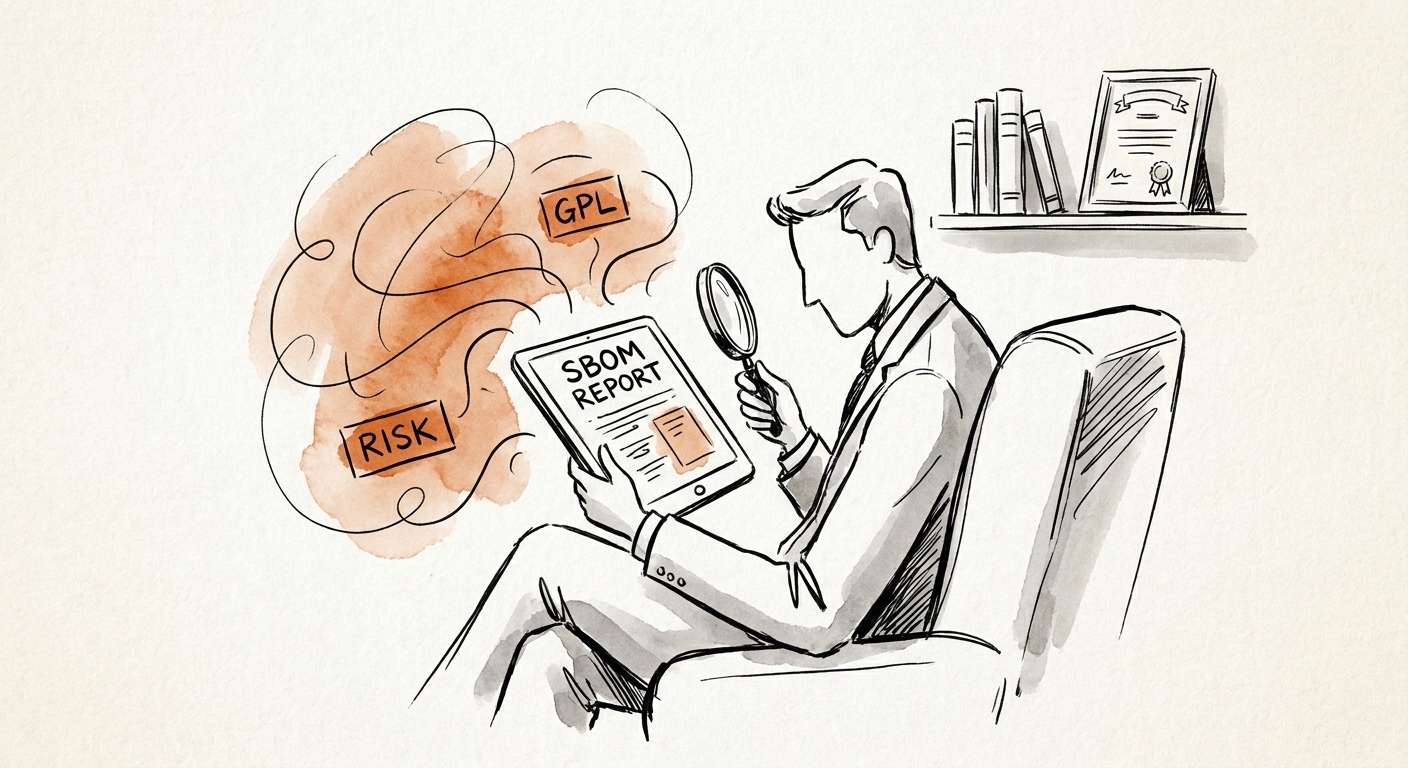
Stop relying on developer recollection and start with proof. The first artifact to request in the data room is a Software Bill of Materials—a machine-readable inventory of every component and transitive dependency mapped to its specific license. If a SaaS company building product on modern tooling cannot produce an accurate SBOM within a day of the request, that's a finding in itself: it means no one is watching what enters the codebase, and the next copyleft surprise is a matter of when. It also signals fragile revenue. Gartner has projected that the majority of enterprise procurement teams will require an SBOM before signing. A target selling into the Fortune 500 without one has ARR that thins the moment a sophisticated buyer audits the supply chain—a connection we trace in The "Silent Deal Killer": Intellectual Property Documentation Requirements for Tech M&A.
When the scan surfaces real copyleft exposure, work it in this order. First, classify the dependency by what it actually does and where it sits: a PDF export utility on a back-office page is a different conversation than the rendering engine behind the product's primary value. Second, make the seller's engineers scope the replacement—exact sprint capacity to swap for a permissively licensed or commercial equivalent, with a behavioral test plan, not a guess. Third, decide who carries it. For anything in a revenue-critical path, that means a price reduction or a pre-closing covenant requiring the seller to remediate at their cost before funds move.
What you do not do is accept a post-closing escrow holdback for a severe copyleft violation in the core stack. The day you close, you own the liability. If an enforcement-minded copyright holder identifies the violation in week one of your hold, it's your fund standing in front of the injunction—and the remedy a court can order isn't a refund, it's compliance, which can mean publishing the source. The move-fast-and-break-things era assumed nobody was reading the manifest. In 2026, your diligence reads it line by line, because in a SaaS acquisition the legal perimeter of the code is the asset.