
The practical answer
- Short answer
- Discover how private equity operators unlock 20-30% in typical cloud cost savings through rightsizing, reclaiming EBITDA from AWS, Azure, and GCP waste.
- Best fit
- Industry: B2B SaaS & Technology. Function: IT Operations & Cloud Management
- Operating path
- Technical Debt → Turnaround & Restructuring → Transaction Advisory Services
- Key metric
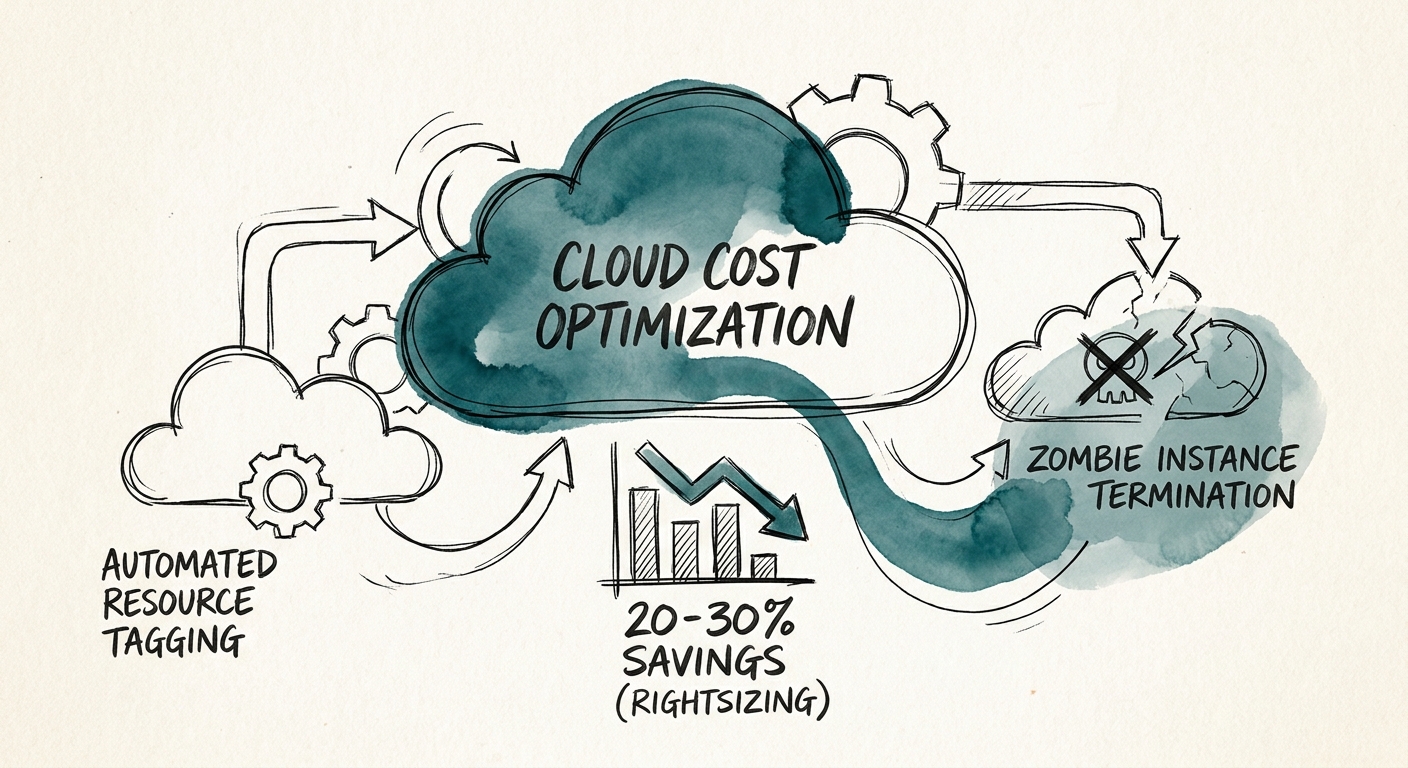
- 20-30% Expected cost savings from comprehensive cloud infrastructure rightsizing.
Every dollar of unoptimized cloud spend in your portfolio company is destroying $12 of enterprise value at a standard exit multiple. Yet, when I run technical due diligence for private equity sponsors, I consistently find that mid-market SaaS companies are burning 20% to 30% of their AWS, Azure, or GCP budgets on severely over-provisioned infrastructure. This is not an abstract engineering problem; it is a direct hemorrhage of EBITDA masquerading as 'scalability.' We see founders bragging about their cloud-native architectures while running CPU utilization rates below 10%. They are treating virtual machines like physical hardware, provisioning for the peak traffic of a Black Friday event that only happens once a year.
In our last engagement with a $40M ARR healthcare software target, we uncovered $1.2M in annual cloud waste within the first three days of our audit. That discovery single-handedly funded their entire integration budget. The market data reinforces this localized finding. According to Flexera's 2026 State of the Cloud Report, organizations self-estimate their cloud waste at 30%, though programmatic analysis often reveals the true figure is closer to 35%. This disconnect occurs because legacy 'lift and shift' migration strategies map on-premises server specifications directly to cloud instances without factoring in elasticity.
The resulting technical debt creates an artificial floor for your cost of goods sold (COGS). When buyers look under the hood, they immediately apply an AWS technical debt discount to the valuation. They know the effort required to untangle this mess. The reality is simple: if you aren't actively rightsizing your cloud footprint, you are paying a massive premium for peace of mind that a basic auto-scaling group could provide for free.
Purchasing Reserved Instances before rightsizing your infrastructure is a critical mistake; you are merely committing to pay a discounted rate on wasteful architecture.
The Mechanics of EBITDA Reclamation: Rightsizing and Modernization
Rightsizing is the most aggressive lever a portfolio operations team can pull to immediately expand gross margins. It requires matching instance types and sizes to your workload performance and capacity requirements at the lowest possible cost. I have rebuilt cloud architectures for three different portfolio companies this year, and the pattern is identical: engineers default to the 'xlarge' instances because they fear latency, completely ignoring the financial consequences. By systematically analyzing CPU, memory, network, and disk utilization, we consistently downgrade instances by one or two sizes without dropping a single packet.
The financial impact of these granular adjustments is significant. Gartner's 2026 Public Cloud Spending Forecast indicates that infrastructure-as-a-service (IaaS) spending will cross $220 billion globally, with nearly a quarter of that tied to oversized instances and abandoned sandbox environments. Operating partners must enforce a disciplined focus on these stale resources. If an instance has been running at less than 5% CPU utilization for 30 days, it is a inactive. Kill it.
Beyond simple resizing, transitioning to current-generation instances offers an immediate arbitrage opportunity. Cloud providers routinely release new silicon that delivers 15% to 20% better price-performance ratios. Yet, engineering teams resist migrating because it requires scheduled downtime or minor configuration changes. This is where the post-acquisition cloud cost surge usually happens; acquired teams freeze operations out of caution. According to McKinsey's Analysis on Cloud Value Leakage, companies that mandate automated upgrades to the latest instance generations capture 12% more value from their cloud investments than those relying on manual interventions.
Instituting FinOps: Sustaining the Multiple
Reclaiming 30% of your cloud spend is an excellent 100-day win, but it is entirely useless if the engineering team spins up a new cluster of unoptimized resources on day 101. Cost optimization must transition from a one-time surgical strike into a continuous financial discipline. This is where FinOps—Cloud Financial Management—becomes mandatory for any PE-backed technology asset. We mandate that every engineering team in our portfolio adopts strict tagging taxonomies. If a resource is not tagged with a specific product, environment, and owner, an automated script terminates it.
This level of financial governance shifts the conversation from 'What is our AWS bill?' to 'What is our unit cost per customer?' Forrester's State of Cloud Cost Optimization highlights that mature FinOps practices reduce cloud unit costs by an average of 24% year-over-year. Once you have baseline predictability, you can strategically deploy Reserved Instances (RIs) and Savings Plans. However, purchasing RIs before rightsizing your infrastructure is a critical mistake; you are merely committing to pay a discounted rate on wasteful architecture.
The ultimate goal is to prepare the asset for its next transaction. Acquirers are conducting deeper, more invasive technical diligence than ever before. If your infrastructure costs scale linearly—or worse, exponentially—with revenue, your exit multiple will be heavily penalized. By contrast, a finely tuned, rightsized cloud environment signals operational maturity. Bain's Global Private Equity Report on Cloud Multiples explicitly correlates robust cloud unit economics with top-quartile EBITDA margins and premium exit valuations. Stop treating your AWS bill as a fixed utility cost and start managing it as the most dynamic technical debt lever in your value creation playbook.