
The practical answer
- Short answer
- Why 70% of Veeva Vault features go unused and how 'Release Management' serves as the bridge between 6x implementation shops and 14x strategic partners.
- Best fit
- Industry: Life Sciences / BioPharma. Function: Customer Success / Professional Services
- Operating path
- Process Documentation → Operational Excellence → Transaction Execution Services
- Key metric
- 70% of Veeva Vault enterprise features go unused due to 'Validation Fear' and poor release management.
The "Go-Live" Lie in Life Sciences
In the Veeva partner ecosystem, there is a dangerous celebration that happens the day a Vault implementation goes live. Champagne corks pop, project managers high-five, and the invoice for the final milestone is sent. But for the BioPharma client, the risk has just begun. Unlike other SaaS platforms where "adoption" is a soft metric of user sentiment, in Life Sciences, adoption is a hard metric of regulatory compliance and speed-to-market.
The data is brutal: A single day of delay in a Phase III clinical trial costs a sponsor approximately $540,000 in direct costs and lost revenue opportunity. For blockbuster drugs, that number can climb to $8 million per day. Yet, most Veeva implementation partners treat "Go-Live" as the finish line. They hand over the keys to a validated system and walk away, leaving the client to navigate three major Veeva releases per year, complex validation governance, and a user base that would rather use "Shadow Excel" than navigate a rigid workflow.
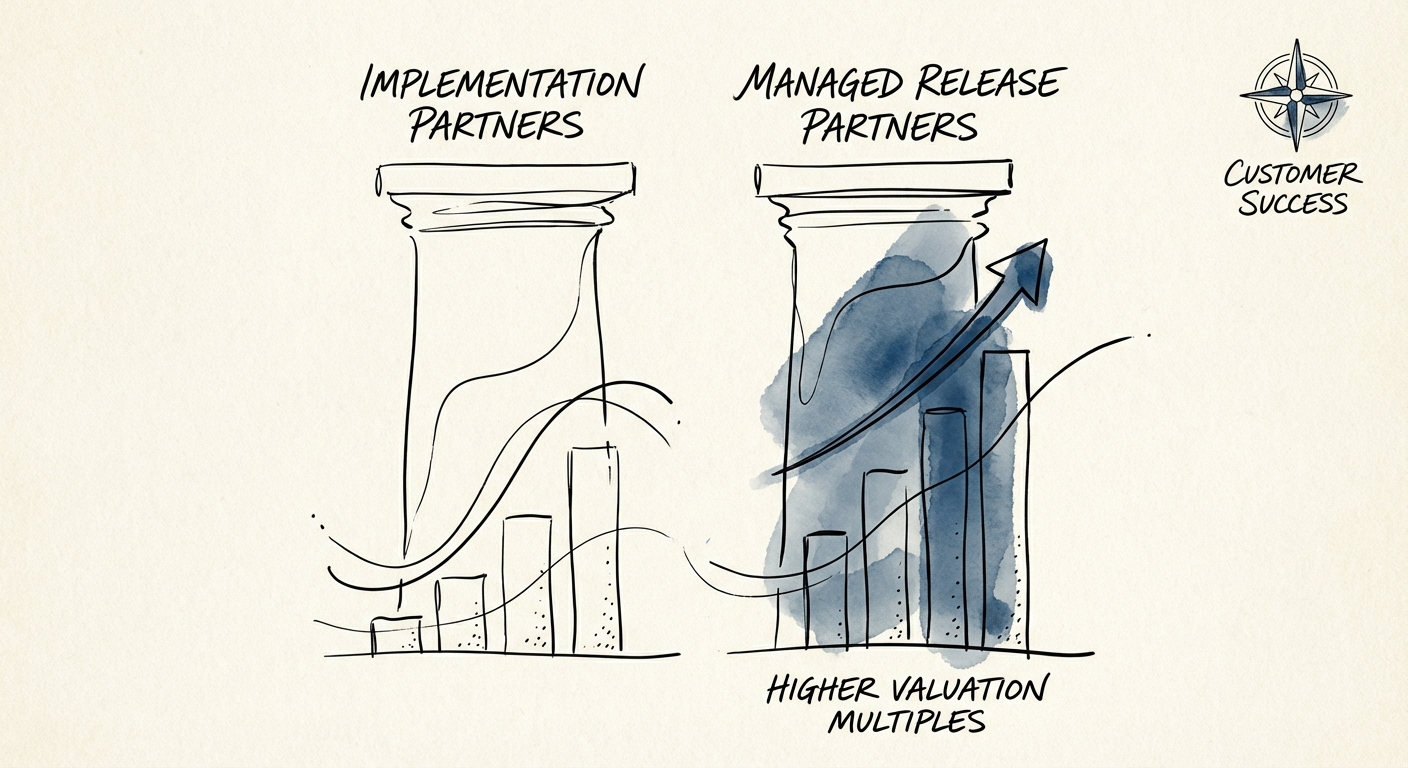
For the Service Firm Founder, this disconnect represents the single biggest valuation gap in your business. If your firm is purely an "Implementation Shop," you are trading at 6x EBITDA. You are selling hours to install software. But if you can pivot your Customer Success function to solve the "Validation Trap"—ensuring clients actually adopt features without breaking compliance—you move into the "Managed Services" category, where valuations hit 12x to 14x. The difference isn't the software; it's the governance wrapper you put around it.
In Life Sciences, 'Go-Live' is a vanity metric. Real value is created in the 18 months that follow, where Release Management determines whether the system accelerates trials or becomes expensive shelfware.
The Diagnostic: Is Your CS Team "Checking In" or "Release Managing"?
Most Veeva partners staff their Customer Success teams with "relationship managers" who check in quarterly to ask, "Are you happy?" In the regulated world of GxP (Good Practice), this is useless. Your clients don't need happiness; they need Release Management.
Veeva releases major updates three times a year (e.g., 25R1, 25R2). Each release comes with "Auto-On" features and "Admin-Enabled" features. Our benchmarks show that 70% of enterprise features in Veeva Vault go unused because internal teams are terrified that turning them on will trigger a full system re-validation. They are caught in the "Validation Trap."
To diagnose if your Customer Success function is adding enterprise value, ask these three questions:
1. The Feature Lag Metric
Measure: What percentage of "Admin-Enabled" features from the last two Veeva releases have your clients deployed?
- < 10%: You are a risk. Your client is paying premium Veeva subscription fees for a stagnant system. They will eventually churn or consolidate vendors.
- > 50%: You are a strategic partner. You are actively managing the "Release Impact Assessment" and guiding them through the validation impact.
2. The "Shadow Excel" Ratio
Measure: During your Quarterly Business Reviews (QBRs), do you audit process drift?
Users often find Vault workflows too rigid. If your CS team isn't identifying where users have created "Shadow Excel" trackers to bypass Vault, you are missing the leading indicator of implementation failure. A true CS partner brings a "Process Drift Diagnostic" to every QBR, showing exactly where user behavior is diverging from the SOP (Standard Operating Procedure).
3. The Ticket Velocity vs. Volume
Measure: specific to post-release windows.
In the 30 days following a Veeva release, does ticket volume spike with "How do I?" questions, or remain flat? Paradoxically, a flat line is often bad—it means users are ignoring the new capabilities. A healthy partner sees a controlled spike in "Adoption" tickets, managed by proactive training materials released before the software update.
From Project Revenue to "Validation-as-a-Service"
The pivot from a 6x implementation shop to a 14x strategic partner requires productizing your Customer Success function. You must stop selling "blocks of hours" for support and start selling Managed Release Governance.
The "Release Management" Retainer
Instead of a reactive help desk, structure a retainer that explicitly covers:
- Pre-Release Impact Analysis: Six weeks before a Veeva update, you provide a dossier detailing exactly which features impact their specific configuration and validation status.
- Validation Scripts: You provide the OQ (Operational Qualification) scripts for the new features, reducing their QA burden.
- Training Deltas: You update their SOPs and training decks. (Note: Process documentation is the stickiest part of the relationship).
The Valuation Impact
Private Equity buyers scrutinize revenue quality. Project revenue is "low quality" because it re-sets to zero every January 1st. Managed Services revenue tailored to the Veeva release cycle is "high quality" because it is structurally embedded in the client's compliance license. It cannot be turned off without risking regulatory findings.
By positioning your Customer Success team as the "Guardian of the Release Cycle," you solve the client's biggest fear (compliance drift) and the investor's biggest requirement (recurring revenue). You move from being a vendor who installed a tool to a partner who protects their $500k/day clinical trial timeline.