The practical answer
- Short answer
- Prevent the 47% attrition spike. A 48-hour communication protocol for tech acquisitions, including specific scripts for employees, customers, and leadership.
- Best fit
- Industry: Private Equity / B2B Tech. Function: Operations / Human Resources
- Operating path
- Process Documentation → Operational Excellence → Transaction Execution Services
- Key metric
- 47% Average employee turnover within the first year of a merger (EY).
The High Cost of "We'll Tell Them When We Know More"
In the response room, the deal is closed when the wire hits. In the break room, the deal hasn't even started. The 48 hours following a tech acquisition announcement are the most dangerous period in the investment lifecycle. This is where the "Silence Tax" is levied.
According to EY, the average employee turnover after a merger hits 47% within the first year. This isn't random attrition; it is a direct response to uncertainty. In the absence of information, human beings do not assume the best; they hallucinate the worst. They assume layoffs, product sunsets, and culture erasure. McKinsey data suggests that 57% of merger failures can be directly attributed to poor communication during this integration phase.
For Private Equity Operating Partners, the risk isn't just internal. PwC reports that 17% of customers reduce or stop doing business with a company during an M&A event. If you acquire a $50M ARR SaaS platform and fumble the Day One messaging, you are effectively agreeing to an immediate $8.5M revenue haircut before you've realized a single synergy. The goal of Day One communication is not to share every detail of the integration plan (which likely doesn't exist yet); it is to transfer certainty from the buyer to the acquired entity.
In the absence of information, human beings do not assume the best; they hallucinate the worst. The 'Silence Tax' is paid in talent attrition.
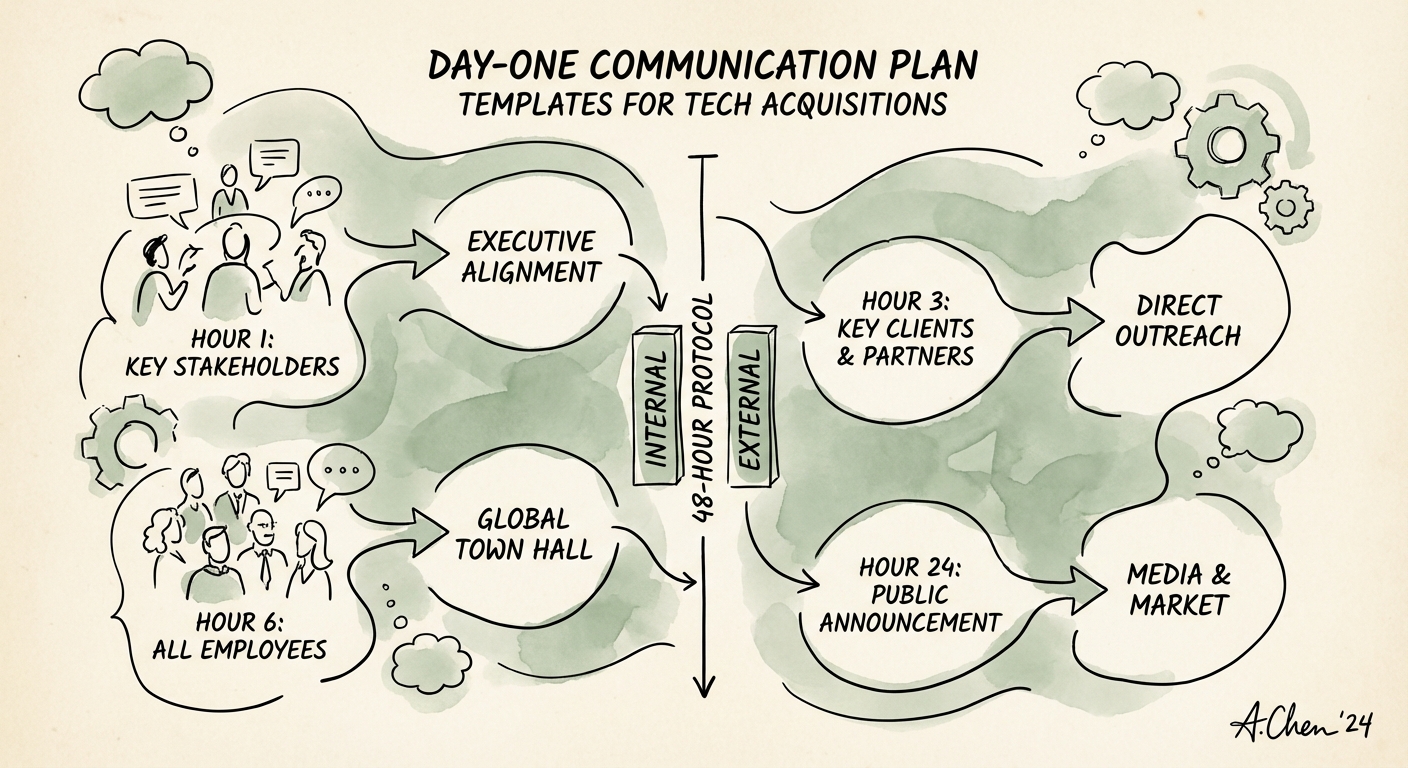
The 48-Hour Communication Protocol: A Template
You cannot wing this. The following timeline is a standardized protocol we see in top-quartile PE firms to stabilize the asset immediately.
Hour 0: The "Circle of Trust" (Pre-Announcement)
Before the press release drops or the all-hands invite goes out, you must secure the key leaders. The Founder/CEO is likely already on board, but the VP layer is the flight risk.
- Audience: C-Suite and VPs only.
- Format: 1:1 Video Calls or In-Person (No emails).
- The Script: "This deal is happening. You are critical to the next phase. Here is exactly what your role looks like for the next 90 days. We have a retention package for you."
- Goal: Prevent the "resume blast" that happens when leaders feel blindsided.
Hour 2: The All-Hands (The Narrative Anchor)
This is the most scrutinized speech the CEO will ever give. It must be scripted, rehearsed, and delivered jointly by the acquiring and acquired CEOs.
- The Template Structure:
- The "Why" (Strategic Logic): Not "synergies," but "strength." (e.g., "Together, we can finally build the X feature you've wanted.")
- The "What Changes" (Immediate Logistics): Payroll, benefits, reporting lines. If nothing changes Day 1, say that explicitly.
- The "What Stays" (Culture): Explicitly name the cultural artifacts you are protecting (e.g., "Remote-first isn't changing.")
- The "Plain-Language" Q&A: Address the layoff question head-on. If you don't know, say: "We are reviewing roles over the next 60 days. No changes will happen before [Date]."
For a deeper dive on managing the cultural friction during this phase, review our guide on Post-Merger Culture Clash.
Hour 4: The Customer Defense Shield
Your competitors will call your top 20 customers within 60 minutes of the press release. You must beat them to the phone.
- Top 20 Accounts: Personal phone calls from the CEO or CRO.
- The Mid-Tail: Personalized email sequences from the Account Manager (not a generic marketing blast).
- The Message: "This acquisition accelerates the roadmap you care about. Here is the feature we are now building for you."
Timing is critical here. See the specific benchmarks in Post-Acquisition Customer Communication Timeline.
The Artifacts of Trust: What to Send
Spoken words evaporate; written documents persist. To support the verbal announcements, you must deploy a "Day One Kit" that answers the silent questions.
1. The "Safe Harbor" FAQ
Create a searchable internal document answering the tactical questions that cause anxiety. Do not fill this with corporate speak. Be binary where possible.
- "Will my health insurance change?" (Yes/No/Not until Jan 1)
- "Do I still report to Sarah?"
- "Is the Denver office closing?"
2. The Integration Roadmap (High Level)
Employees don't need to know the database schema migration plan yet, but they need to know the governance structure. Who is leading the integration? What are the milestones? Providing a visible structure suggests competence and control. For the person leading this charge, the Integration Manager's Playbook is mandatory reading.
3. The "Unchanged" List
Psychologically, humans focus on loss. Counteract this by publishing a list of things that are not changing. "Our Slack channels stay. Our Friday demos stay. Our dev methodology stays." This provides a psychological anchor during the storm.
Summary: Clarity is Currency
In the first 48 hours, silence is interpreted as malice. A Deloitte study found that companies with a well-defined communication strategy during post-merger integration are 3.5 times more likely to outperform their peers. The investment you make in drafting these templates today pays out in the retention of the very assets—people and customers—you just bought.