The practical answer
- Short answer
- A 350-page onboarding wiki where 8% of pages get read isn't process maturity—it's shelfware. The per-role page caps that actually speed up ramp time.
- Best fit
- Industry: B2B SaaS / Technology. Function: Operations & Human Resources
- Operating path
- Process Documentation → Operational Excellence → Transaction Execution Services
- Key metric
- 15 Maximum pages of onboarding documentation for Enterprise Sales to hit quota faster.
The wiki nobody reads after week two
I once sat in a management presentation where a founder pulled up a 350-page onboarding wiki like it was a trophy. Forty-five engineers, every process documented, the whole company's institutional memory in one Confluence space. He called it a moat. Then we pulled the analytics. After week two, new hires touched roughly 8% of those pages. The other 92% was shelfware—written once, never updated, never opened, sitting there as proof that someone had been busy.
Here's the trap, and almost every scaling founder walks into it: you assume page count equals process maturity. A thick welcome manual feels like a sign the business runs without you. It's the opposite. When you hand a brand-new VP of Sales 150 pages of unstructured text, you haven't transferred knowledge—you've handed the job of organizing your processes to the one person who knows the least about them. Volume is what you produce when you haven't done the hard work of deciding what actually matters in the first 30 days.
And it shows up in money. That company was losing people in early tenure at a clip that lined up with the Bureau of Labor Statistics 2025 JOLTS data on tech-sector churn—and replacing an early-tenure exit isn't a $5K problem, it's tens of thousands per seat once you count recruiting, ramp, and the deals that didn't close while the chair was empty. If your onboarding leans on heavy reading instead of structured action, a buyer will find it in diligence. The transferability premium goes to companies whose processes work without the founder in the room. A wiki nobody reads doesn't pass that test—it fails it loudly.
Nobody pays a premium for your word count. They pay for how fast a new hire becomes useful—and a fat wiki is usually the thing slowing that down.
The page caps, by role
Stop paying expensive people to read and start paying them to do. Gartner's 2026 HR practice benchmarks are blunt about it: push information density past roughly 40 pages for a single role and 30-day retention of that material falls off a cliff. So set hard ceilings. Not guidelines—ceilings. Here's where I draw them, and what goes inside each one.
Enterprise sales: 15 pages, hard stop
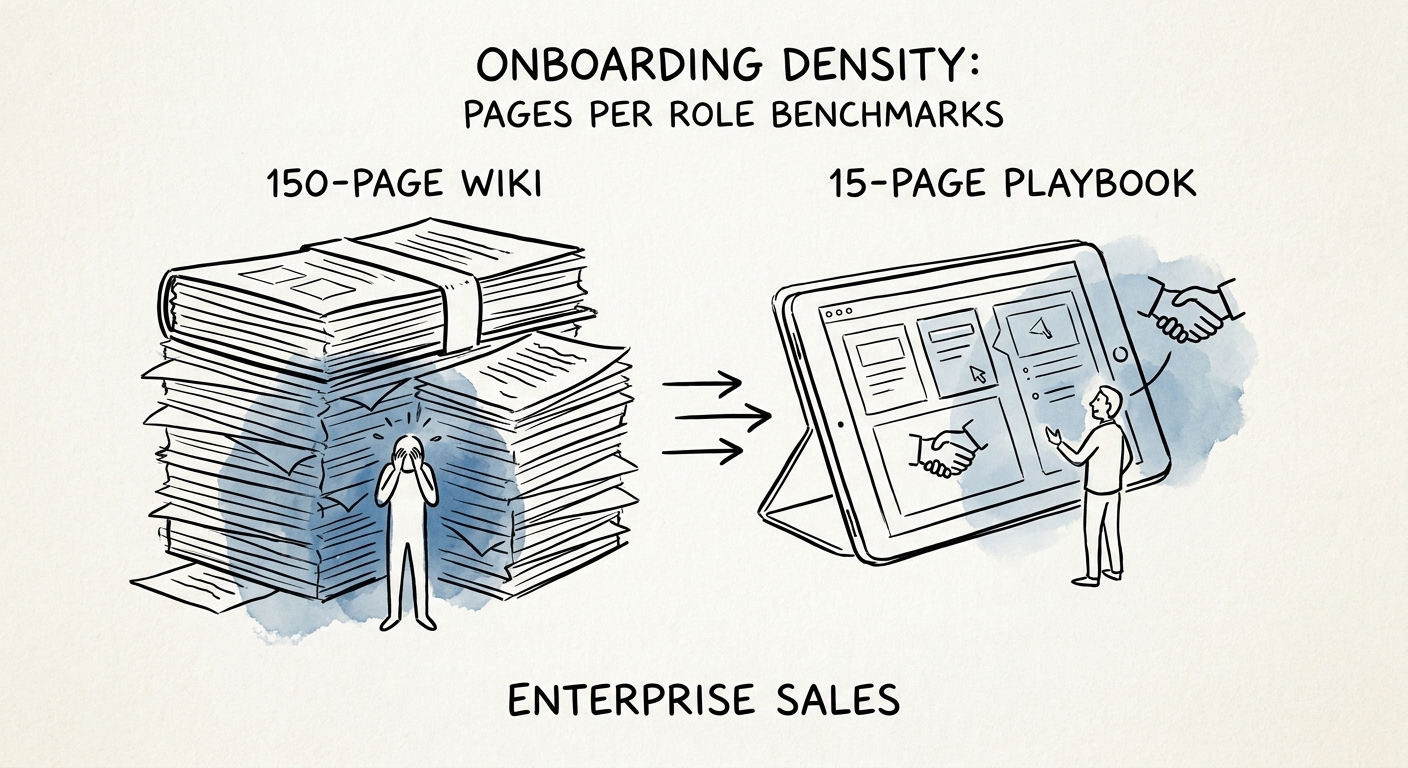
A new rep does not need your founding story or a chronological company timeline. They need to know who to call and how to qualify them. Spend 5 pages on the ideal-customer profile and the disqualification triggers (who to walk away from is more valuable than who to chase), 5 pages on your qualification framework, and 5 pages on the CRM hygiene rules that keep your forecast honest. Everything else moves into live deal reviews, where a senior rep watches them work a real pipeline. MIT Sloan Management Review has found interactive, role-specific onboarding dramatically outpaces static reading on speed-to-quota—because a deal review teaches judgment, and a PDF never will.
Engineering: 25 pages, and if you need 40 you have a different problem
Engineers learn by shipping, not by reading an 80-page treatise on your microservices. Give them 10 pages on environment setup, 5 on security protocols, and 10 on how and when code goes to production. That's it. And watch the setup section like a diagnostic instrument: if it takes 40 pages to explain how to spin up a local environment, the documentation isn't the issue—your codebase is. Bloated setup docs are technical debt wearing a costume. They make the onboarding look thorough while hiding the fact that nobody can run the thing without tribal knowledge.
Customer success: 20 pages, scenarios only
CSMs need playbooks for the moments that actually happen—an account going quiet, a renewal at risk, a champion leaving—not an essay on empathy. Cap it at 20 pages covering health-score thresholds, the exact escalation path when a number turns red, and the 90-day renewal triggers. The rest belongs inside the CS platform itself as prompts and automated steps, so the guidance shows up at the moment of the action instead of buried in a doc. If you're eyeing a transaction in the next two years, run your CS materials against our exit-ready documentation checklist—a buyer wants turn-key systems, not a reading list.
Refactor it like code
You'd never let dead functions rot in your codebase for years. Treat onboarding docs the same way. The goal isn't more pages—it's the smallest set of instructions that reliably produces a productive hire. Three moves get you there.
Put a 90-day expiration date on every process doc. If a page hasn't been updated, verified, or actually used in the last quarter, archive it. Don't debate it—archive it. Stale docs are worst in a merger, where a new owner inherits a pile of contradictory instructions and can't tell which ones are real. That confusion is exactly the kind of integration governance gap that quietly eats the value a deal was supposed to create. A small, current set of docs is worth more than a vast outdated one—every time.
Move the words into the tools. Replace the 500-word "how we handle X" page with a 5-step checklist living inside Jira, Salesforce, or Zendesk—right where the work happens. The instant a new hire has to leave their workflow and go hunting through a wiki, you've lost them for fifteen minutes and broken their momentum. Multiply that context-switch across a whole team, every day, and it's a real line item.
Track time-to-first-value, not page count. The number that matters is how many days until a hire does the actual job: a rep books their first qualified meeting, an engineer pushes their first production commit, a CSM independently saves an at-risk account. Pick the benchmark for each role, then watch the relationship between that clock and your doc volume. If the docs are getting longer and time-to-first-value is getting slower, your onboarding is working against you. Cut pages until the ramp speeds up. That's the whole test.