
The practical answer
- Short answer
- A Dynamics 365 roll-up doesn't fail at the bank account. It fails when your F&O architects refuse to work with the CE team. Here's how to integrate the practice, not just the P&L.
- Best fit
- Industry: Private Equity / Technology Services. Function: Operations
- Operating path
- Migration & Integration → Turnaround & Restructuring → Transaction Advisory Services
- Key metric
- 30% Avg. drop in billable utilization during the first 6 months of unmanaged integration.
The deal closes. Then the F&O team stops talking to the CE team.
You bought a platform: a Microsoft Dynamics partner with a real Finance & Operations (F&O) practice. Then you bolted on two more shops to get scale and a Customer Engagement (CE) book to cross-sell into. The model showed 22% EBITDA by Year 2 on the strength of "one integrated practice." Three weeks after close, your F&O delivery lead tells you, in a calm and professional tone, that the CE consultants "don't understand enterprise GL complexity" and he'd prefer they not be staffed on his accounts.
That sentence is the whole problem. You didn't buy one company. You bought three tribes who each believe their way of scoping a Dynamics implementation is the correct one — and in the Microsoft ecosystem, the way you scope, configure, and deliver is the asset. There's very little IP. The value walks out the door at 6pm and decides every morning whether to come back.
Why Dynamics roll-ups break in a specific place
Most operating partners track financial integration at Day 1 and back-office at Day 90, then hand "practice integration" to the practice leads — the exact people whose authority shrinks if the practices actually merge. Bain & Company puts the failure rate of M&A deals to hit intended synergies around 70%, with execution — not strategy — as the usual cause. In a Dynamics services business that execution gap shows up as resource managers quietly hoarding their best people, dual methodologies running in parallel, and a CE-to-F&O cross-sell motion that nobody is actually compensated to drive. The synergy line in the model assumed cooperation you never bought.
In a Dynamics shop, the asset is the senior F&O architect who knows where the bodies are buried in a client's general ledger. You can't buy that in the data room. You either keep her past month nine, or you bought a logo.
Do the utilization math before you do anything else
Churn is the metric everyone watches. In a services roll-up the one that quietly eats the deal is billable utilization, and a messy integration drags it 15 to 30% in the first six months — consultants who don't know which methodology to follow, whose ticket they're on, or who signs their staffing decisions stop billing and start refreshing recruiter messages.
Put real numbers on it. Say you've combined three Dynamics shops into 50 billable consultants at a blended $225/hour. A 10-point utilization drop — modest for an unmanaged integration — is roughly $180,000 a month in lost gross margin. Six months of that erases a million dollars of value before a single planned synergy lands. That's the budget you're really protecting, and it dwarfs whatever you'd spend to integrate properly.
Pick One Way — and accept it won't be "best of both"
"Best of both worlds" is how you end up with two of everything and clarity on nothing. Choose one delivery spine and enforce it:
- One Dynamics delivery methodology. Decide whether F&O Sure Step-style waterfall or the CE team's agile cadence wins for which workstream, document it, and stop letting each lead run their own. Mixed methodology is invisible margin leakage.
- One rate card and title ladder. A Senior Dynamics Consultant cannot bill $175 from one legacy entity and $250 from another for identical F&O config work. Harmonize titles and rates in the first 60 days or your gross margin reporting is fiction.
- One PSA and time system. If F&O lives in one professional-services-automation tool and CE in another, you have no real-time view of utilization or backlog. Pick one. Migrate fast. Painful beats blind.
- A central resource desk. Take staffing away from practice leads and give it to one Resource Management Office that assigns on skills and availability, not tribal loyalty.
If you want the catalog of where these gaps form, our breakdown of post-merger integration mistakes that destroy deal value maps them by function.
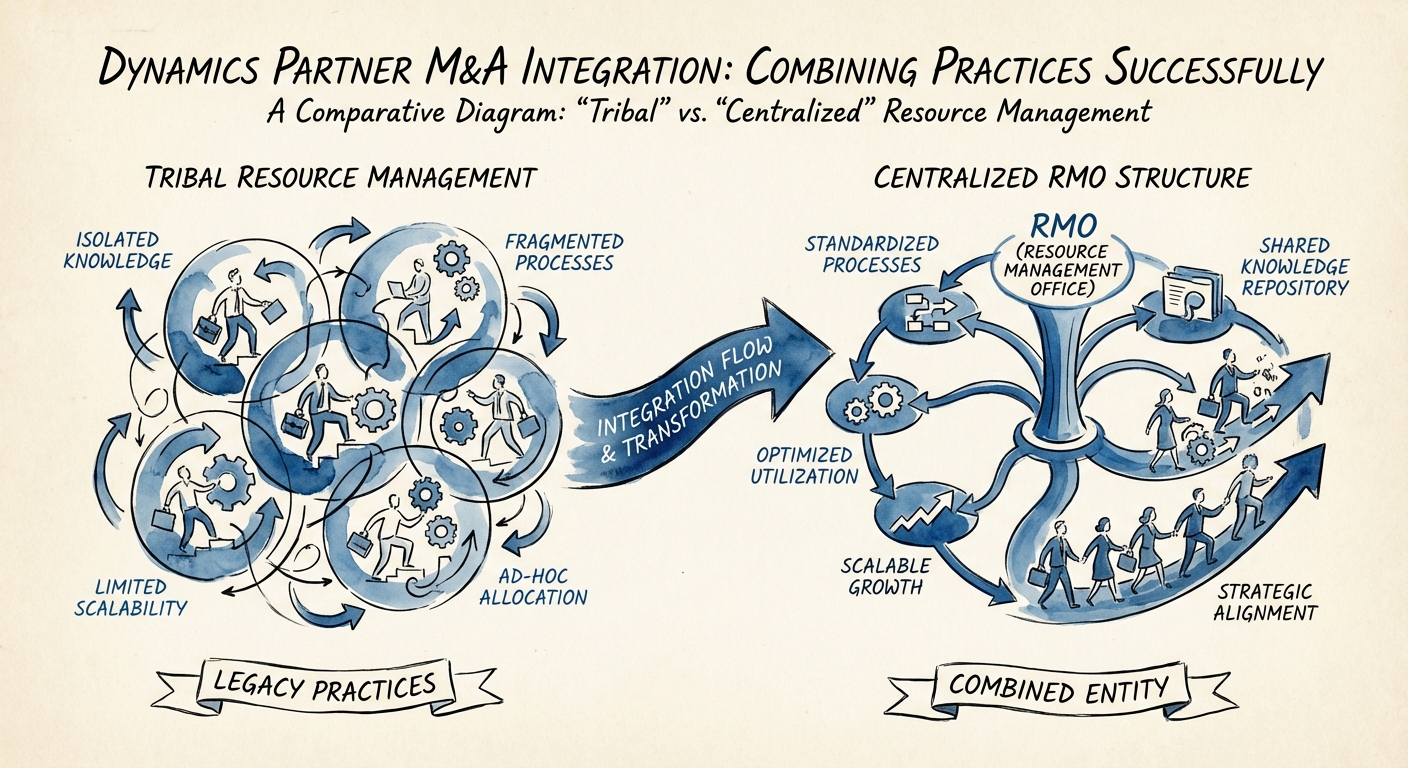
The senior F&O architect is the deal. Treat her like it.
In the Dynamics market a senior F&O architect carries a $180k+ salary, fields recruiter pings weekly, and personally holds the client trust that makes your backlog real. Lose three of them in the first year and your multiple — built on that backlog and those relationships — quietly resets. BCG finds employee intent-to-stay can fall by nearly half under poorly managed change. You don't get a warning email before they leave; you find out when a client asks why their lead consultant's calendar went dark.
A 90-day safe harbor, then change
Don't reorganize everyone in week one. Give the integration room to land:
- Freeze methodology on live projects. Let acquired teams finish in-flight client work their existing way. Disrupting an active F&O go-live to enforce a new process is how you turn a retention problem into a reference-customer problem.
- Ring-fence comp for a year. Guarantee commissions and bonuses through the transition. A retention bonus is a rounding error next to the fully loaded cost of post-acquisition attrition — backfill, ramp time, and the revenue that leaves with the relationship.
- Plant a bridge, not a spy. Embed one leader from the acquirer inside the acquired delivery org — visibly there to remove friction, not to police it. The difference is obvious to the team within a week.
And if the deal also moves you from staff augmentation toward managed services, expect more friction, not less — the operating model shift is its own chasm, which we lay out in staff augmentation vs. managed delivery.
The test: one dashboard by Day 120
Successful Dynamics integration isn't a shared Slack and a new logo on the door. It's whether you can read utilization, gross margin, and backlog for all three legacy practices on a single dashboard by Day 120. If you can't, you haven't integrated anything — you've just made three companies harder to manage from one bank account. Fluent EBITDA means fluent operations, and in this ecosystem operations are measured one billable hour at a time.