
The practical answer
- Short answer
- Why 79% of earnout value evaporates for technical founders. A guide to structuring retention packages based on product milestones, not EBITDA.
- Best fit
- Industry: Private Equity / Software. Function: M&A Deal Structure
- Operating path
- Exit Readiness → Operational Excellence → Transaction Advisory Services
- Key metric
- 33% of non-life sciences deals in 2024 included an earnout, up from 21% in 2022.
The 21-Cent Reality Check
If you are a technical founder staring at a Term Sheet that bridges a $10M valuation gap with an earnout, you are likely looking at a hallucination. According to the 2025 SRS Acquiom M&A Deal Terms Study, the average earnout pays just 21 cents on the dollar across all deal types. For technical founders, the odds are often worse.
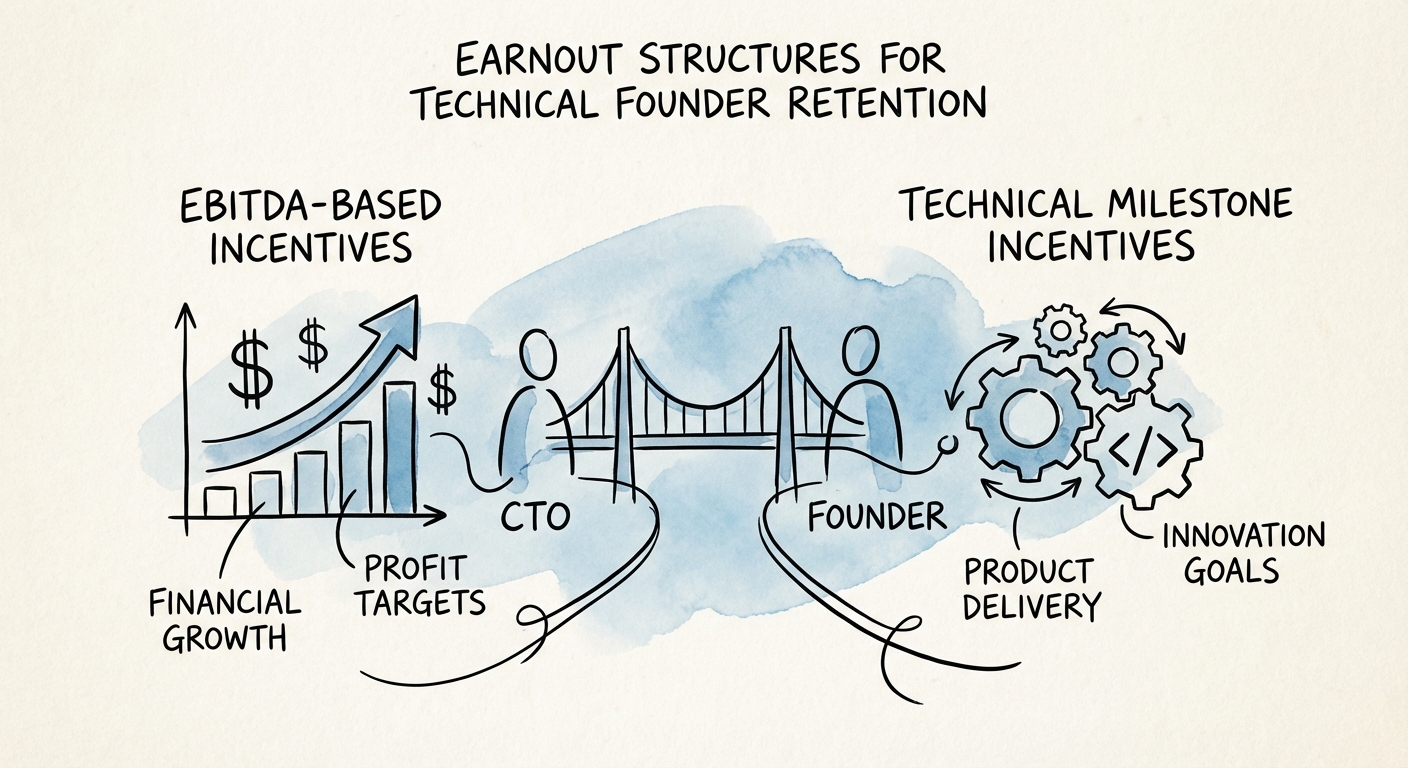
The reason is a fundamental misalignment of incentives. Most private equity earnouts are tethered to EBITDA or Gross Revenue targets. For a CEO or VP of Sales, these metrics align with their day-to-day control. But for a CTO or technical co-founder, an EBITDA target is a direct conflict of interest with their primary value driver: innovation.
When a technical founder is incentivized on EBITDA, they are financially rewarded for starving the R&D budget. They stop hiring expensive senior engineers, they delay cloud migrations, and they patch technical debt instead of refactoring it. The result? The PE firm hits its year-one financial target, but the acquired platform rots from the inside out. By year three, the "innovative asset" is legacy code, and the founder has vested in peace and left the building.
The "Integration Trap"
The second failure mode is the "Integration Trap." In 2025, 33% of non-life sciences deals included an earnout provision—a significant spike driven by valuation uncertainty. However, acquirers often demand that technical founders lead post-merger integration (PMI) while simultaneously hitting aggressive standalone revenue targets. This is operational cognitive dissonance. You cannot expect a CTO to migrate their tenant to your Azure instance (a non-revenue generating activity) while simultaneously growing ARR by 40% to hit a revenue trigger. When faced with this choice, the founder protects the earnout and kills the integration.
An earnout protects the buyer from downside risk. A retention bonus protects the buyer from brain drain risk. In a services firm or IP-heavy SaaS company, brain drain is the far more expensive problem.
Structuring "Technical Milestone" Earnouts
To retain technical talent and protect the asset's long-term value, smart sponsors and founders are moving away from financial metrics toward Technical Milestone Earnouts. These structures tie payout to the intrinsic value of the technology, not just the P&L.
1. The "Platform Unity" Gate
Instead of a revenue target, structure 30-40% of the technical earnout around specific integration milestones. This aligns the founder's financial outcome with the private equity firm's thesis.
- Metric: Successful migration of customer data to the acquirer’s Snowflake instance by Month 9.
- Metric: Deprecation of legacy data centers and transition to 100% cloud-native architecture by Month 12.
- Metric: Implementation of SOC 2 Type II controls across the combined entity.
This structure ensures the founder is paid for enabling future scale, rather than just harvesting current revenue.
2. The "Knowledge Extraction" Gate
Technical founders often hold 80% of a company's IP in their heads. A "key person dependency" of one is a massive risk for any acquirer. Structure a portion of the earnout specifically for documented knowledge transfer.
- Metric: Completion of 30 core process documents validated by a third-party technical audit.
- Metric: Successful hiring and onboarding of a successor (VP of Engineering or CTO) who remains in role for at least 6 months.
3. The "Product Velocity" Gate
If growth is the goal, measure the inputs of innovation, not just the lagging indicator of revenue.
- Metric: Shipping the "GenAI Module" referenced in the CIM by Q2.
- Metric: Reducing ticket resolution cycle time by 40% through automation.
The "Retention Bonus" Pivot
Sometimes, the best earnout structure is no earnout at all. For purely technical talent—engineers and architects who are not commercial leaders—earnout disputes are a primary driver of attrition. The ambiguity of "Adjusted EBITDA" (and the inevitable add-back battles) breeds resentment.
For these roles, consider shifting from a performance-based earnout to a time-based Retention Bonus structure, or "Pay to Stay."
The "retention packages" that Actually Fit
A Retention Bonus pool, paid out quarterly over 24 months, offers certainty. It removes the distraction of financial engineering and allows the technical leader to focus on code and product. In our analysis of 2024-2025 deal terms, technical retention packages structured as guaranteed cash (vesting over time) retained key leaders 2.4x longer than contingent earnouts.
The Strategic
Trade-off:
An earnout protects the buyer from downside risk. A retention
bonus protects the buyer from brain drain risk. In a services firm or IP-heavy
SaaS company, brain drain is the far more expensive problem. If your technical
co-founder is truly irreplaceable, do not gamble their retention on a dispute
over EBITDA margin calculations. Pay them to build the future.