
The practical answer
- Short answer
- In a B2B tech exit, founder dependency cuts multiples roughly in half. A 3-test diagnostic and a 12-month extraction sprint to de-risk key person risk before LOI.
- Best fit
- Industry: B2B Technology. Function: Executive Leadership
- Operating path
- Exit Readiness → Operational Excellence → Transaction Advisory Services
- Key metric
- 50% Valuation haircut applied to companies with high founder dependency vs. systematized peers.
The single point of failure is sitting in your Slack DMs
Here is the moment that decides your multiple, and it happens in week three of diligence, not at the negotiating table. The buyer's technical lead pulls your VP of Engineering into a room without you and asks one question: "When the core billing service throws that intermittent error at 2 a.m., who fixes it?" If the honest answer is "we escalate to the founder," you have just been repriced. Quietly. Before anyone shows you a number.
In a B2B technology business this risk is sharper than it is anywhere else, because the founder is rarely just the rainmaker. You are usually the de facto CTO, the keeper of why the architecture was built the way it was, and the only person who remembers which "temporary" hack from 2021 is now load-bearing. That concentration feels like control. To an acquirer it reads as a fragile dependency they will have to underwrite.
The pricing gap is not subtle. Systematized lower-middle-market businesses are trading in the healthy mid-to-high single-digit EBITDA range, while companies carrying heavy founder dependency get stuck around 3-4x. Strategic Exit Advisors frames founder dependency bluntly as the hidden valuation killer, and roughly half your enterprise value can evaporate not because the business is bad, but because it cannot run a quarter without its architect.
It gets worse after the handshake. Once a buyer flags key person risk, they stop trying to price it out and start trying to structure around it: earnouts, holdbacks, multi-year founder lockups. Per SRS Acquiom's 2025 M&A Deal Terms Study, earnouts now appear in more than a third of private deals, and across all deals the average payout is about 21 cents on the dollar. Translate that: if you are "irreplaceable," you are agreeing to gamble a meaningful slice of your exit on hitting performance targets right when you have the least operational leverage to hit them.
A diligence team will ask your senior engineer one question: "What happens if Justin gets hit by a bus?" If the answer is a long pause, you just lost two turns of EBITDA.
Three tests a tech founder usually fails
Most founders insist they have delegated. They have an org chart, a leadership team, standups. But delegation of tasks is not delegation of judgment, and in a software company the gap shows up in three specific places. Run these honestly; a buyer's diligence team will run them whether you do or not.
Test 1: The pull-request test
Forget the 90-day vacation cliche for a second and make it concrete. Over the last quarter, how many architectural or roadmap decisions got made without your input, all the way to merged and shipped? Not "Slack-approved by me" — made without you. If every meaningful technical bet still routes through your head, your engineering velocity is capped at your personal bandwidth, and you have built a company that scales exactly as far as one person's calendar. Say a 60-person SaaS firm: if the VP of Eng cannot greenlight a schema migration without a founder sign-off, the buyer prices the founder, not the team.
Test 2: The rainmaker test, tech edition
If you personally touch more than 30% of closed new revenue, you do not have a sales team — you have sales assistants who set up demos for you to close. In technical B2B this is especially sticky because the "trust" is partly technical credibility: prospects believe the founder will personally make the integration work. That credibility does not transfer in a data room. PE modeling commonly assumes a sharp conversion drop when founder-led sales hand off, which is exactly why firing yourself from sales is worth turns of multiple, not just peace of mind.
Test 3: The bus-factor test on the core engine
This is the one unique to software and the one founders hide from. If you are the only person who can debug the core engine, the only one who knows why the legacy module was never refactored, the dependency lives in your head and nowhere in the repo. That surfaces in the code-quality audit and again in operational due diligence, and quantifying key person dependency in a tech company almost always starts in the codebase. The fix is not a wiki nobody reads. It is a second engineer who has independently shipped against the riskiest part of the system. This is the same trap the delegation paradox describes: tasks went out the door while the irreplaceable judgment stayed home.
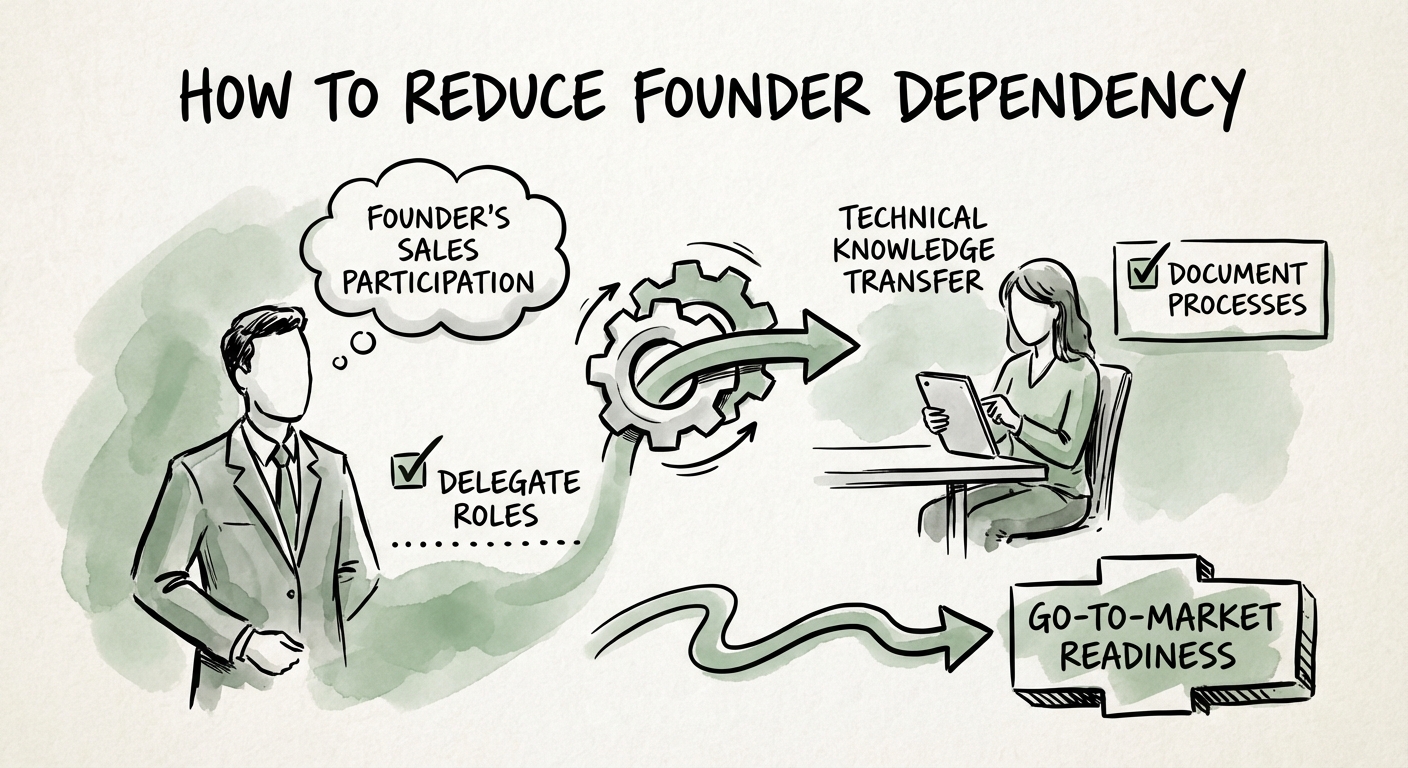
The 12-month extraction sprint, sequenced for a software company
Reducing founder dependency is not about disappearing. It is about moving from operator to shareholder while the business proves, on the record, that it runs without you. In a tech firm this takes 12 to 18 months done right, and the order matters because the hardest handoff — the technical one — needs the most runway.
Months 1-4: Document the decisions, not the tasks
SOPs are table stakes and acquirers barely glance at them. What they pay a premium for is transferable judgment: your pricing logic, your build-versus-buy framework, your technical-debt triage rules, and the actual reasoning behind the architecture. Start a "decision log" for every non-obvious technical or commercial call and the why behind it. Fold in your customer concentration mitigation plan while you're at it — concentration plus founder dependency is the combination that gets the steepest haircut.
Months 5-10: Two clean handoffs in parallel
Run the sales handoff and the engineering handoff at the same time, because in a tech company they reinforce each other. On sales, move deliberately from player to coach to observer and aim for two consecutive quarters where the team hits quota with zero direct revenue attribution to you. On engineering, hand the on-call pager and architectural authority to a named technical owner and watch what breaks — the incidents that surface here are the dependencies a buyer would have found in diligence, except now you have months to fix them instead of a repricing email.
Months 11-12: The interim test before the LOI
Before you sign anything, simulate the exit. Hand full P&L authority to your COO or CFO for a quarter and a senior engineer full technical authority alongside. Let them run the board meeting. Let them own the next production incident and the next roadmap fight. If they stumble, you have time and no LOI on the table. If they hold, you walk into the data room with the one proof point that re-rates the whole deal: the business is an asset independent of its creator. That is the founder-ownership story acquirers actually pay for, and the ownership math finally tilts toward you instead of the buyer.