
The practical answer
- Short answer
- A Private Equity due diligence framework for Adobe Partners. Valuation benchmarks for AEP, Commerce, and Content Supply Chain practices in 2026.
- Best fit
- Industry: Private Equity. Function: M&A
- Operating path
- Exit Readiness → Operational Excellence → Transaction Advisory Services
- Key metric
- 13.6x Average EBITDA multiple for Adobe Partners with verified AEP Specializations in 2026.
The 'Agency Discount' vs. The 'Platform Premium'
In the 2026 Adobe ecosystem, not all partners are created equal. Private Equity buyers have bifurcated the market into two distinct asset classes: Creative Agencies (who use Adobe tools) and Platform Partners (who implement Adobe infrastructure). The valuation gap between these two groups has widened to a chasm, driven by the commoditization of creative production via GenAI and the rising complexity of the Adobe Experience Platform (AEP).
For years, many service firms blurred the lines, billing for both creative strategy and technical implementation. However, with the launch of the unified Adobe Digital Experience Partner Program in March 2026, buyers are relentlessly categorizing targets. Firms labeled as 'Creative Agencies'—reliant on project-based campaign work and billable hours for asset creation—are trading at 5x to 7x EBITDA. Buyers view these revenue streams as high-churn and vulnerable to automation tools like Adobe Firefly.
Conversely, 'Platform Partners'—those holding Specializations in AEP, Real-Time CDP, and Adobe Commerce—are commanding 12x to 15x EBITDA. These firms are valued not for their creative output, but for their ability to architect the Content Supply Chain. They are infrastructure plays, not service plays. PE investors are specifically hunting for partners who have moved beyond simple AEM (Adobe Experience Manager) website builds and are now integrating complex data layers that power personalization at scale. If your revenue mix is over 40% creative services, you are actively depressing your exit multiple.
In 2026, an Adobe 'Gold' badge is table stakes. The exit premium is entirely determined by your ability to monetize the Content Supply Chain and the Adobe Experience Platform.
The 'Content Supply Chain' Premium
The single biggest valuation driver in 2026 is the Content Supply Chain. With the explosion of content demand and the integration of Adobe GenStudio, enterprise clients are no longer looking for partners to just make content; they need partners to build the factory that makes content.
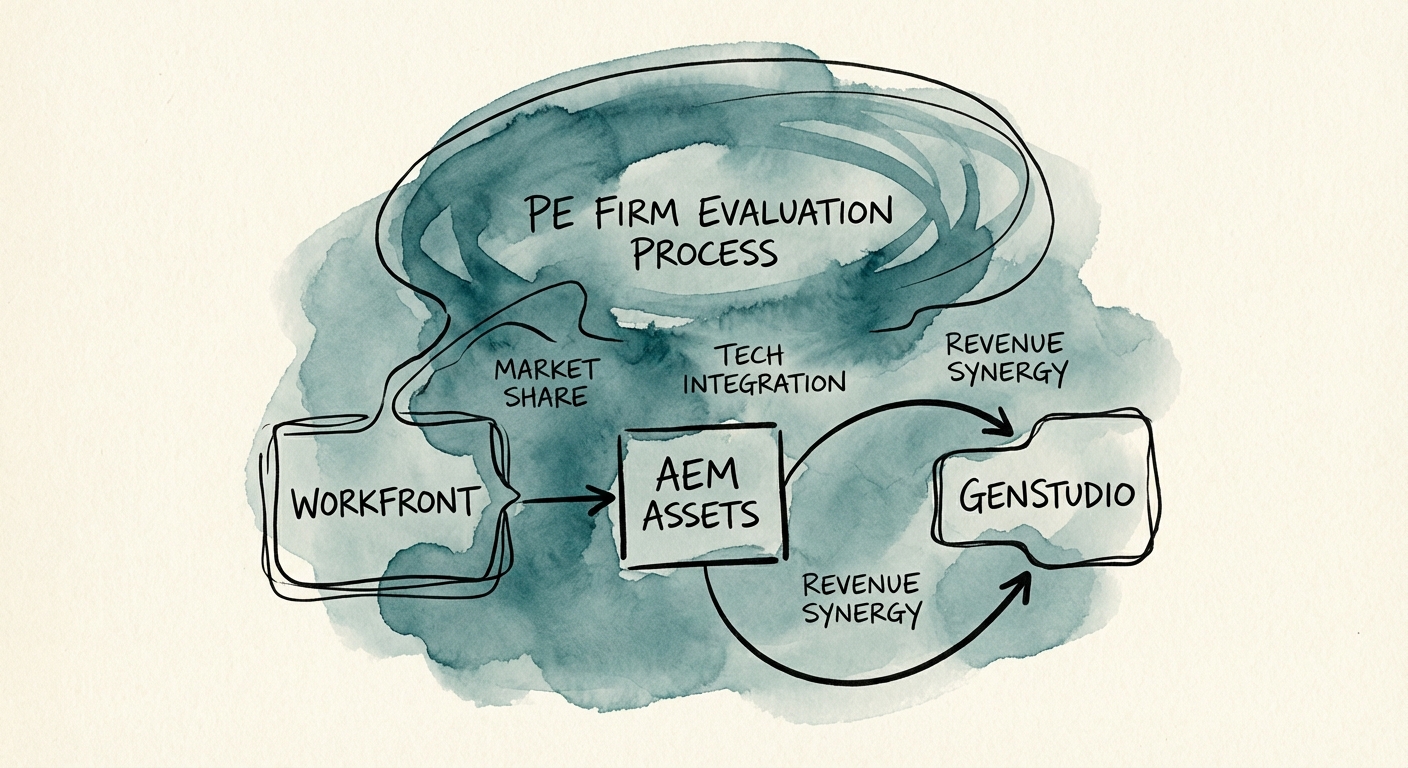
PE buyers are scrutinizing the 'GenAI Readiness' of Adobe partners. This isn't about using AI tools; it's about implementing the governance, workflow, and data structures that allow Global 2000 companies to use AI safely. A partner that merely resells Adobe licenses or provides staff augmentation for creative work is seen as a commodity. A partner that implements Workfront connected to AEM Assets and Firefly is seen as a strategic enabler of the client's entire marketing operation.
The Specialization Moat
In Due Diligence, the first document requested is often the Adobe Partner Scorecard. Buyers are looking for 'Specializations'—not just 'Certifications.' A Specialization requires verified customer references and a critical mass of certified staff. Red flags in technology due diligence often appear here: if a firm claims 'Gold' status but lacks the underlying Specializations in high-growth areas like Adobe Journey Optimizer (AJO) or Customer Journey Analytics (CJA), the multiple collapses. We see firms with 'Generalist' AEM practices trading at a 4-turn discount compared to those with proven AEP expertise.
The Revenue Quality Diagnostic
Beyond technical badges, PE firms are conducting a forensic audit of revenue quality. The 'Project Trap' is the most common deal-killer for Adobe partners. If 80% of your revenue resets every January 1st because it is tied to discrete implementations or creative campaigns, you are a risky asset. Premium multiples are reserved for firms that have successfully transitioned to Managed Services (AMS) and long-term data orchestration contracts.
Buyers differentiate between 'Break/Fix' support (low value) and 'Optimization' retainers (high value). High-value AMS involves continuous tuning of the personalization algorithms within Adobe Target and AEP. This revenue is sticky, high-margin, and defensible. In contrast, pure-play implementation revenue is often subjected to rigorous Quality of Earnings (QofE) adjustments, stripping out one-time 'mega-projects' that distort the growth narrative.
The Talent Density Metric
Finally, buyers evaluate Talent Density. In the Adobe ecosystem, the ratio of 'Architects' to 'Developers' is a proxy for sophistication. A high ratio of junior developers suggests a 'Body Shop' model, vulnerable to offshore price pressure. A high ratio of Adobe Certified Architects implies a consultative, high-value model. Furthermore, reliance on contractors for core delivery is a massive valuation haircut. PE firms want to acquire a cohesive, retentive culture, not a rolodex of freelancers. For a deeper dive into how talent impacts valuation, see our guide on The Human Capital Audit.