
The practical answer
- Short answer
- A diligence read for PE buyers acquiring Google Cloud Partners: the $7.05 service-attach test, BigQuery consumption padding, and what Vertex AI debt actually costs post-close.
- Best fit
- Industry: Private Equity / Technology. Function: M&A Strategy
- Operating path
- Exit Readiness → Operational Excellence → Transaction Advisory Services
- Key metric
- $7.05 Amount of services revenue elite partners generate for every $1 of Google Cloud consumption sold (2025).
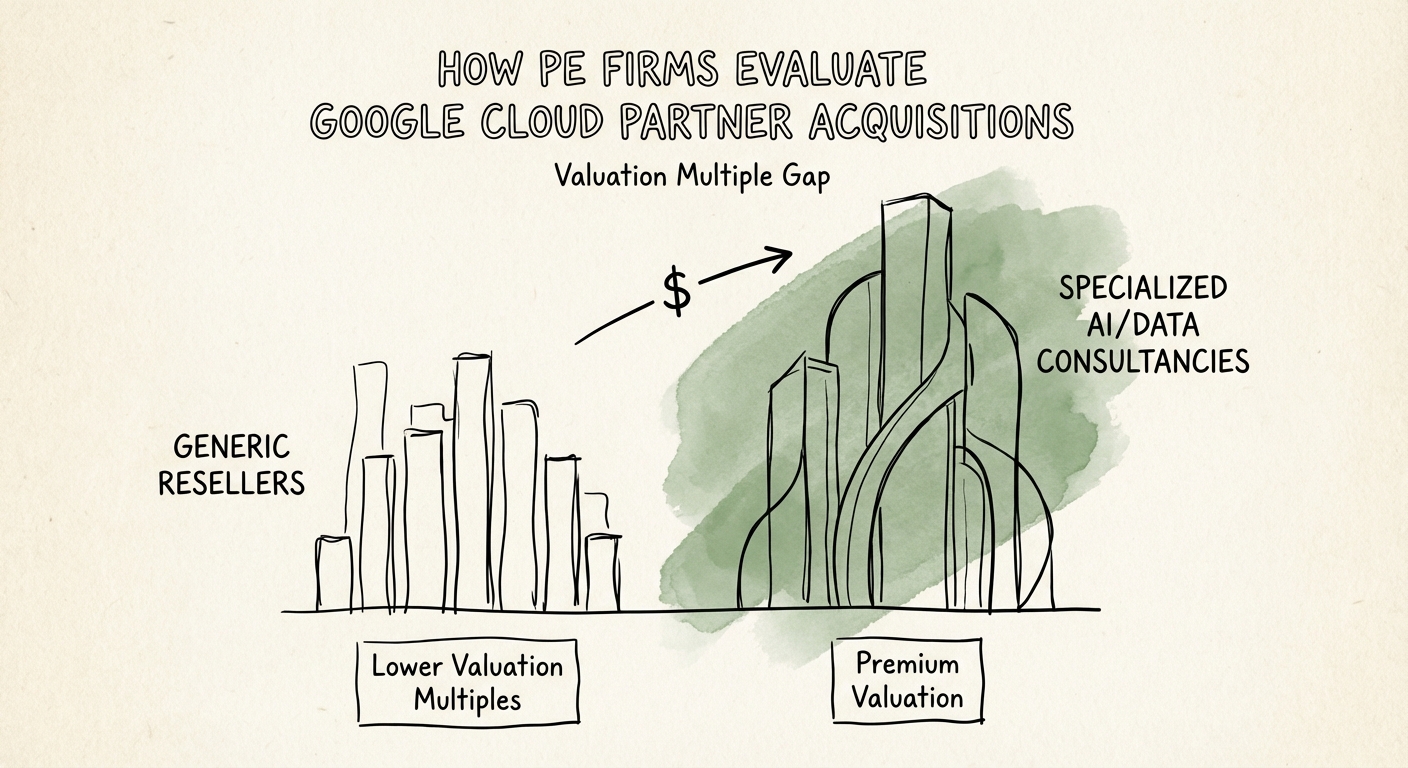
Put two Google Cloud Partners side by side. Both have the badge. Both have a slide deck full of the same Google product names — BigQuery, Vertex AI, Gemini. Both book around $30M in top-line revenue. One sells for 4x EBITDA. The other clears 11x. The badge tells you nothing. The shape of the revenue underneath it tells you everything.
The split isn't about size — it's about what the partner actually does once Google's product is sold. The reseller takes a commission for moving licenses and consumption, then steps back. The build-and-operate partner sells the consumption and wraps it in implementation, optimization, and ongoing management — work that compounds and locks in the client. Canalys's ecosystem work put a hard number on the gap: top-tier partners now generate roughly $7.05 in their own services revenue for every $1 of Google Cloud consumption they sell (Canalys & Google Cloud, Partner Ecosystem Multiplier Study, 2025). That ratio is the single fastest read on which partner you're standing in front of.
So before you open the data room, ask the question that reorders the whole deal: of every dollar of Google Cloud consumption this partner influenced last year, how many dollars of their own services did it pull through? If the answer rounds to $1 or less, you're looking at a license desk that learned to say "Vertex AI" in sales calls. If it's pushing $5, $6, $7, you're looking at a services engine — and the spread between those two outcomes is the spread between a small add-on and a platform you can build a portfolio around.
The agentic line item everyone is mispricing
The 2026 buyer's trap is the "AI practice." Every partner now has one on the org chart. The distinction worth diligence: is it productized, or is it staffing? A genuine agentic capability — a repeatable framework that deploys, say, a finance-reconciliation agent or a tier-one support agent on top of Gemini and Vertex AI, with the orchestration and guardrails packaged — earns SaaS-adjacent economics because it's reusable across clients. A team of engineers billing hourly to hand-wire one-off Gemini prompts for whoever asks is staff augmentation in a nicer font. The first compounds. The second walks out the door at the next comp cycle. Verify which one you're buying by asking to see the second deployment of the same agent — if every "AI engagement" is bespoke, there is no IP, just headcount.
]]>A Google Cloud partner that books resale margin as "cloud revenue" isn't a tech company. It's a low-margin lender that happens to log into the Google Cloud console.
The most dangerous number in a Google Cloud Partner's financials is the one labeled "cloud revenue." It is where resale pass-through hides. A partner reporting $50M can be sitting on $45M of consumption it merely brokered and $5M of work it actually performed. That's not a $50M business carrying a small services arm — it's a $5M services business carrying a $45M liability portfolio of margin-thin commitments it has to keep selling forever just to stand still.
The fix is to refuse the blended line and split every dollar into what the partner resold, what it built, and what it operates — the same discipline we apply in a revenue quality audit. Each bucket prices differently:
- Resell — the commission floor. License and consumption pass-through with commercial management on top. Low margin, high churn, almost no defensibility. In the multiplier model this is a thin slice of the real value at stake. When it dominates gross profit, the multiple has to come down to meet it — you're underwriting a sales motion, not a technology asset.
- Build — where the $7.05 actually lives. Specialized implementation in Generative AI and data: standing up Vertex AI, modeling in BigQuery, wiring Gemini into real workflows. The asset to hunt for here is the accelerator — pre-built code libraries and reference architectures that shorten a BigQuery or Vertex deployment from twelve weeks to four. Accelerators turn labor into margin and make the next engagement faster than the last. One-off custom code does neither; it just rents you the engineers' calendars.
- Manage — the anchor you pay up for. True managed services: ongoing cost optimization, security posture, model tuning and retraining under contract. This is the recurring, multi-year revenue PE actually wants. Set a floor — a healthy target draws a meaningful share of gross profit from multi-year managed agreements, not from time-and-materials support tickets dressed up as "managed."
Run the split and the valuation almost writes itself. Top-line parity between two partners means nothing once you see one is 80% resell and the other is 60% build-and-manage. The aggregate "MSP" multiple ranges that get quoted in the market — see Aventis Advisors, MSP Valuation Multiples, 2025 and the deal data in Solganick's Google Cloud Partners M&A Snapshot (2024) — only make sense once you know which bucket the revenue came from. The number on the tin is an average of businesses that should never be averaged together.
]]>
Financial diligence tells you what the partner booked. Technical diligence tells you whether they can keep it. In the Google Cloud world, the recurring revenue you're paying a premium for can be quietly undermined by how the work was actually built — hidden technical debt that doesn't show up until a client tries to scale and can't. Three things are worth sending an engineer in to verify before you sign:
- Vertex AI models with no MLOps under them. Ask whether the partner's AI deployments run on managed pipelines (Vertex AI Pipelines, Kubeflow) or on hand-run notebooks that one engineer babysits. Notebook-and-prayer deployments aren't recurring revenue — they're a maintenance time bomb that detonates the first time the model drifts and there's no retraining pipeline to catch it. The "managed AI" contract is only worth its multiple if there's machinery keeping the models alive.
- BigQuery built to bill, not to govern. Look at how data lands in BigQuery. A partner that imposed real governance — partitioning, slot management, query cost controls — built something durable. A partner that dumped raw data in to maximize the client's consumption (and its own resale commission) built a cost-shock waiting to land at renewal. When the client's monthly bill triples and nobody can explain why, they churn, and the recurring revenue you underwrote churns with them.
- Identity stitched in afterward. Check whether deployments follow Google's zero-trust posture (BeyondCorp, IAM least-privilege, VPC Service Controls) or whether security was bolted on in the rush to go live. Shortcuts here don't surface in a P&L — they surface as a remediation invoice you inherit on day one, on every client estate the partner ever touched.
None of this is exotic. It's the difference between a partner whose client deployments hold up under growth and one whose "managed" book quietly leaks at every renewal. For how these reads translate into the price you actually pay, see our analysis of IT services M&A valuation and deal-structure trends. The partners worth 11x in 2026 are the ones who can speak fluent EBITDA and fluent Vertex AI — and prove the second one inside their own client estate, not just on a slide.
]]>