
The practical answer
- Short answer
- Analysis of Palo Alto Networks partner valuation multiples. Why 'Diamond' MSSPs trade at 12x EBITDA while 'Innovator' resellers stall at 6x.
- Best fit
- Industry: Cybersecurity. Function: Partnerships
- Operating path
- Exit Readiness → Operational Excellence → Transaction Advisory Services
- Key metric
- 12x EBITDA multiple for specialized Diamond MSSPs, compared to 6x for generalist Innovator resellers.
The "NextWave" Valuation Bifurcation
For over a decade, the path to profitability for Palo Alto Networks partners was linear: sell more firewalls, get better discounts, increase margin. That era is dead. The 2024-2025 evolution of the NextWave Partner Program has structurally bifurcated the market, creating a massive valuation gap between partners who merely transact and those who have adopted the "Platformization" strategy.
Our analysis of recent M&A activity in the cybersecurity services sector reveals a stark reality: Innovator-level partners focused on hardware resale are trading at 5x-6x EBITDA, while Diamond-level partners with robust MSSP (Managed Security Service Provider) practices are commanding 10x-12x multiples. This isn't just about revenue scale; it's about revenue quality. Private equity buyers have priced in the commoditization of hardware resale. They know that in a world of SASE (Secure Access Service Edge) and XDR (Extended Detection and Response), the value lies in the management of the security posture, not the shipping of the box.
The "NextWave" program's recent mandate requiring Diamond Innovators to hold the Certified Professional Services Partner (CPSP) specialization is a leading indicator of this shift. It forces a distinction between certification-only partners—partners who have certifications but no delivery capability—and true consulting firms. For a founder leading a $20M cyber consultancy, the message is clear: if your growth strategy is built on volume rebates rather than intellectual property and managed services, your exit valuation has already hit its ceiling.
In 2026, the market doesn't pay for volume. It pays for the 'Day 2' capability. If you can't manage the policy, monitor the threat, and remediate the breach, you are just a logistics company with a security badge.
The $10M to $50M Chasm: Specialization as a Moat
Scaling from $10M to $50M in the Palo Alto Networks ecosystem requires a fundamental business model pivot. At $10M, many partners are still heavily reliant on "hero architects"—founders or early hires who can deploy complex Strata firewalls in their sleep. This model is unscalable and, in the eyes of an acquirer, risky. To bridge the gap to $50M and unlock "Platinum" or "Diamond" valuation premiums, firms must operationalize specialization.
The "Three-Pillar" Requirement
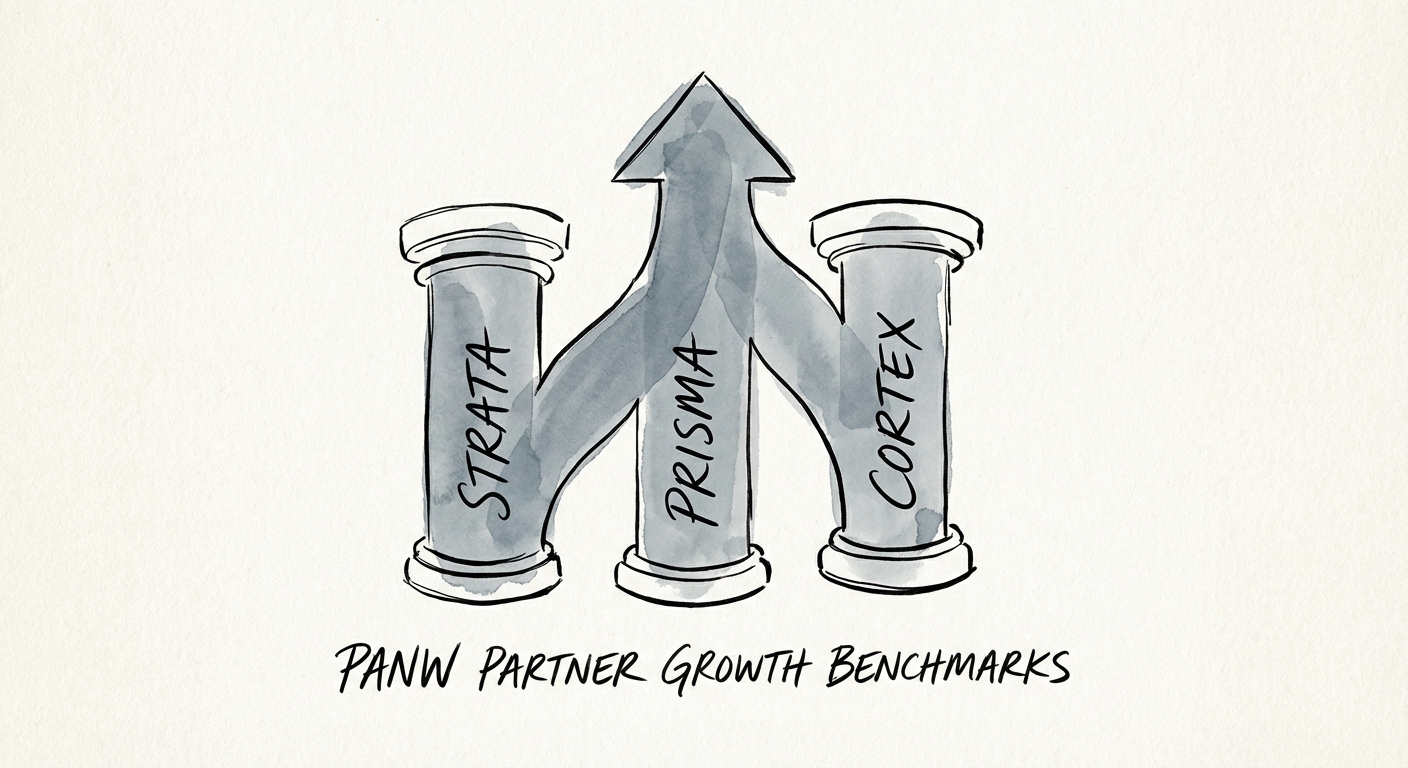
To command a premium multiple, a partner must demonstrate competency across the three pillars of PANW's platform: Strata (Network), Prisma (Cloud), and Cortex (SecOps). Acquirers are specifically discounting firms that are "single-pillar" shops (e.g., only doing firewall refresh). Data shows that partners with active practices in all three pillars see a 22% higher retention rate and significantly higher Lifetime Value (LTV) per customer. This "stickiness" is what drives the multiple expansion from 6x to 10x.
The CPSP Valuation Lift
The requirement for Diamond partners to build managed services and professional services capabilities underscores the importance of service delivery. Achieving CPSP status isn't just a compliance hoop; it validates your firm's ability to deliver high-margin professional services independent of vendor support. In due diligence, we see a direct correlation: partners with CPSP status consistently pass Quality of Earnings (QofE) audits with fewer adjustments, as their revenue is tied to delivered expertise rather than pass-through hardware costs.
The Diamond MSSP Exit: Unlocking 12x EBITDA
The holy grail of the Palo Alto Networks ecosystem is the specialized MSSP. This is where the "Cybersecurity Premium" truly kicks in. While a traditional VAR (Value Added Reseller) might struggle to find a buyer at 6x EBITDA, an MSSP that wraps Cortex XDR or Prisma SASE into a monthly recurring revenue (MRR) offering serves as a prime target for PE platform acquisitions.
Why the premium? Because these partners have solved the "Day 2" problem. They don't just sell the tool; they operate it. They provide the 24/7 SOC (Security Operations Center) monitoring that mid-market enterprises cannot staff themselves. This shifts the revenue mix from 80% non-recurring (hardware/projects) to 50%+ recurring (managed services), a ratio that MSP Valuation Factors confirm is the primary driver of double-digit multiples.
Benchmarks for "Exit-Ready" Diamond Partners
To position for a premium exit, your metrics must align with the top decile of the ecosystem:
- Revenue Mix: >40% Managed Services / <30% Hardware Resale.
- Net Revenue Retention (NRR): >110% (driven by cross-selling Prisma/Cortex into the Strata base).
- Technical Leverage: Ratio of Engineers to Revenue should demonstrate scalability, not just headcount growth.
The partners achieving these benchmarks aren't just "selling Palo Alto Networks"; they are building a proprietary security outcome powered by Palo Alto Networks. That distinction is worth millions in enterprise value.