
The practical answer
- Short answer
- Why generic Palo Alto Networks resellers trade at 4x EBITDA while Cortex and Prisma specialists command 14x. An exit readiness guide for NextWave partners.
- Best fit
- Industry: Cybersecurity / IT Services. Function: M&A / Strategy
- Operating path
- Exit Readiness → Operational Excellence → Transaction Advisory Services
- Key metric
- 35% Average valuation discount applied to partners with >40% hardware revenue mix.
The Hardware Valuation Trap: Why Hardware Resellers Are Hard to Sell
For over a decade, the path to a comfortable exit for a Palo Alto Networks partner was simple: achieve Platinum status, maximize firewall throughput, and ride the renewal wave. In 2026, that playbook is not just obsolete; it is a liability. Private equity buyers have bifurcated the market with brutal efficiency. On one side are the Transactionalist Resellers, trading at 4x-6x EBITDA, treated essentially as low-margin logistics businesses. On the other are Platform Specialists, commanding 12x-14x multiples by wrapping intellectual property and managed services around the software stack.
The root cause of this divergence is the commoditization of the perimeter. While Palo Alto Networks continues to lead in hardware firewalls, the value has shifted entirely to the cloud and the SOC (Security Operations Center). Buyers view hardware-heavy revenue (Hardware > 40% of mix) as low-quality, non-recurring, and defenseless against direct-to-consumer shifts. If your P&L is dominated by hardware margins and one-off professional services for installation, you are not building an asset; you are building a job.
Our analysis of 2025 cybersecurity service transactions shows a clear penalty for partners lacking a "Next-Gen Security" (NGS) narrative. Firms that failed to pivot from "firewall deployment" to "security posture management" saw LOIs re-traded down by an average of 35% during quality of earnings (QofE) due to lack of recurring revenue stickiness. As noted in our analysis of MSP vs. Consultancy valuations, the market pays for the continuity of the security outcome, not the installation of the appliance.
We are at the point in our growth where partnerships are going to be even more critical... specifically around next-generation offerings such as Prisma SASE, Cortex XSIAM and Cortex Cloud.
The Specialization Premium: Cortex, Prisma, and the 'Platformization' Multiplier
The partners commanding 14x multiples in 2026 are those who have aligned with Palo Alto Networks' "Platformization" strategy—specifically within the Cortex (SecOps) and Prisma (Cloud Security) portfolios. These partners are not selling products; they are selling specialized security outcomes that require high-margin expertise to design, implement, and manage.
The Cortex XSIAM Arbitrage
The most aggressive valuation premiums currently sit with partners specializing in Cortex XSIAM (Extended Security Intelligence & Automation Management). Because XSIAM aims to replace the traditional SIEM, partners who build managed detection and response (MDR) services on top of it are effectively building "stickiness" that hardware resellers cannot replicate. Buyers pay a premium for this because it represents embedded IP—proprietary playbooks, automation rules, and threat hunting workflows that make the service non-transferable.
Data from 2025 M&A activity suggests that partners with a NextWave Cortex XSIAM Specialization and at least $2M in ARR attached to managed SOC services are trading at a 4-turn EBITDA premium over generalist security peers. This mirrors the trend we see in security due diligence, where buyers are desperate for assets that can demonstrate automated, AI-driven defense capabilities rather than labor-intensive monitoring.
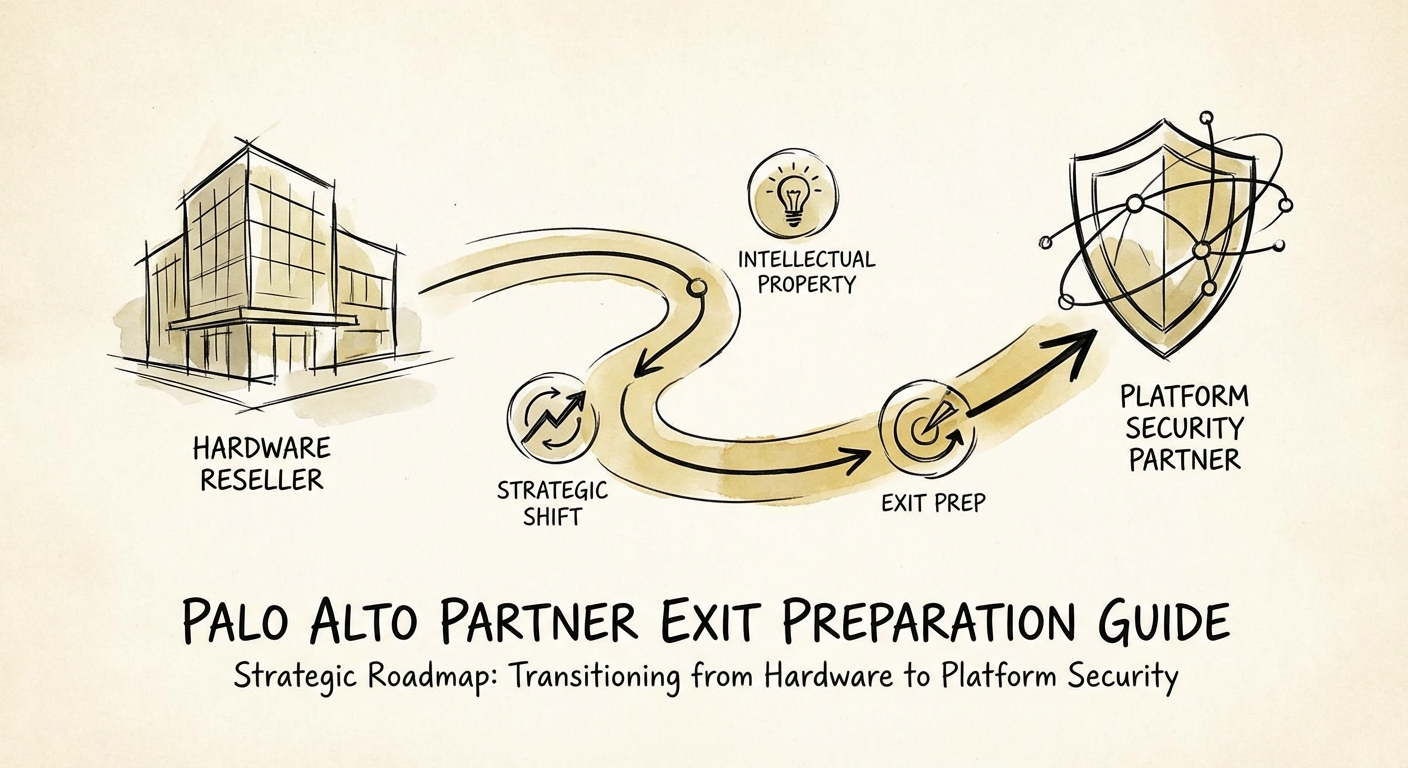
The 18-Month Exit Roadmap: Pivoting to Premium
If you are planning an exit in late 2026 or 2027, you must radically alter your revenue mix today. The goal is to shift your "Revenue Quality" from transactional to recurring, and from generalist to specialist. This is not a marketing exercise; it is an operational overhaul.
Phase 1: The Hardware Purge (Months 1-6)
Stop incentivizing hardware-only deals. Restructure sales compensation to penalize "box-only" transactions and double-weight NGS (Next-Gen Security) ARR. Your goal is to drive hardware revenue below 20% of total revenue. Hardware should be the wedge, not the meal.
Phase 2: The IP Wrapper (Months 6-12)
Select one ecosystem anchor—either Prisma Cloud or Cortex—and build a proprietary service layer. This could be a "Cloud Compliance Dashboard" built on Prisma APIs or a library of industry-specific XSOAR playbooks for Cortex. This IP converts "hours for dollars" revenue into "license" revenue in the eyes of a buyer.
Phase 3: The Certification Moat (Months 12-18)
Achieve the highest level of specialization in your chosen niche. A generic "Platinum" status is table stakes. A "Cortex XMDR" specialization or similar advanced designation serves as a third-party validation of your differentiated value. When you go to market, you want to position yourself not as a "Palo Alto Partner," but as a "leading Cloud Security Platform powered by Palo Alto Networks."