The practical answer
- Short answer
- 2025 analysis of Microsoft Dynamics partner valuations. Learn why some partners trade at 6x EBITDA while others command 12x, and how to engineer your multiple.
- Best fit
- Industry: IT Services & Software. Function: M&A / Strategy
- Operating path
- Exit Readiness → Operational Excellence → Transaction Advisory Services
- Key metric
- 12.4x Average EBITDA multiple for Dynamics partners with >40% IP revenue and <10% churn.
The 2025 Valuation Rift: Body Shops vs. Platforms
In 2025, the Microsoft Dynamics ecosystem is experiencing a violent bifurcation in valuation multiples. We are no longer seeing a bell curve where most partners trade around 7-8x EBITDA. Instead, we are seeing a twin-peak distribution that punishes generalists and rewards specialists.
On one side, you have the Implementation Generalists. These are the traditional VARs and Systems Integrators (SIs) running on a project-based revenue model. They are trading at 4x to 6x EBITDA. Why? Because Private Equity buyers have realized that these businesses are essentially "staff augmentation with a Microsoft badge." They have zero leverage, high key-person risk, and revenue that resets to zero every January 1st.
On the other side, you have the Vertical Platforms. These are partners who have built industry-specific IP (Intellectual Property) on top of Dynamics 365 or Business Central, coupled with high-margin managed services. They are trading at 10x to 15x EBITDA. These firms don't just sell hours; they sell outcomes and compliance. They command high Net Revenue Retention (NRR) because their clients are sticky, and their margins are defensible against wage inflation.
The "AI Premium" is Real but Specific
Everyone claims to be an "AI Partner" in 2025, but buyers are discerning. Simply reselling Copilot licenses gets you nowhere. The premium multiples are going to partners who have operationalized AI into their delivery model—reducing their own Cost of Goods Sold (COGS)—or who have built proprietary AI agents that solve specific vertical problems (e.g., "Automated FDA Compliance for Pharma Manufacturers"). If your AI strategy is just a slide in your pitch deck, it’s worth 0x. If it’s driving 20% margin expansion in your delivery org, it’s worth 2 turns of EBITDA.
Your EBITDA is a lie if it relies on the founder working 80 hours a week and your best architect never taking a vacation. Buyers aren't buying your heroics; they are buying your systems.
The Quality of Earnings Trap: Why 60% of LOIs Get Retraded
As an Operating Partner, you know that the Letter of Intent (LOI) value is a vanity metric. The closing value is what matters. In the Dynamics space, the gap between the two is widening due to Quality of Earnings (QofE) failures. Buyers in 2025 are aggressively normalizing EBITDA, and the most common "add-backs" are being rejected.
The Three Revenue Streams Buyers Are Discounting
- One-Time Implementation Spikes: If 40% of your 2024 growth came from two massive ERP migrations that won't repeat, buyers will strip that out of your run-rate EBITDA. They are valuing predictable cash flow, not lucky years.
- "Pass-Through" License Margin: We are seeing buyers cap the valuation credit for CSP (Cloud Solution Provider) margin. While recurring, it’s low-margin (single digits) and arguably belongs to Microsoft, not you. If 30% of your gross profit is pure license resale, expect a blended multiple compression.
- Founder-Led Sales: If the CEO is the only one who can close a $500k Business Central deal, that revenue is discounted. This is a classic key-person dependency risk. Buyers are modeling the cost of hiring two enterprise AEs to replace the founder, which often wipes out $600k of EBITDA instantly.
The Metric That Matters: Services Gross Margin
High-performing Dynamics partners run Services Gross Margins of 55%+. If you are running at 35%, you aren't a consulting firm; you're a staffing agency. Low margins indicate you haven't productized your IP or standardized your delivery. In due diligence, we see this as a "technical debt" of the P&L that requires massive investment to fix.
Engineering the Exit: How to Move from 6x to 12x
You cannot talk your way into a higher multiple. You must engineer it. If you are a Dynamics partner looking to exit in the next 18-24 months, or a PE sponsor looking to maximize a portfolio exit, you need a value creation plan focused on three levers.
1. Verticalize or Die
Generalist partners are commodities. To command a premium, you must own a niche. This doesn't mean "Manufacturing"; it means "Discrete Manufacturing for Aerospace Defense Contractors." Buyers pay for the moat. Show that your CAC (Customer Acquisition Cost) is 40% lower than the industry average because you own the referrals in a specific sub-vertical.
2. Convert Projects to Managed Services
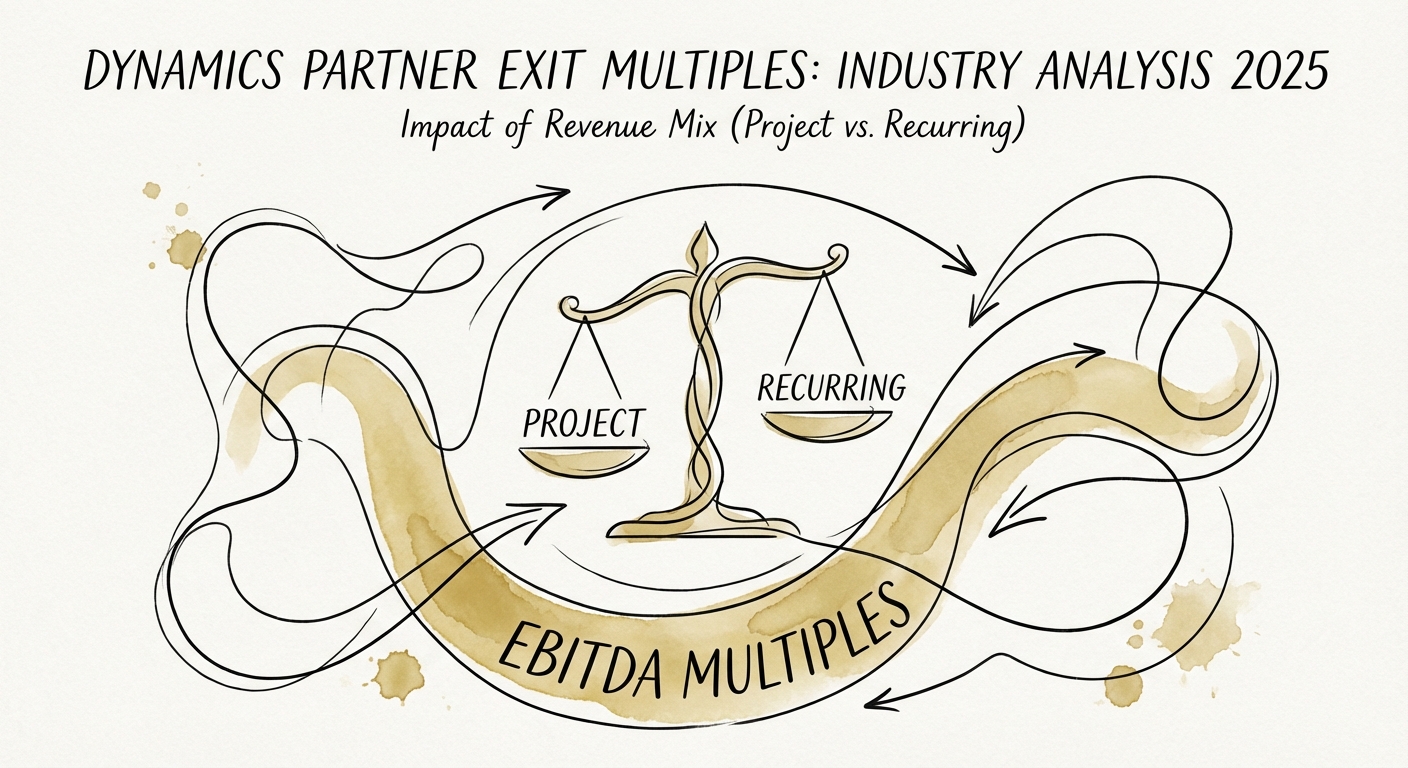
Stop selling "support buckets." Start selling "outcomes." Shift your revenue mix from 80% Project / 20% Recurring to 50/50. This requires packaging your IP and support into a monthly subscription that clients cannot turn off. See our guide on Managed Services valuation margins for the math on why this doubles your enterprise value.
3. Document the "Secret Sauce"
Tribal knowledge is a valuation killer. If your "unique methodology" exists only in the heads of your three best architects, it’s not an asset; it’s a liability. You need documented SOPs, automated workflows, and a delivery model that allows a mid-level consultant to deliver senior-level results. This is what we call "Transferable Value," and it is the single biggest factor in defending your multiple during diligence.