The practical answer
- Short answer
- Merging two B2B software support teams? The "Follow-the-Sun" promise and tier collision drive a 30% attrition spike. Here's the org design that prevents it.
- Best fit
- Industry: B2B Software. Function: Customer Support
- Operating path
- Migration & Integration → Turnaround & Restructuring → Transaction Advisory Services
- Key metric
- 30% The post-merger customer attrition rate when support experiences degrade (Satrix Solutions).
The synergy line that's really a churn line
Six months after the close, the deal model still shows the support synergy hitting plan. Headcount is down, two Zendesk instances became one, the tooling line item shrank exactly as forecast. And yet net revenue retention on the acquired book is sliding, and nobody on the integration call can fully explain why. The honeymoon ended quietly, ticket by ticket.
Here's the mechanism nobody modeled. In B2B software M&A, the most seductive support synergy is "Follow-the-Sun" — acquire a team in another time zone and you get 24/7 coverage for free. The slide says the acquired agents will handle Tier 1 for your product, and yours will cover theirs, inside 90 days. But you combined two support orgs without combining their knowledge bases, their tribal shortcuts, or the specific way each product breaks at 2 a.m. So you now have agents fielding tickets for software they have never opened. First contact resolution craters. That collapse is a primary engine behind the 20-30% customer attrition spike that shows up after integration.
And the cost doesn't stay inside the support P&L. When agents can't resolve, they escalate — and the escalation path runs straight into the engineering team you were counting on to ship the combined roadmap. Engineers start firefighting basic config questions. That's the part the synergy case never captures: a support shortfall that gets paid for in delayed releases. You "saved" eight support seats and quietly taxed twenty engineers.
When you force a White Glove customer base into a ticket queue without a transition plan, you aren't integrating them — you're evicting them, and they'll thank you for it by renewing with your competitor.
White Glove meets Factory Floor — and loses
The quieter killer is a culture collision dressed up as a process question. Picture a high-volume platform — strict SLAs, tiered queues, self-service docs do the heavy lifting — acquiring a smaller, high-ACV specialist where every customer has the personal cell number of a senior support engineer named Dave. The acquirer runs a factory floor. The target runs a concierge. Both work. They do not merge.
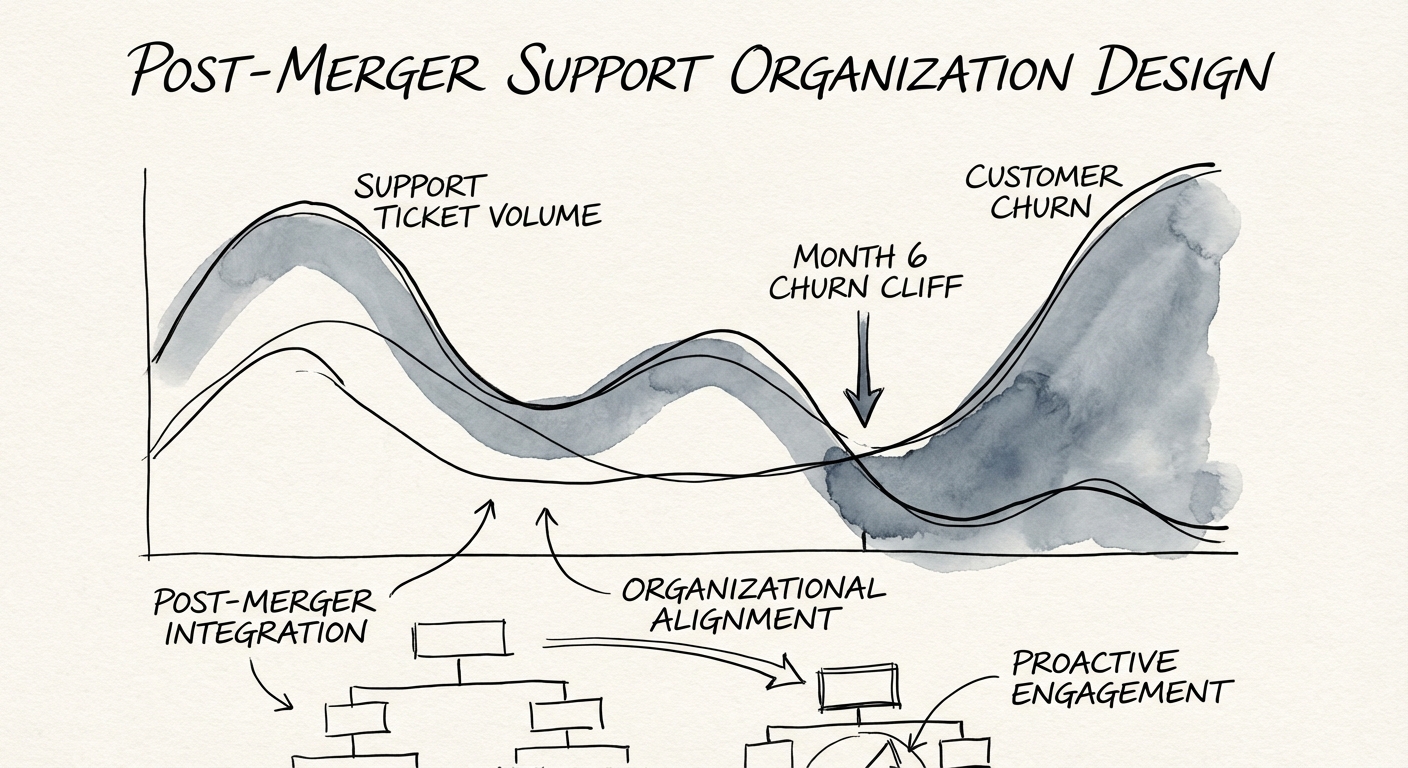
The day you route the acquired customers into the tiered queue, here is what they experience: the relationship they were actually paying for disappears. Yesterday they emailed Dave and had an answer in twenty minutes. Today they are ticket #49201, behind an SLA clock that promises a response in two business days. Nothing in your dashboard flags this as a problem — the SLA is being met. But the customer's perceived value just dropped by half, and they are now reading their competitor's pricing page. This is the human reason churn so often spikes around month six: that's when the integration's operational reality finally reaches the desk of the person who has to renew.
Why the cost-synergy math inverts
PE sponsors routinely underwrite 6-18% cost synergies from consolidating support tools and headcount. The trap is sequencing: if you merge the tools before you've reconciled the service models, churn on the acquired book will eat the savings and then some. Lose a single seven-figure logo because it got demoted from concierge to queue, and you've spent the entire tooling synergy on one renewal you didn't have to lose. The fix isn't to keep two systems forever — it's to build a named Premium tier (with a price attached) to house the high-expectation customers before you dismantle the model they bought.
The first 90 days, run differently
Most integration plans treat support as a tooling migration: pick one help desk, map the fields, cut over. That's the visible 20% of the work. The org-design decisions below are what actually hold the revenue. Deloitte's integration research keeps landing on the same point — the soft, people-and-process side is where deals quietly miss. Three moves matter more than the tool choice.
Pick one Head of Support by Day 30, not Day 90
The instinct to keep both legacy leaders "to preserve culture" creates two principalities with different severity definitions, different escalation paths, and different ideas of what "urgent" means. Every week you wait, the two orgs harden their own way of working and the eventual merge gets more violent. Name one owner early, give the other a defined and respected role, and let one definition of the support operation take hold while it's still soft.
Reconcile "Sev 1" before you touch the data
If the acquirer calls a single-user outage a Sev 3 and the target calls it a Sev 1, your blended SLA reporting is fiction for a year — and you won't know which fires are real. Before any ticket data moves, get both teams in a room and write one severity matrix with worked examples: this exact symptom is a Sev 1, this one isn't. It's an unglamorous afternoon that prevents twelve months of arguing about numbers that don't mean the same thing.
Build the Premium lifeboat first
Rank the acquired customers by revenue and take the top decile out of the general queue entirely. Stand up a small transitional pod staffed by their existing contacts — yes, keep Dave reachable on purpose. This protects the ARR while the broader org stabilizes, and it buys you the runway to do the real integration calmly. In Year 2 you can productize it as a paid Premium tier or phase it down. In Year 1 it is the cheapest churn insurance you will ever buy. Monday move: pull the renewal dates and ACV for the acquired book, flag every account renewing in the next two quarters, and decide today which ones go in the lifeboat — before the queue decides for you.