
The practical answer
- Short answer
- A private SaaS firm at $20M-$100M ARR should pay $150K-$250K for an audit. Here's why founders overpay by 40%, and the close-cycle moves that recover it.
- Best fit
- Industry: B2B SaaS. Function: Finance
- Operating path
- Financial Infrastructure → Commercial Performance → Valuations
- Key metric
- 30% Potential reduction in audit fees achievable by automating ASC 606 revenue recognition.
The number on your engagement letter is a confession
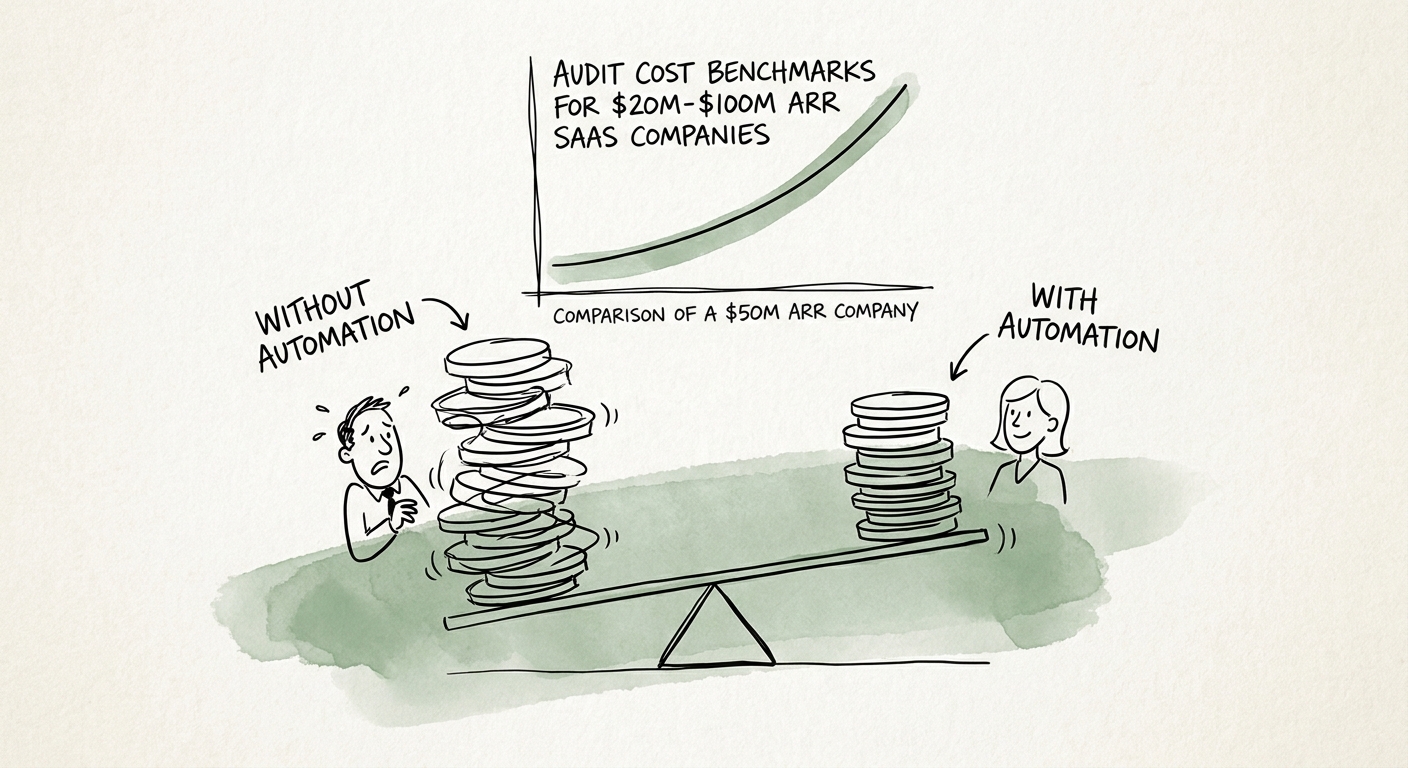
A private SaaS company between $20M and $100M ARR should pay somewhere between $150,000 and $250,000 for a clean financial audit. So when I see a $60M ARR enterprise software firm get quoted $350,000 for what should be a routine engagement, I do not assume the audit partner is greedy. I assume the partner read the room. They saw something in the data room that told them this was going to be a slog, and they priced the slog.
Here is the part founders miss: the base audit rate barely moved. The CPA Practice Advisor pegged the average increase at 6.4% last year. That 6.4% is not what blows up your bill. What blows it up is the surcharge for chaos. Crossing $20M ARR means you are no longer counting cash in the door. You are now carrying deferred revenue schedules, multi-year contracts with bespoke opt-out clauses, capitalized software development costs, and stock-based comp under ASC 718. Each of those is a place an auditor can either tie out a number in ten minutes or spend three days reconstructing it from a spreadsheet that three people have edited.
I have rebuilt a finance function from the studs three separate times. In that $60M ARR case, the auditors took one look at the manual revenue-recognition workbook and quietly staffed three extra associates to vouch invoices and trace journal entries by hand. That labor does not go away. It gets passed straight to your P&L. We installed an automated rev-rec engine and clean data pipelines before the auditors sent their first Provided-by-Client list, and the quote came down $120,000. Same company, same auditor, same standards. The only thing that changed was how long it took them to trust our numbers.
An audit fee is a mirror. When the partner pads it by 40 percent, they are not gouging you, they are pricing the time it takes to clean up after your finance team.
ASC 606 is where 60% of the fieldwork hours go to die
If your team still amortizes implementation fees, handles upgrades and downgrades, and recognizes subscription revenue inside Excel, your auditor will charge a premium to re-verify every calculation themselves. They have no choice. A spreadsheet has no audit trail, so the testable population is "all of it." As the team at OnlyCFO has noted, a public SaaS company near $140M can burn millions on compliance, while a private company of similar scale running pristine systems can keep Big 4 fees capped around $300,000. The delta between those two worlds is not size. It is operations.
Picture the contract that triggers it. A rep closes a three-year deal, throws in the first three months free, and bundles a custom implementation package to get the signature. Great quarter. But now you have multiple distinct performance obligations, a discount to allocate across them, and a recognition schedule that does not match the invoice schedule. If you never wrote the policy and never automated the schedule, the auditor cannot rely on your controls, so they expand the sample. That expansion is the literal mechanism behind the revenue recognition trap: every undocumented modification multiplies the contracts they have to pull and test by hand.
The fee is the cheap consequence. The expensive one shows up at exit. When a private equity buyer runs diligence, they open the same workbooks your auditor did. If the audit required dozens of adjusting journal entries just to land your financials in GAAP, the buyer reads that as a signal that your reported ARR is soft. They will commission a Quality of Earnings report and use every adjustment they find to chip at your revenue quality, which compresses the multiple applied to the most valuable number on your cap table.
You don't negotiate the rate. You shrink the sample.
You will never argue an audit partner down on their hourly rate, and you should stop trying. You lower the fee by shrinking the testing they are required to perform and removing their reliance on manual substantive procedures. Three moves do that, and none of them happen during the audit. They happen in the eleven months before it.
First, compress your close. The Manufacturers Alliance benchmarks on audit costs show that organizations leaning on manual reconciliations watch their billed fees diverge wildly from the original quote, because every manual step is a place the auditor has to re-perform. Going from a 15-day close to a 5-day close is not a vanity metric. It forces automated reconciliations and hard cut-off policies, which is exactly the discipline that lets you understand why your financial close takes too long and fix it. By the time fieldwork starts, the trial balance is locked and the variance analysis is already written.
Second, kill the Provided-by-Client list as an event. Your controller should run an always-on audit room where every enterprise contract, cap-table update, capitalized-software memo, and board minute is digitized and referenced before anyone asks. When the auditor requests the ASC 718 stock-comp calculation and gets a system-generated report instead of a workbook with manual overrides, you have just bought trust, and trust converts directly into smaller samples and fewer billed hours.
Third, write the technical accounting memos in advance. A fractional technical accountant who documents your position on a recent acquisition or a pricing-model change costs a fraction of what an auditor bills to untangle it after the fact. Hand the partner a memo that already cites the relevant GAAP, and their role shifts from investigator to reviewer. That shift is the whole game. Between $20M and $100M ARR, deleting the mess tax is one of the highest-ROI things your finance function will do all year, and it is the rare improvement that pays you twice: once on the audit invoice, and again on your eventual valuation.