
The practical answer
- Short answer
- Enterprise AEs carrying 50+ accounts miss quota; the ones at 25 hit 118%. The 2026 account-count math by segment, plus the tiering that makes it work.
- Best fit
- Industry: Technology. Function: Sales
- Operating path
- GTM Execution → Commercial Performance → Performance Improvement
- Key metric
- 20-25 Optimal number of named accounts for an Enterprise Account Executive in 2026.
The number I check first in a sales diligence
When I walk into a sales-org diligence, I do not start with the forecast. I ask one operations leader to export every account assigned to every Account Executive, then sort by the date of the last meaningful, two-way interaction — not an email open, not an auto-sequence touch, an actual conversation. On a bloated team, the result is brutal and consistent: the top dozen accounts per rep are alive, and the next hundred-plus have not been touched since the day they were assigned. That dead tail is not a territory. It is a backlog the CRO is quietly counting as coverage.
Here is the mechanism that produces it. Give an AE 150 accounts and they will not work 150 accounts — there are not enough hours in a quarter to. They work the 15 logos they already recognize, run aggressive cadences at the most obvious names, and let the other 135 calcify in the CRM. The damage is not just neglect. It is that the calcified accounts get burned: a half-hearted outbound touch from a stretched rep poisons a name you could have won later with a real plan. Gartner's 2025 B2B Sales Effectiveness Benchmark puts a number on it — AEs assigned more than 100 accounts actively penetrate only 12% of them in a given fiscal year. The remaining 88% is opportunity cost wearing the costume of pipeline.
And the cost compounds at the deal level. Forrester's 2025 B2B Sales Productivity Report found that reps carrying bloated patches run 24% fewer multi-threaded engagements, which is exactly where mid-stage deals go to die — a single champion goes quiet and the whole opportunity stalls. If you want the full anatomy of that failure, we walk through it in The Multi-Threading Deficit: Why Single-Threaded Deals Die. The point for territory design is simpler: account count and thread depth are inversely linked. Every account you add to a rep's list quietly subtracts a stakeholder from the deals they should be deepening.
Pull up the account list and sort by last meaningful activity. The accounts nobody has touched in 90 days aren't a territory — they're a write-off your CRO is calling pipeline.
The actual account counts, by segment
The old planning default — 100 to 150 accounts for a mid-market AE — was set when a B2B deal had three people on the buying committee and a polished cold email could carry you. In 2026 the committee is five to seven people, each of whom has read three competitor comparison pages before your rep gets a meeting. You cannot run that motion across 150 names. So here are the ceilings I actually implement when I rebuild a patch, with the math behind each.
Enterprise (ACV above $150K): 20 to 25 named accounts. Not 40, not 50. McKinsey's 2026 Global B2B Go-to-Market Survey found enterprise reps under 30 named accounts hit 118% of quota, while reps over 50 accounts could not clear 70% attainment. That gap is not effort — it is arithmetic. A real enterprise account plan is a quarter-long project. Twenty-five of them is a full-time job; fifty is a to-do list nobody finishes.
Mid-market (ACV $50K to $150K): 60 to 80 accounts. Past 80, the cadences flatten into the same templated sequence for everyone, and your tailored motion turns into volume by another name. Bain's 2025 Technology Sales Operations Study found organizations that cut mid-market territory sizes by 30% improved CAC payback by 14% — deeper penetration, higher conversion, less wasted acquisition spend per closed deal.
Commercial / SMB (ACV under $50K): 120 to 150 accounts. Here velocity does more of the work, so the ceiling rises — but it is still a ceiling. Push an SMB rep to 300 accounts and you have made a quiet, expensive substitution: you are paying commissioned sales labor to do the demand-gen job marketing should be doing, and your unit economics eat the difference. Where this same volume-first instinct shows up in quota planning, it produces the failure we map in The Quota Multiplier Trap: Why 1.5x Over-Assignment is Destroying Your Pipeline.
The tiering and the clawback that make it stick
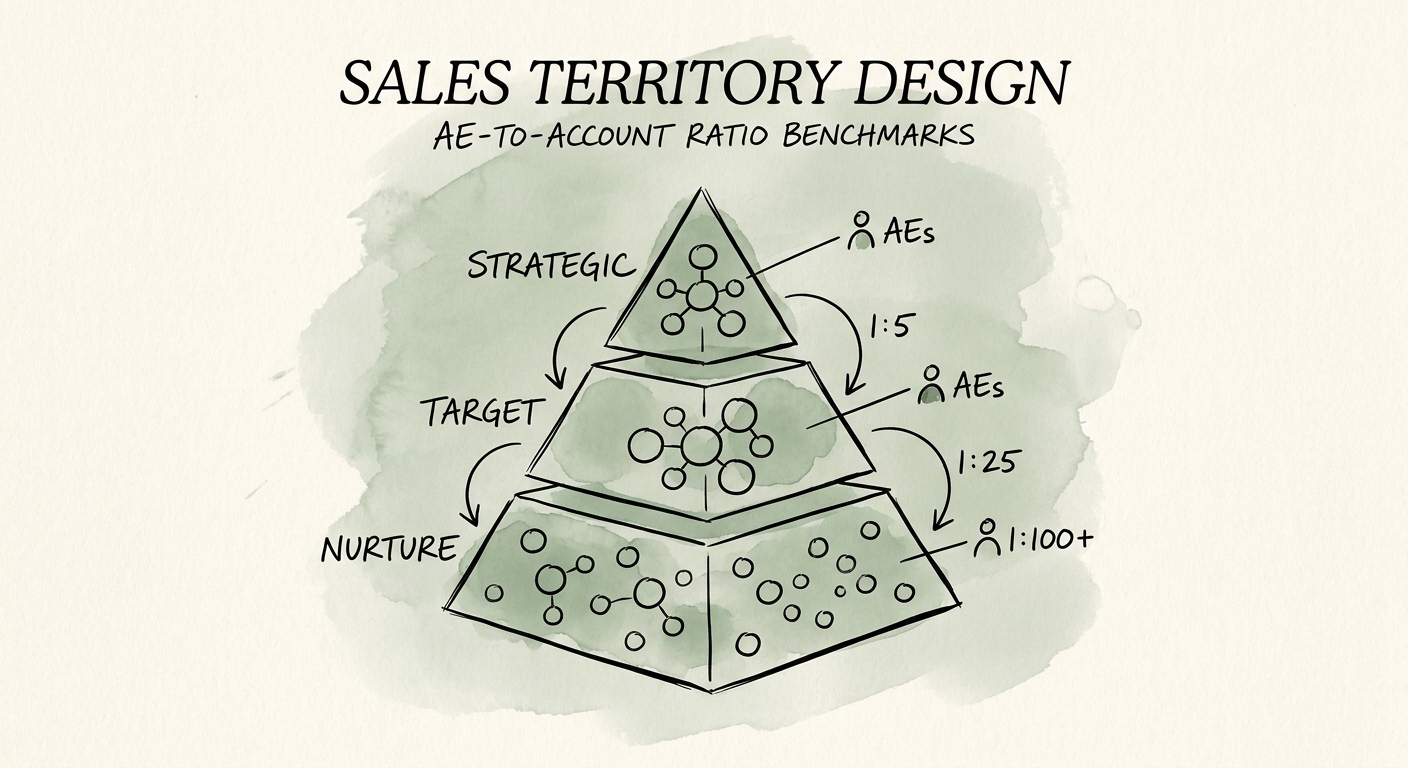
Cutting the account list in Salesforce is the easy 10% of this work. The other 90% is changing what a rep does on a Tuesday, because a smaller list with the same scattershot habits just gets neglected more slowly. So inside every patch I impose a three-tier structure. Take that 60-account mid-market territory: 10 Tier 1 accounts that get a real, customized account plan and weekly senior attention; 20 Tier 2 accounts on a personalized but lighter rhythm; 30 Tier 3 accounts that live almost entirely on marketing nurture and automated sequences until they raise a hand. The tiers are not labels — they are a contract for where the rep's hours go, and they end the all-day bouncing between low-propensity names that eats the calendar of every unstructured AE.
Then the part most teams skip: a clawback policy with teeth. If a Tier 1 account shows no multi-threaded movement and no real pipeline progression in 90 days, it leaves the rep's name and goes back into a holdout pool or to another AE. Territory is rented through execution, not owned through tenure — and reps who have been sitting on a marquee logo for two years "because it's mine" are exactly the dead weight a quarterly hygiene review is built to surface. The measure is not activity volume. It is penetration depth: is the rep working the CFO, the VP of Engineering, and an end-user inside the same account, or are they leaning on one friendly champion? BCG's 2026 Sales Productivity Analysis found AEs with relationships across three or more departments generate 3.4x the revenue yield of single-champion reps. That multiple is the entire argument for constraint.
Do this Monday: export the account list, sort by last meaningful activity, and circle every account untouched in 90 days. That count is your real over-assignment number — and the gap between it and what your forecast claims is exactly what a buyer will find in diligence. If you want to see how that gap shows up in valuation, read The Pipeline Lie: Why 3x Coverage Still Means You'll Miss the Quarter. Starve the rep of volume and they are forced to feast on depth — and depth is the only thing that survives a buyer's inspection.