
The practical answer
- Short answer
- The SAP S/4HANA talent gap has hit a deficit of 40,000 experts. Learn why day rates are skyrocketing and how to build an 'Academy Model' to survive the 2027 deadline.
- Best fit
- Industry: Enterprise Software / IT Services. Function: Talent & HR
- Operating path
- Team & Hiring → Operational Excellence → Transaction Execution Services
- Key metric
- 92% Relevance of Security/Data Protection in 2025 SAP Projects (DSAG)
The 2027 Math Doesn't Work
If you are an SAP partner or a CIO planning a migration, you are staring at a math problem that has no solution in the current labor market. The 2027 maintenance deadline for SAP ECC is not a "soft" target anymore; it is a hard wall that has triggered a global scramble for resources. The data is unequivocal: we are facing a global deficit of 30,000 to 40,000 SAP project experts right now, a number that is projected to widen as we approach the deadline.
According to the 2025 DSAG Investment Report, 51% of companies in the DACH region alone are still running on legacy SAP ERP or Business Suite systems. They haven't even moved yet. Meanwhile, 68% of organizations plan to invest heavily in S/4HANA Cloud in the next 12 months. Do the math. You have tens of thousands of enterprises—approximately 27,000 globally according to some estimates—attempting to draw from a static pool of qualified talent in a 24-month window.
This isn't a "hiring difficulty." It is a structural impossibility for those relying on traditional recruitment. If your strategy is to "hire experienced S/4HANA architects" when the project starts, you have already failed. Those architects are gone. They are billing £800+ ($1,000+) per day on multi-year contracts, or they are being hoarded by the Big 4. The "S/4HANA Skills Apocalypse" described by industry analysts is not hyperbole; it is the new operational reality.
The worst shortage right now is in SAP—it's chronic, prolonged, and isn't improving. We are looking at a deficit of 30,000 to 40,000 experts worldwide.
The "Perfect Hire" Fallacy Destroys Margins
The most expensive mistake I see founders and Operating Partners make is holding out for the "Perfect Senior Consultant"—the unicorn with 10 years of S/4HANA experience (which barely exists) and perfect communication skills. While you wait for this candidate, your billable utilization drops, your project timeline slips, and your cost of delivery explodes.
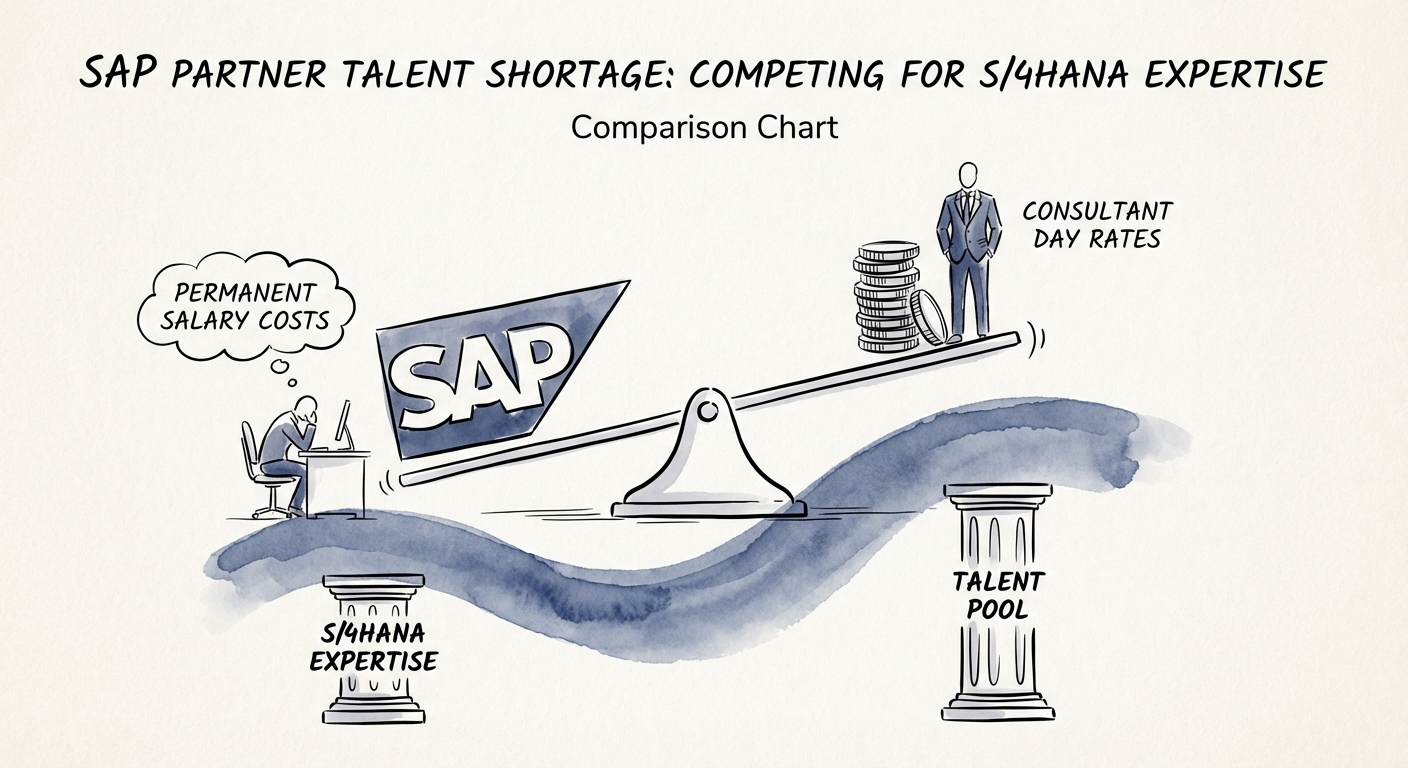
In 2025, scarce skills like SAP BTP (Business Technology Platform), MDG, and GRC are commanding day rates upwards of £800 ($1,050). Competing for these resources on the open market is a race to the bottom for your EBITDA margins. You cannot build a scalable services firm or a sustainable internal practice on mercenary talent that churns for an extra $10/hour. We are seeing a massive shift toward freelancing, with 30% more consultants entering the contract market to capitalize on this desperation.
Every week a seat sits empty waiting for a "Senior Architect," you are losing not just the billable revenue (approx. $4,000/week), but you are burning the goodwill of your customers who see delays. The true cost of a mis-hire or a delayed hire in this market isn't just the recruiter fee; it's the opportunity cost of the entire project lifecycle.
The Only Way Out: The "Academy Model"
You cannot buy this talent; you must build it. The firms that will win the next five years are not the ones with the biggest recruiting budgets, but the ones with the best internal training academies. This means shifting your hiring profile from "proven skill" to "proven aptitude."
1. Hire for Business Process, Train for SAP
Stop looking for SAP configuration experts. Look for supply chain managers, accountants, and manufacturing plant supervisors who are tired of their industries. They understand how a business works. Teaching a smart accountant how to configure FICO is infinitely easier than teaching a technical consultant how accruals work. The ASUG 2025 Pulse of the SAP Customer report highlights that business process knowledge is now as critical as technical skill.
2. The 12-Week Ramp
Build a structured 12-week boot camp. Weeks 1-4: SAP Theory and Methodology (Activate). Weeks 5-8: Shadowing and Documentation (force them to write the process documentation you've been neglecting). Weeks 9-12: Low-risk ticket resolution. This approach drastically reduces your key person dependency on expensive seniors.
3. Retention via Certification
Pay for their certifications, but tie them to retention bonuses. Create a career path that offers "Architect" status in 24 months, not 5 years. If you don't show them a future, the market will show them a higher salary.