The practical answer
- Short answer
- Cisco's acquisition of Splunk increases the importance of cloud migration, ingest optimization, observability architecture, and recurring managed services for partners.
- Best fit
- Industry: Enterprise Software. Function: All
- Operating path
- GTM Execution → Commercial Performance → Performance Improvement
- Key metric
- Observability Migration work is stronger when it includes data routing, retention, cost, and security outcomes.
The Cisco Catalyst: Why Cloud Migration Matters
The Cisco-Splunk acquisition changed the strategic context for Splunk partners. Customers are evaluating cloud migration, observability, security operations, and AI-enabled workflows through a broader Cisco lens. For partners, the legacy on-premise renewal model is no longer enough to defend a premium growth story.
Cisco's strategy increases the importance of cloud readiness, security operations, and platform integration. Partners that only renew legacy environments are easier to compare on support capacity. Partners that help customers modernize the data pipeline, reduce ingest waste, and prepare for advanced observability and security use cases can create a more strategic relationship.
The partner who only moves logs is easy to compare. The partner who reduces ingest waste and improves security operations becomes strategic.
The Ingest Trap: Where Margins Get Pressured
The most dangerous pitfall in Splunk Cloud migrations is the ingest trap. In the on-premise world, customers often planned around fixed capacity. In cloud and hybrid environments, poor data routing, noisy logs, and weak retention policies can create bill shock.
High-quality partners approach migration differently. They do not just move data. They architect observability: source filtering, routing, retention policies, data quality, and operational dashboards that connect cost to use case. Tools such as Splunk Edge Processor, Cribl, and partner-built accelerators can help reduce unnecessary ingest before data hits the indexer.
The Valuation Distinction
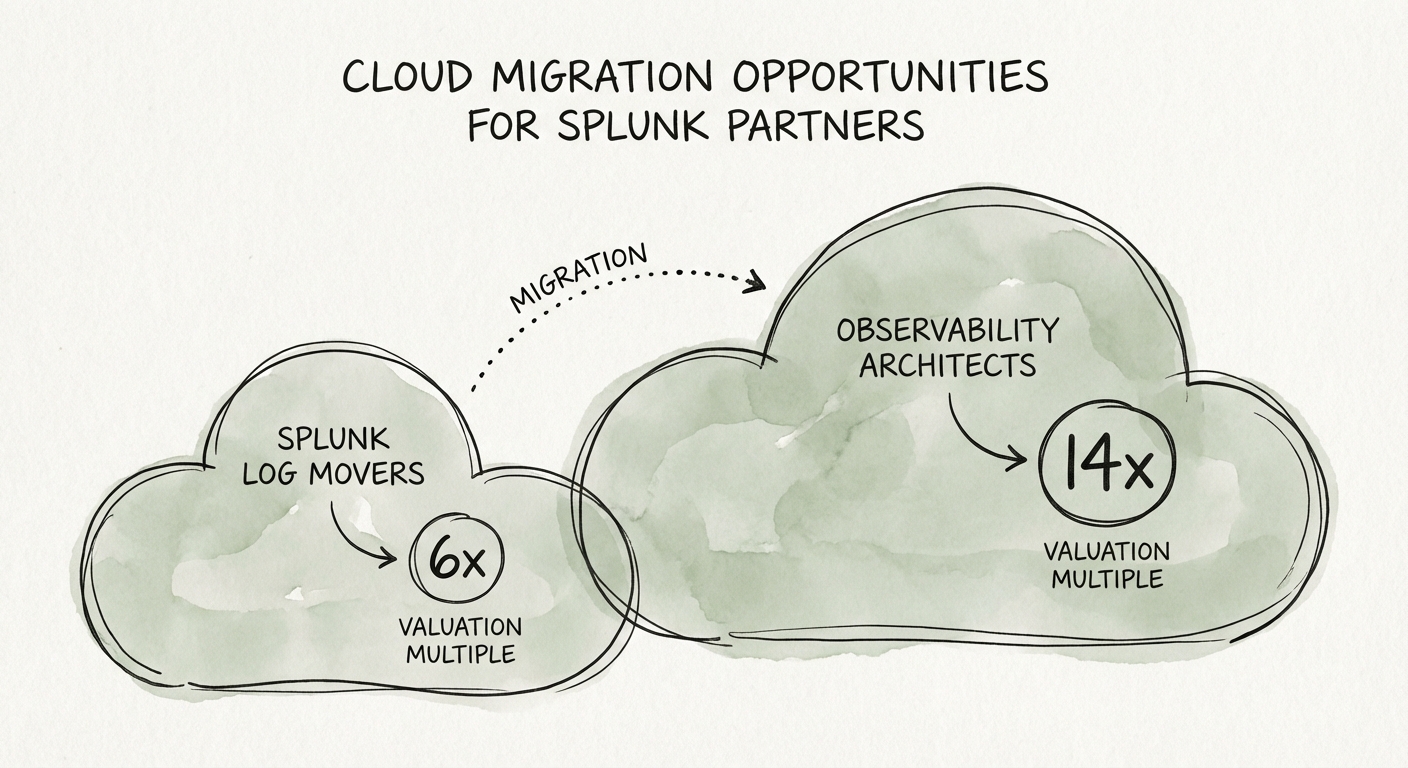
Buyers will distinguish between log movers and observability architects. Log movers execute technical migration projects. Observability architects use migration as a wedge to implement full-stack monitoring, security intelligence, and recurring managed services. The second model has a stronger recurring revenue and margin story.
Beyond Migration: AI and Security Convergence
The end-state of a successful Splunk Cloud migration is not only a hosted dashboard. It is a cleaner data pipeline that supports security, observability, and AI-enabled operations. Partners should shift GTM messaging from cloud readiness alone to data readiness, SOC workflow readiness, and security operations maturity.
To build a stronger exit story, partners need Day 2 managed services that continuously tune rules, reduce noise, optimize ingest, and support customer teams. The goal is to move the customer from logging to action, creating recurring revenue that is less exposed to one-time project cycles.