service pillar 2

Technical Rescue & DevOps Efficiency

When the implementation is stuck, the budget is blown, and the vendor is pointing fingers—we unblock it.


Every enterprise has a project graveyard.

They acquire a promising tech company, and within six months they discover the founder IS the company. The org chart shows 80 employees. The reality is one person making every decision, approving every hire, and personally delivering to the top 10 clients.

We've been that founder. And we've been the operators who fix it.

Operational Scalability isn't about adding headcount or buying software. It's about building the systems, processes, and infrastructure that let a company run without its founder—and scale without breaking. This is what PE buyers pay premium multiples for. This guide shows you how to build it.

What "Technical Rescue" Actually Means

When PE firms evaluate a technology company, they're not just buying revenue. They're buying a machine that can operate without its current owners. Exit-ready means:

Documented Processes
- Every critical workflow exists outside someone's head. Onboarding, delivery, escalation, QA—all documented, all repeatable, all trainable.
- If your best employee quits tomorrow, the company doesn't skip a beat.
- How do you build pricing power instead of discounting to win?
Scalable Hiring
- How do you move from founder-led sales to a repeatable GTM motion?
- What's the right sales methodology, coverage model, and capacity plan?
- How do you align marketing, sales, and customer success into one commercial engine?
Clean Financials
- Do your CAC and LTV actually support your growth ambitions?
- Are you building EBITDA margin or buying growth at any cost?
- Can you survive without the next fundraise?
Founder Extraction
- Does your board see the numbers that matter—or vanity metrics?
- Can you forecast accurately enough to make confident hiring decisions?
- Is your commercial data clean enough to survive due diligence?

Most companies optimize one of these while ignoring the others. Revenue grows but margins collapse. Or efficiency improves but growth stalls. The companies that scale and exit well get all four right simultaneously.

Service Offerings

We've worked inside dozens of tech companies in the $5M-$50M range. The patterns are consistent. Every commercial breakdown we've seen falls into one of five failure modes:

The Five Technical Failure Modes

The Absent Architect

The person who designed the system is gone. Maybe they left. Maybe they were a contractor. Maybe they're still there but have moved on mentally. Nobody understands why critical decisions were made. The team is reverse-engineering their own codebase.
Related Intelligence Reports:
Learn more
$500M+ in value delivered
$18M+ relationships rescued
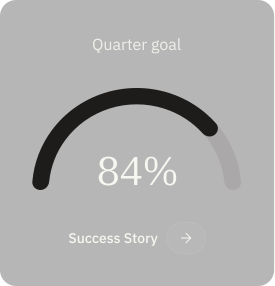
Dashboard-style card showing “Quarter goal” progress at 84% with a link labeled “Success Story.”
Vendor Death Spiral
The implementation partner is failing, but switching vendors feels impossible. You've already paid them $500K. Starting over means admitting failure. So you keep paying, keep hoping, keep watching the timeline slip.
Related Intelligence Reports:
Learn more
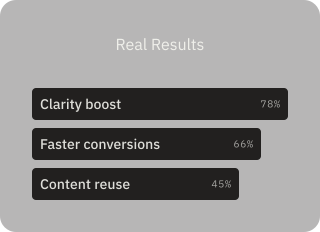
Dashboard card titled “Real Results” showing three progress bars for Clarity boost 78%, Faster conversions 66%, and Content reuse 45%.
4x revenue growth achieved
30-day project unblocking
Scope Explosion
The project started with clear requirements. Then stakeholders started adding "just one more thing." Now the scope is 3x the original, the budget is unchanged, and the team is drowning. Nobody has the authority to say no.
Related Intelligence Reports:
Learn more
Dashboard card titled “Real Results” showing three progress bars for Clarity boost 78%, Faster conversions 66%, and Content reuse 45%.
4x revenue growth achieved
30-day project unblocking
Integration Nightmare
The new system needs to talk to 7 legacy systems, 3 third-party APIs, and a mainframe from 1997. Nobody mapped the integrations properly. Now you're discovering dependencies in production. Every fix breaks something else.
Related Intelligence Reports:
Learn more
Dashboard card titled “Real Results” showing three progress bars for Clarity boost 78%, Faster conversions 66%, and Content reuse 45%.
4x revenue growth achieved
30-day project unblocking
Governance Theatre
There are weekly status meetings. There are Gantt charts and RAG reports. There's a steering committee. And none of it matters because nobody has actual authority to make decisions or kill scope. Process has replaced progress.
Related Intelligence Reports:
Learn more
Dashboard card titled “Real Results” showing three progress bars for Clarity boost 78%, Faster conversions 66%, and Content reuse 45%.Portrait of a woman with curly hair looking thoughtfully at the camera.
4x revenue growth achieved
30-day project unblocking

The diagnostic question: Which failure mode is costing you the most? Most companies we work with have two or three active simultaneously.

Operator-led execution

The Technical Assessment (Week 1-2)

Request a Turnaround Assessment
Team having a discussion around a meeting table in an office.
Engagement phases
Diagnostic Assessment
Cursor icon showing a hand pointer
Turnaround Plan
Implementation
Value Capture
Pipeline Reality Check
- What's your true conversion rate at each stage?
- How does forecast accuracy compare to commitment?
- Where do deals die, and why?
People walking through a bright hallway with wooden floor and neutral decor.
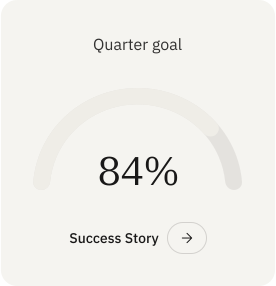
Card displaying “Quarter goal” progress at 84% with a blurred background and link labeled “Success Story.”
Unit Economics Audit
- What's CAC by channel, segment, and rep?
- What's true customer lifetime value (not theoretical)?
- Where is margin leaking?
Close-up of hands typing on a laptop at a wooden desk.
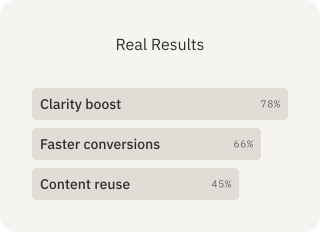
Card titled “Real Results” showing progress bars for Clarity boost 78%, Faster conversions 66%, and Content reuse 45% over a blurred laptop background.
GTM Alignment Analysis
- Where are marketing, sales, and CS misaligned?
- What's the handoff quality score?
- Where does attribution break down?

The output: A single-page commercial health scorecard. Red, yellow, green on every metric that matters. No ambiguity about what's broken.

The Four Pillars of Technical Rescue

Fix these in order. Each builds on the one before.

Pillar 1: Revenue Architecture
Get the foundation right before optimizing execution:

- ICP Precision: Define your Ideal Customer Profile with hard criteria, not "companies in our target market." Include firmographics, situational triggers, and—critically—disqualification criteria.

- Pricing Power: Build pricing around value delivered, not cost-plus or market matching. Package for expansion, not just initial sale.

- Revenue Mix: Determine the optimal balance of new logos, expansion, and renewals. Design compensation and capacity around that mix.
Pillar 2: GTM Engine
Build the machine that converts ICP to revenue:

- Sales Methodology: Install a repeatable process with objective stage-gate criteria. "They seemed interested" is not a stage advancement.

- Coverage Model: Match capacity to market. Inside vs. field. SDR model vs. AE-led prospecting. Partner channel vs. direct.

- Operating Rhythm: Weekly pipeline reviews. Monthly metrics review. Quarterly strategy alignment. Consistent cadence builds predictability.
Pillar 3: Unit Economics
Make the math work at scale:

- CAC Management: Know your all-in CAC by channel and segment. Cut the channels that don't pay back.

- LTV Optimization: Retention is cheaper than acquisition. Expansion is the highest-margin revenue. Invest accordingly.

- Payback Discipline: If payback exceeds 18 months and you're not yet profitable, you're funding growth with investor dollars. That only works until it doesn't.
Pillar 4: Financial Infrastructure
Make commercial performance visible and manageable:

- Forecast System: Move from rep opinions to data-driven projections. Weight pipeline by actual conversion rates, not wishful thinking.

- Board Reporting: Lead with the metrics that matter. ARR growth is meaningless without context on efficiency and sustainability.

- Data Hygiene: Your Salesforce data should survive due diligence. If a PE associate can't trust it, neither can you.

"Human Renaissance unblocked our $13M stalled initiative in 30 days. After 6 months of finger-pointing between vendors and internal teams, they cut through the politics and got the project moving. Within 90 days we were live."

Center for Excellence Director
Enterprise Hardware Manufacturer

The Technical Health Dashboard

Metric
Healthy Range
Warning Sign
Win Rate
30%+
Below 25%
Forecast Accuracy
85% (30-day)
Below 70%
Sales Cycle
Stable or decreasing
Strentching 20%+
Average Discount
Below 10%
Above 20%
CAC Payback
12-18 months
18-24 months
Gross Margin
70%+ (SaaS)
Below 65%
Net Revenue Retention
110%+
Below 100%

The Metrics that Matter

Track these metrics weekly. Not monthly—weekly. By the time a monthly metric shows a problem, you've lost 30 days of correction time.

Leading vs. Lagging

The mistake most companies make: obsessing over lagging indicators (revenue closed, logos acquired) while ignoring leading indicators (pipeline created, stage conversion rates, activity volume).

By the time revenue misses, it's too late. The deal was lost 90 days ago when you didn't have enough pipeline, or when Stage 2 conversion dropped, or when activity slipped. Fix the leading indicators and the lagging indicators follow.

Benchmarks by Stage

$5-20M ARR (Series A-B):

  • CAC Payback: 12-18 months
  • LTV/CAC: 3:1 minimum
  • Net Revenue Retention: 100%+
  • Magic Number: 0.75-1.0

$20-50M ARR (Series B-C):

  • CAC Payback: 15-24 months (can extend with proven retention)
  • LTV/CAC: 3:1 minimum
  • Net Revenue Retention: 110%+
  • Magic Number: 0.5-1.0 (efficiency matters more)

$50M+ ARR (Growth Stage):

  • CAC Payback: 18-30 months (justified by scale)
  • LTV/CAC: 3:1 minimum
  • Net Revenue Retention: 115%+
  • Rule of 40: Combined growth rate + EBITDA margin ≥ 40%
measure what matters

When clarity compounds, everything improves

110%+
Net Revenue Retention Target
3:1
LTV/CAC Minimum
85%+
Forecast Accuracy Standard
12
CAC Payback Target (months)

The 30-Day Technical Unblocking Timeline

If commercial performance is broken now, here's the realistic timeline:

Team having a discussion around a meeting table in an office.
Days 1-30: Diagnose and Stabilize
• Audit 8 quarters of pipeline data
• Map actual sales process vs. documented
• Identify primary failure mode(s)
• Stop the bleeding (tighten ICP, fix broken forecasting)
People walking through a bright hallway with wooden floor and neutral decor.
Days 31-60: Install the System
• Implement stage-gate criteria
• Launch operating rhythm (weekly pipeline, monthly metrics)
• Document playbooks from top performers • Clean up data hygiene
Close-up of hands typing on a laptop at a wooden desk.
Days 61-90: Optimize and Measure
• Track conversion by stage
• Compare forecast accuracy before/after
• Adjust methodology based on data
• Begin capacity planning for scale

Ready to Fix Your Revenue Engine?

Most founders wait until they've missed three quarters to address revenue problems. By then, you've lost board credibility, team morale, and 12-18 months of growth. Get ahead of it.