
The practical answer
- Short answer
- The green IMO dashboard hides where a tech-services deal is bleeding. Here are the day-by-day integration KPIs a PE operating partner should track for 100 days.
- Best fit
- Industry: B2B Technology & IT Services. Function: Integration Management Office (IMO)
- Operating path
- Migration & Integration → Turnaround & Restructuring → Transaction Advisory Services
- Key metric
- 14 Months added to technical integration timelines when critical engineering talent turns over before Day 60.
The all-green dashboard is the first symptom
Here is the slide I have watched at board meeting after board meeting in the first month after a tech-services acquisition closes. The integration management office stands up a dashboard, and it is beautifully green: cultural workshops completed, synergy roadmap drafted, town halls hosted, "integration charter signed." Everyone nods. Nobody asks the question that matters, which is whether anything the acquired company actually does to make money still works. Meanwhile McKinsey's 2025 M&A Integration Value Survey finds that integrations leaning on cross-sell pipeline as their headline first-30-day metric are markedly more likely to miss year-one EBITDA. Cross-sell pipeline is a lagging indicator that quietly assumes the base business is stable. In the first 30 days, it almost never is.
On the last stalled tech-enabled services roll-up I was brought in to rebuild, I deleted the financial synergy tracker for the entire first quarter. Not de-emphasized — deleted. In its place went three boring operational reads, because in week two of an integration those are the only things that predict whether Day 100 lands soft or hard.
First: IAM provisioning time, measured in hours. When an acquired account executive cannot get authenticated, scoped access to the parent CRM, they sell out of a personal spreadsheet, the pipeline goes dark to the IMO, and forecast integrity is gone before anyone realizes it. I want the median hours from offer-of-access to working login on the board. Cross 48 hours and your IT integration is already behind, full stop. Second: key-talent friction signals — a sudden cluster of PTO requests, code commits that slow then stop, one-on-ones quietly getting skipped. PwC's 2026 M&A Integration Operations Benchmark shows that losing even a tenth of critical engineering or sales talent before Day 60 stretches full technical integration by well over a year. You do not learn that from an exit interview; you learn it from a calendar. Third: the actual count of acquired customers who have been re-contracted, re-papered, or even just successfully re-onboarded onto a working support path. We map exactly when these pressures peak in our M&A Integration Timeline Benchmarks: The 30, 60, and 90-Day Milestones That Save Your Deal. The point of the first 30 days is not to celebrate momentum. It is to find the friction while it is still cheap to fix.
Show me the IMO dashboard that's all green at Day 30 and I'll show you a deal that's about to find out it was measuring the wrong things. Friction is a leading indicator; financials are a confession.
Days 31 to 60: the velocity tax shows up on the deploy graph, not the org chart
By Day 30 the honeymoon ends and two genuinely different engineering organizations have to share a roof. This is where most PE firms reach for the wrong instrument. They track "applications rationalized" and "systems sunset" — a count of things switched off — because it photographs well for the LP update. It tells you nothing about whether the combined org can still ship.
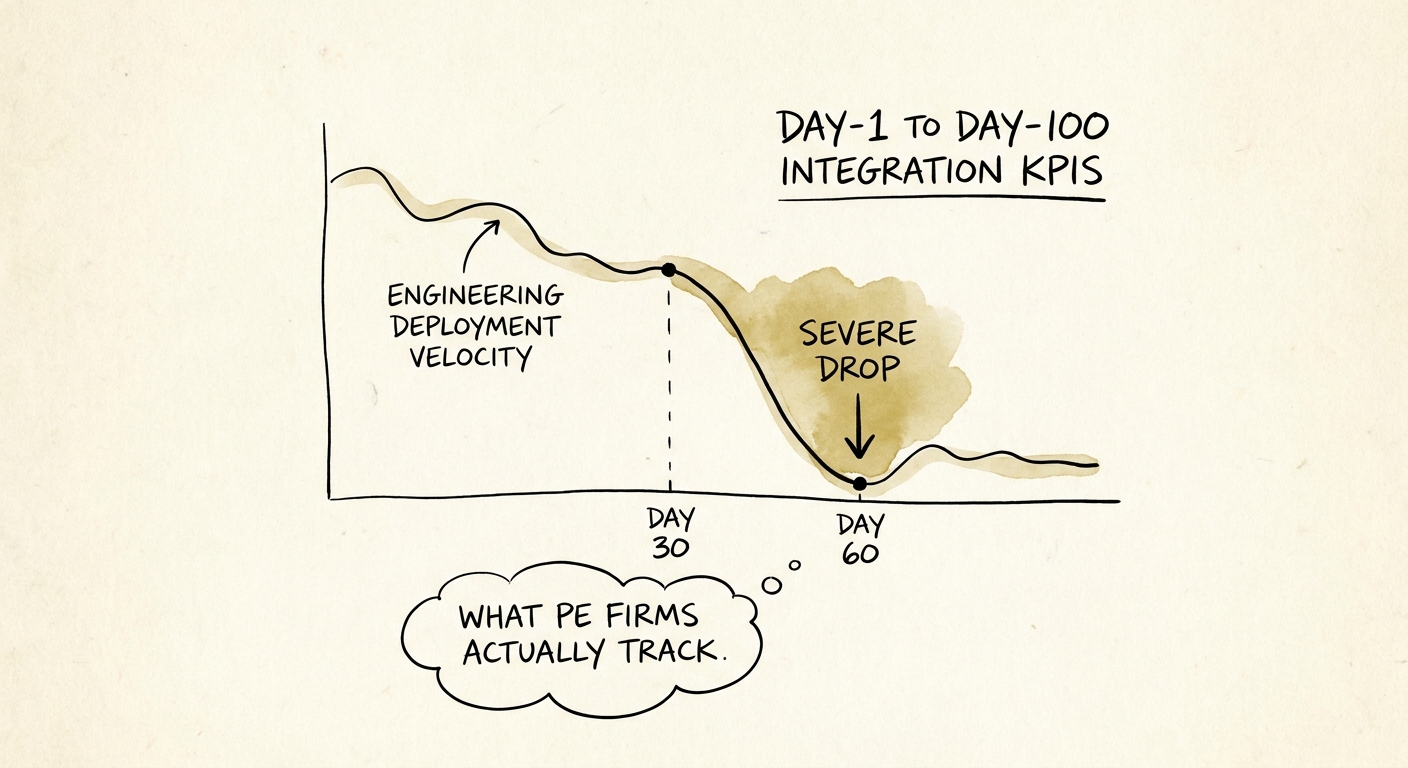
Here is the trap I watched spring at a mid-market Azure-partner consolidation. The buyer rushed to merge active directories and fuse the two CI/CD pipelines in the same fortnight. Within days the flagship product's deploy cadence collapsed — engineers spent their sprint untangling broken auth and a release process that no longer recognized half the team. Gartner's 2026 IT Integration Success Report describes this precisely: a majority of software integrations hit a deployment freeze in this window, with engineering output dropping by roughly 40% between Days 30 and 60. That is the velocity tax, and the only way to see it coming is to watch throughput, not headcount.
So in this window the scorecard changes. Track deployment frequency against each side's pre-close baseline — a 40% fall is not a blip, it is the deal slowing down. Track pull-request cycle time, because the first sign a merged team is drowning is reviews that used to take hours now taking days. Track data-sync lag and API failure rates between parent and target systems, daily. When cross-system error rates push past 5%, your engineers have quietly become a firefighting crew, and no go-to-market synergy you penciled into the model will land on top of data architectures that are actively rejecting each other. This is the same mechanism we dissect in The 'Velocity Tax': Why Acquired Engineering Teams Stall for 6 Months. And it is not abstract: Bain & Company's Global M&A Report 2026 ties IT integration delay to a meaningful reduction in year-one synergy realization. The keep-the-lights-on cost of a stalled pipeline is the synergy you sold the deal on.
Days 61 to 100: instrument the Month 6 cliff before you stand down the IMO
As Day 100 approaches, the boardroom instinct is to declare victory, hand out credit, and shut down the integration office. I push back on that every time. Day 100 is not the finish line — it is the lip of the most expensive crater in any tech-services integration: the customer-churn cliff that hits around Month 6, when internal friction finally seeps out to the client and they leave. The KPIs you choose now exist to predict that, not to wrap a ribbon on the quarter.
Stop watching NPS. A two-point NPS move tells you nothing in this window and gives everyone permission to feel fine. Watch the operational tells instead. Track time-to-first-response and time-to-resolution for the acquired customer base specifically, separated from the legacy book so the parent's healthy numbers can't average away the problem. KPMG's 2025 Deal Advisory & Integration Study finds that a 15% rise in resolution time for acquired customers inside the first 100 days foreshadows a sharp spike in gross churn by Month 6. Those customers don't leave because they dislike the new logo — they leave because the consolidated ticketing system is silently routing their urgent issues to the wrong support tier, and the new owner can't see it happening.
Two more reads belong on the Day-100 scorecard. First, revenue-recognition delay — the gap in days between closed-won and recognized revenue after the systems merge. If that gap drifts even a few days, your order-to-cash plumbing is broken and the financials you're about to report are fiction. Second, the share of "cross-trained" reps who have actually run a joint pitch with a real prospect, not just clicked through an LMS module — because enablement completion is theater and revenue is not. We walk through the full mechanics of this drop-off in The 'Month 6 Cliff': Why You Lose 15% of Acquired Revenue Just When You Think You're Safe. I have rebuilt integration teams enough times to know the pattern cold: if you are not measuring the friction, you are only measuring the failure after it has already cost you. Before your next board meeting, take whatever green dashboard the IMO hands you and replace three vanity tiles with IAM provisioning hours, acquired-customer resolution time, and rev-rec delay. Those three will tell you where the deal actually is.