
The practical answer
- Short answer
- A 12-month blended CAC payback often hides a starved enterprise book. Buyers underwrite 18–24 months when NRR holds. The cohort math, by ACV band.
- Best fit
- Industry: B2B SaaS. Function: Financial Infrastructure
- Operating path
- Financial Infrastructure → Commercial Performance → Valuations
- Key metric
- 24 Months payback acceptable for Enterprise SaaS with >120% NRR
The number that looks best the moment before it hurts you most
Picture a $40M ARR SaaS company walking into a board meeting with a 12-month blended CAC payback. Clean. Efficient. Every VP nods. Six quarters later the same company gets marked down in diligence, because that single number was the symptom, not the strength. The fast payback came from pouring spend into sub-$15K-ACV accounts that recover in 8 to 12 months and churn out the back door, while the enterprise pipeline — the accounts that actually compound — got starved of pre-sales and enablement budget to keep the average pretty.
This is the trap of the blended payback metric: it averages three businesses that don't belong in the same column. According to ScaleXP's 2025 SaaS Benchmarks, SMB SaaS under $15K ACV recovers acquisition cost in 8 to 12 months, mid-market between $15K and $100K ACV takes 14 to 18 months, and enterprise above $100K ACV routinely runs 18 to 24 months — and that longer enterprise number is healthy, not broken. Heavier solution engineering, longer cycles, and real implementation are the cost of deals that don't leave. Roll all three into one figure and the blended average tells you nothing about which motion is creating value and which is quietly destroying it.
The damage is behavioral. A CEO sees an 18-month blended payback creeping up and panics — then cuts the enterprise motion that's compounding at 130% net revenue retention, because it's the visible drag on the average. They've optimized the dashboard and dismantled the engine. Bessemer Venture Partners' Scaling to $100M benchmarks put it plainly: for enterprise-focused companies, late-stage investors will underwrite up to a 24-month payback, and past $50M ARR the acceptable window stretches further still. Punishing an enterprise team for missing 12 months isn't discipline. It's a misread of how capital allocation works above six figures of ACV.
A blended 12-month payback is the one number that looks best right before it costs you the most: it almost always means you funded the cheap logos and starved the ones worth buying you for.
What we actually do with that "perfect" number in diligence
When we open up a target's go-to-market in operational due diligence, the blended payback is the first thing we throw out. Take that $40M ARR company with the flawless 12-month figure. We segmented it by ACV cohort and the picture inverted: the transactional book funded the headline number while net revenue retention sat at a miserable 88%. The management team had hit a vanity metric by selling churn. That trade — short payback for shrinking accounts — is exactly what knocks turns off an exit multiple, because the buyer is purchasing future cash flows, not last quarter's efficiency ratio.
Sophisticated buyers don't look at averages; they look at how long it takes to recover the fully loaded cost of a customer using only the gross profit that customer generates. Sales salary and commission, marketing allocation, onboarding, and the first year of customer success all go in the numerator; gross margin, not revenue, goes in the denominator. Benchmarkit's 2025 SaaS Performance Metrics Report puts the median fully-loaded payback for B2B SaaS at 18 months — a real reset upward from the cheap-capital era, when teams quietly stripped success costs out of the calculation to flatter the board. If your math doesn't carry those costs, you don't have an efficient business; you have a measurement error. The mechanics are worth getting exactly right, which is why we walk through the full numerator-and-denominator build in How to Calculate True CAC Payback Period (And Why Your Investor Deck Is Wrong).
Here's the part that surprises founders: we'll happily fund a longer payback on the enterprise cohort — if the retention holds. KeyBanc Capital Markets' 2025 SaaS Survey shows mid-market churn for $10K to $50K ACV accounts sitting comfortably below 1.5% monthly. An 18- or 20-month payback on an asset that keeps 90% of its logos and expands them 20% a year isn't a risk to underwrite around — it's the reason to write the check. The deciding variable was never the months-to-payback. It was always payback paired with what happens to the account after it pays back.
Rebuild the board slide by ACV band before your next raise
The fix is concrete and you can start it Monday. Split the payback calculation in two — one number for your product-led or SMB motion, a fully separate one for your sales-led enterprise motion — and never report them blended again. The moment you pool them, you're averaging a 9-month flywheel with a 22-month enterprise build and calling the mean "the business." It isn't. It's a number that describes neither motion and misprices both.
Then align comp and budget to that split. OpenView's SaaS metrics benchmarks show what happens when you don't: force enterprise account executives into a short-payback quota and you buy year-one discounting, rushed implementations, and a wall of churn at the first renewal. The behavior you pay for is the revenue quality you get. A rep compensated to close fast and recover cost in twelve months will discount to do it — and hand you an account that leaves before it ever expands. If you also wrap professional services around the software, the trap tightens further, because unstripped service-delivery margin makes the blended number look even healthier than the underlying subscription economics deserve; we break down that specific failure in The 2026 CAC Payback Diagnostic: Why Blended Metrics Are Bankrupting Hybrid Firms.
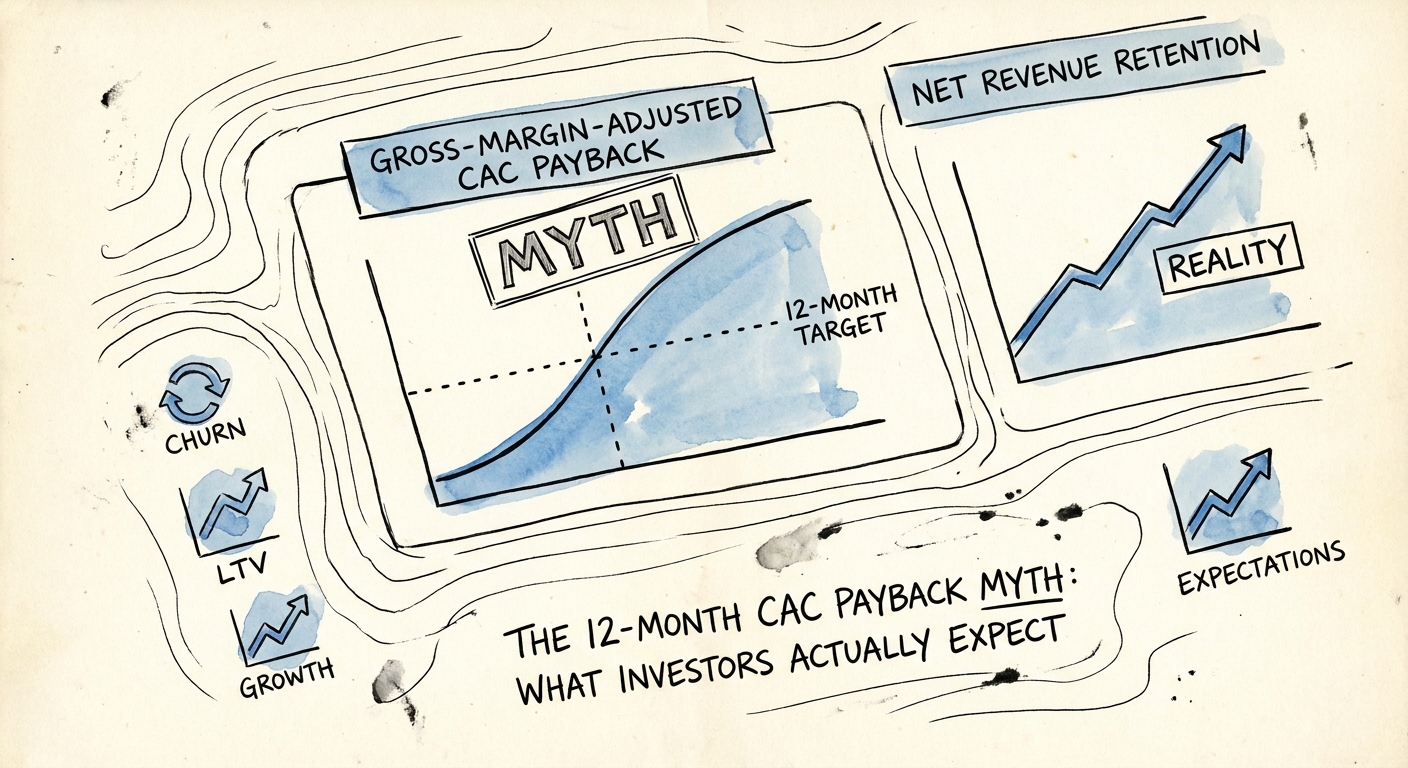
Capital efficiency in 2026 isn't about acquiring customers as cheaply as possible. It's about knowing precisely where a marketing-and-sales dollar throws off the most gross profit over a multi-year horizon — and that answer is different for a $12K account and a $300K one. So rebuild the slide: fully loaded CAC payback, broken out by ACV band, each band sitting next to its own net revenue retention. Then stop apologizing for an 18-month enterprise payback. When you show segmented, gross-margin-adjusted economics instead of a flattering blend, you stop defending a heuristic that expired three years ago and start demonstrating the operating command buyers pay a premium for.