
The practical answer
- Short answer
- Most new execs take 6.2 months to break even — and 60% underperform for two years. Here's the 30-60-90 onboarding architecture that fixes both.
- Best fit
- Industry: B2B Software & Services. Function: Human Resources & Talent Strategy
- Operating path
- Team & Hiring → Operational Excellence → Transaction Execution Services
- Key metric
- 60% of new executives underperform in their first 24 months due to mechanical onboarding checklists.
The week six trap nobody warns the new VP about
Here's the scene I've watched play out more times than I'd like. A founder spends four months and a six-figure search fee landing a name-brand VP. Week one is a parade of welcome lunches. By week six, the new exec — desperate to look decisive, sensing the founder's silent impatience — kills a process the team built, reorganizes a function they don't yet understand, and overrides a manager who's been right about this market for three years. Credibility gone. Not because the hire was wrong. Because the onboarding was a benefits walkthrough and a Slack invite, and nature abhors a vacuum.
That instinct to act fast has a name in the literature — the action imperative — and it's the single most reliable way to torch a senior hire in the first quarter. The data underneath it is brutal: somewhere between 27% and 46% of executive transitions are judged failures or disappointments within two years, per McKinsey's analysis of leadership transitions. The cause is almost never competence. The person could clearly do the job in the interview. The cause is that they tried to lead before they'd mapped who actually holds power, what derailed the last person in the seat, and which "obvious" change is actually a tripwire.
And the clock is expensive. A newly hired executive takes roughly 6.2 months to reach breakeven — the point where the value they've added finally exceeds the salary, search fee, and ramp time they've consumed, a benchmark popularized in Harvard Business Review's work on the first 90 days. If your "onboarding" is introductions and a laptop, you don't hit 6.2 months. You drift to nine or twelve, and every extra month is real money. The number behind that drift is what I unpacked in The $2.4M Mistake: What It Actually Costs to Replace Your VP of Sales.
An executive's first 90 days aren't about making them feel welcome. They're about deciding, on purpose and ahead of schedule, the one or two early wins that earn them the right to change anything that matters.
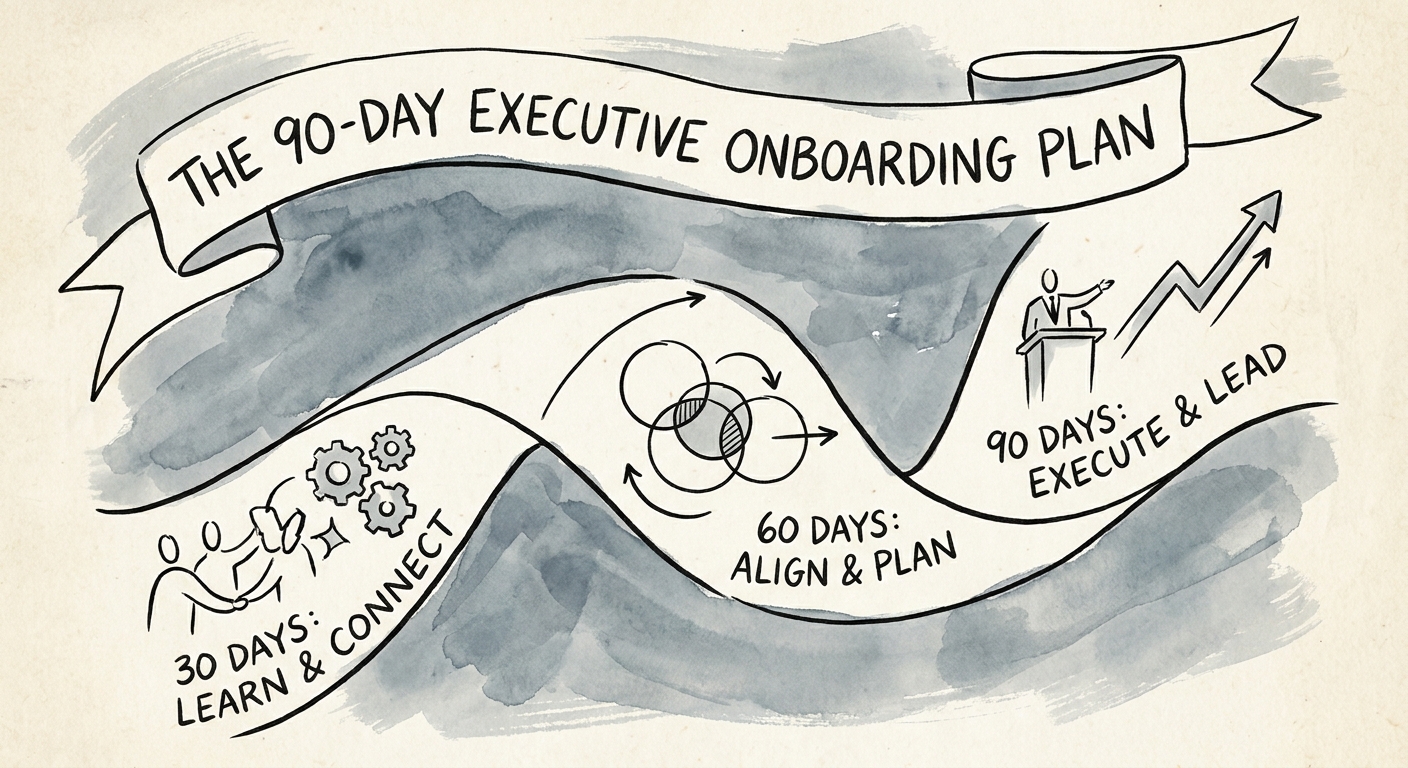
What goes on the calendar in each of the three windows
The reason 60% of new executives underperform across their first 24 months, per Gartner's executive onboarding benchmarks, is that companies hand strong leaders a mechanical checklist instead of intelligence. A capable VP doesn't need a buddy and a wiki page. They need the unwritten org chart — and a schedule that protects them from their own urge to move too soon. Here's what I actually put on the calendar.
Pre-start through day 30 — listen with a map, not a microphone. Before day one, the hiring CEO writes down two things in plain language: who holds real influence versus who holds the title, and the specific landmine that hurt the last person in this role. Then the exec runs structured listening conversations against those names — not vague "getting to know you" coffees, but a deliberate sweep of the people whose support they'll need. The one rule I enforce: no irreversible decisions in month one. If a founder is pressuring a new leader for a strategy verdict in week three, the founder is the problem, not the hire.
Days 31 to 60 — choose the early win on purpose. This is where the action imperative bites. The fix isn't to suppress the urge; it's to point it at a deliberately chosen, low-blast-radius win. Say a new VP of Ops inherits a quoting process that takes four days — fixing the bottleneck nobody defends earns trust without threatening anyone's turf. You are choreographing one visible success that signals competence without picking a fight. The CFO version of this sequencing — what to touch and what to leave alone in the first quarter — is laid out in The New CFO's First 90 Days: A Survival Guide for the 'Operator' Era.
Days 61 to 90 — switch from observer to owner. Now the leader writes the plan they'll be held to: the metrics they own, the decisions that are theirs to make, the P&L or function they're accountable for. If days 1 through 60 were run well, the team has already bought into how this person leads, so the changes that would have been rejected in week six now land as expected. Resistance you defused in month one doesn't reappear in month three.
The three gates that tell you it's working before you've spent six months finding out
You don't get to wait two years to learn the hire failed. The downside compounds fast: when integration goes sideways, around 70% of senior leaders seriously consider leaving, per Deloitte's Human Capital Trends research — and if they walk, you're paying to do this all over again at up to 213% of their salary, per SHRM's cost-of-hire benchmarks. So track the transition the way you'd track pipeline, with three hard gates instead of a vague sense that "they seem to be settling in."
Day 30 gate — listening vs. dictating. Pulse three or four stakeholders who've worked closest with the new leader and ask one blunt question: is this person mostly asking, or mostly telling? Telling at day 30 is a flashing red light, not a personality quirk. Day 60 gate — did the chosen win land clean? Did they ship the deliberate early win without trampling a norm or a person to do it? Speed at the cost of a bruised manager is a fail, not a win. Day 90 gate — are they ahead of the 6.2-month curve? By now the CEO or board should be able to point at evidence — owned metrics moving, the function organizing around them — not a feeling.
The honest version of this: a structured 90-day plan is the cheapest risk mitigation you'll ever run on a senior hire, and most companies skip it because it looks like soft HR work instead of the financial control it actually is. If you want to avoid the related failure mode — paying for an empty seat for months while a search drags — I broke that math down in The 198-Day Void: Why Your CFO Search Timeline Is a $2.1M Hallucination. Pick one role you're hiring into this quarter, block the three gates on a calendar, and write down today's two pieces of org intelligence before the offer letter goes out. That's the work. It takes an afternoon and saves a year.