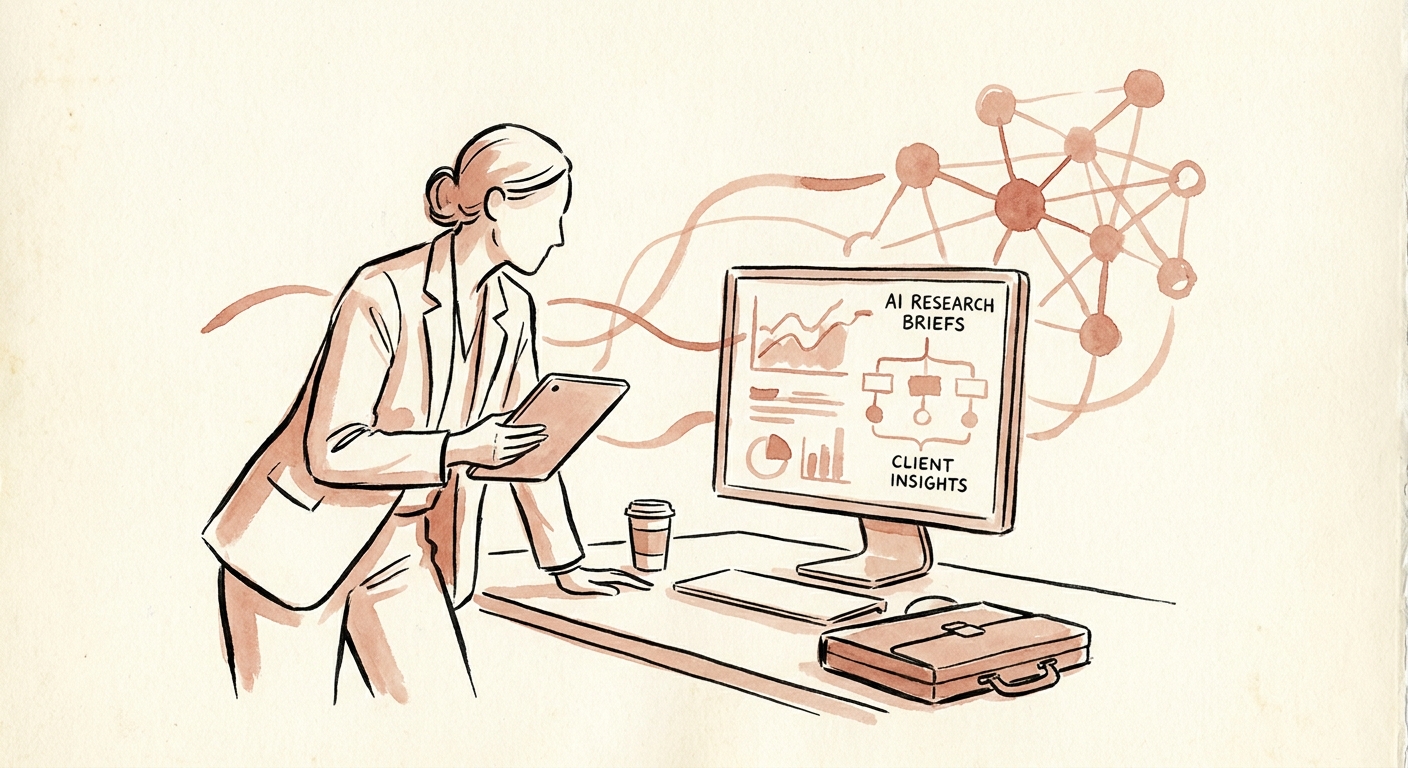
The night before the meeting, a partner has 90 minutes and four browser tabs open
Picture a managing director at a 30-person advisory firm getting ready for an 8 a.m. intro call with a regional health system. She opens the prospect's website, a funding announcement, a LinkedIn profile, and the CRM record her associate touched eighteen months ago. She stitches a story together in her head, jots three questions on a legal pad, and hopes the good one surfaces in the moment. Half the time it doesn't. That ninety minutes is the workflow AI should attack first — not because research is hard, but because it's the highest-leverage hour your most expensive person spends all week, and right now it's improvised every single time.
Account research is a near-ideal first AI use case for a consulting firm precisely because the inputs are knowable: the CRM history, the public signals, the prior engagements your firm has run in that vertical, and the buyer-specific angle only a partner can choose. The Salesforce State of Sales report keeps surfacing the same complaint from revenue teams — they don't lack data, they lack time to turn it into something usable before they're in front of someone. A research brief is exactly that conversion. And McKinsey's State of AI 2025 makes the broader point bluntly: the value shows up when the workflow itself changes, not when you bolt a chatbot onto the old one. The change here is concrete — you stop researching from scratch the night before and start reviewing a structured brief that's already assembled.
What separates a brief a partner trusts from one she rewrites from scratch
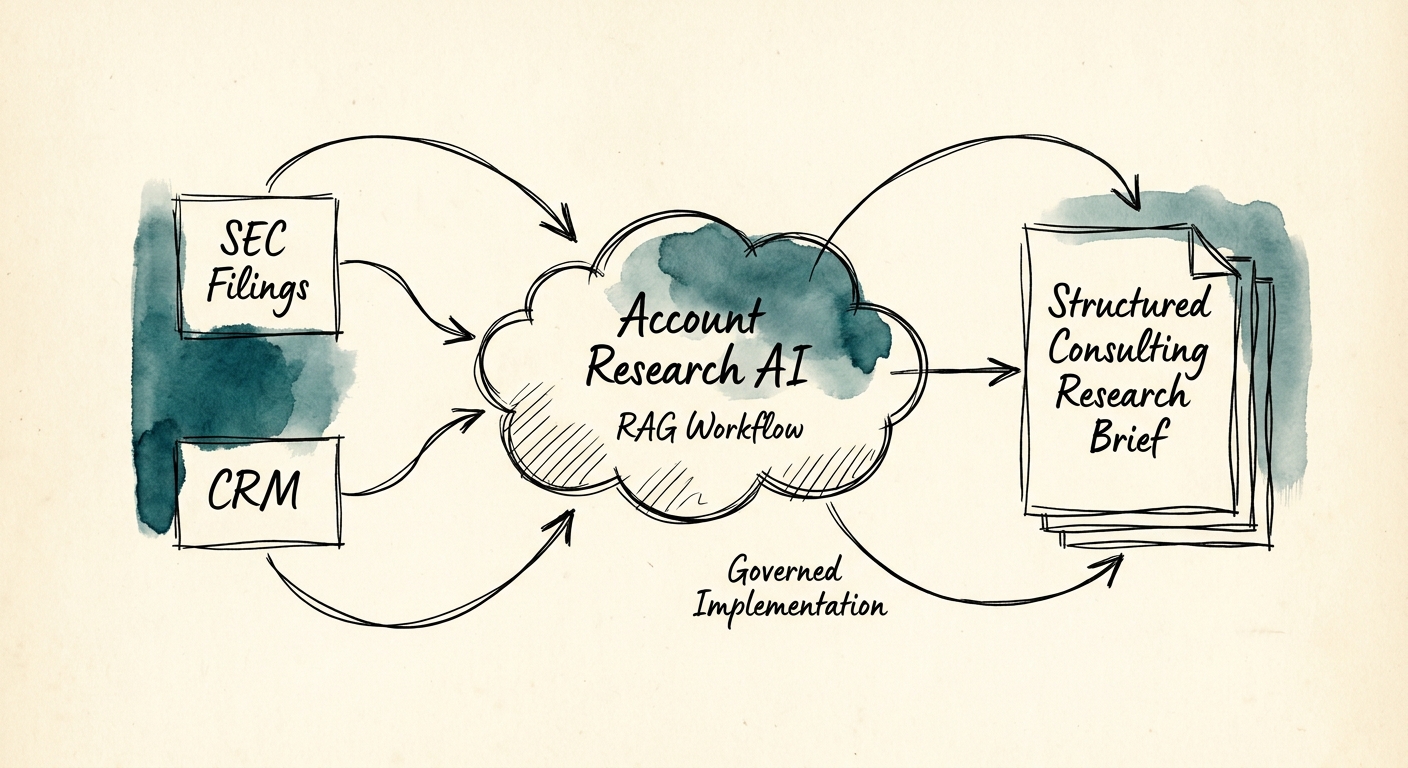
Here's the failure mode I see most: a firm wires up AI to generate a glossy "account overview," the partner reads two sentences, spots a confidently-wrong fact, and never opens one again. The trust is gone after the first miss. So the design question isn't "can it write a brief" — anything can write a brief. It's whether every claim is traceable back to where it came from. The IBM Institute for Business Value research lands on the same thing from the ROI side: returns track to capabilities like trusted data and adoption, not raw generation. For account research that means the real work is upstream — source selection, CRM hygiene, and pulling the right internal expertise — not the paragraph at the end.
Make the brief show its work. Each line should carry its source inline: "Expanding into two new markets (Q3 press release)" beats "poised for growth" every time, because the partner can decide in a glance whether to lean on it. Then there's the part most firms skip until it bites them. Your richest signal is your own prior work — the deck from a similar client, the diagnostic findings, the engagement notes. That material is also exactly what you're contractually forbidden from leaking into the next prospect's brief. The Microsoft 365 Copilot data protection architecture documentation is worth reading specifically for how permissions gate what internal documents an assistant can retrieve and summarize. Get this wrong and you don't get a bad brief — you get a confidentiality breach with your name on it. So the rule is simple: prior-client material can inform the firm's general point of view, never name a competitor's client back to a prospect.
Measure whether the brief earned a better first question — not how long it is
Length is a vanity metric. A three-paragraph brief that lets a partner walk in and ask "you opened a second clinic in March and your billing team is still on the old system — is that what's slowing collections?" is worth ten pages of generic company history. So track what actually moves: minutes of prep time reclaimed, what share of claims carried a real source, how heavily the partner edited the brief before walking in, and — the one that matters most — whether briefed calls advance to a real next step more often than improvised ones did. If partners stop editing and start trusting, you've built something. If they keep rewriting from scratch, the brief is theater.
Start narrow. Pick one vertical your firm actually wins in, build the brief template for that buyer, run it against your next ten intro calls, and compare the conversion against your last ten. If you want to weigh this against automating proposals or follow-ups instead, run the AI Opportunity Score to see which workflow returns the most for the least risk, and look at Sales and Marketing AI for how the briefing step fits the rest of your revenue motion.
