The clock that actually costs you money
Every staffing firm runs two clocks. One is time-to-fill: how fast you put a candidate in front of a client. The other is the one most firms ignore until it's bleeding — time-to-redeploy: how many days a billable contractor sits on the bench between assignments. A contractor rolling off Friday with nothing lined up is margin you already trained, vetted, and onboarded, now earning zero. That is where AI should land first, and almost nobody starts there.
The reason firms start elsewhere is that sourcing is loud and redeployment is quiet. The Bullhorn GRID 2025 Industry Trends Report tracks exactly the levers that move a staffing P&L — automation, AI adoption, search and screening, placement speed — and the pattern is consistent: the firms pulling ahead aren't the ones that read resumes fastest, they're the ones that compress the gap between a recruiter's intuition and the next placement. Picture a 60-recruiter IT staffing shop with 400 contractors on assignment. If even 30 of them roll off each month and the average bench gap is nine days, that's not a sourcing problem you can hire your way out of. It's a signal problem: the data to act existed in the ATS, the assignment record knew the end date, and no human got to it in time.
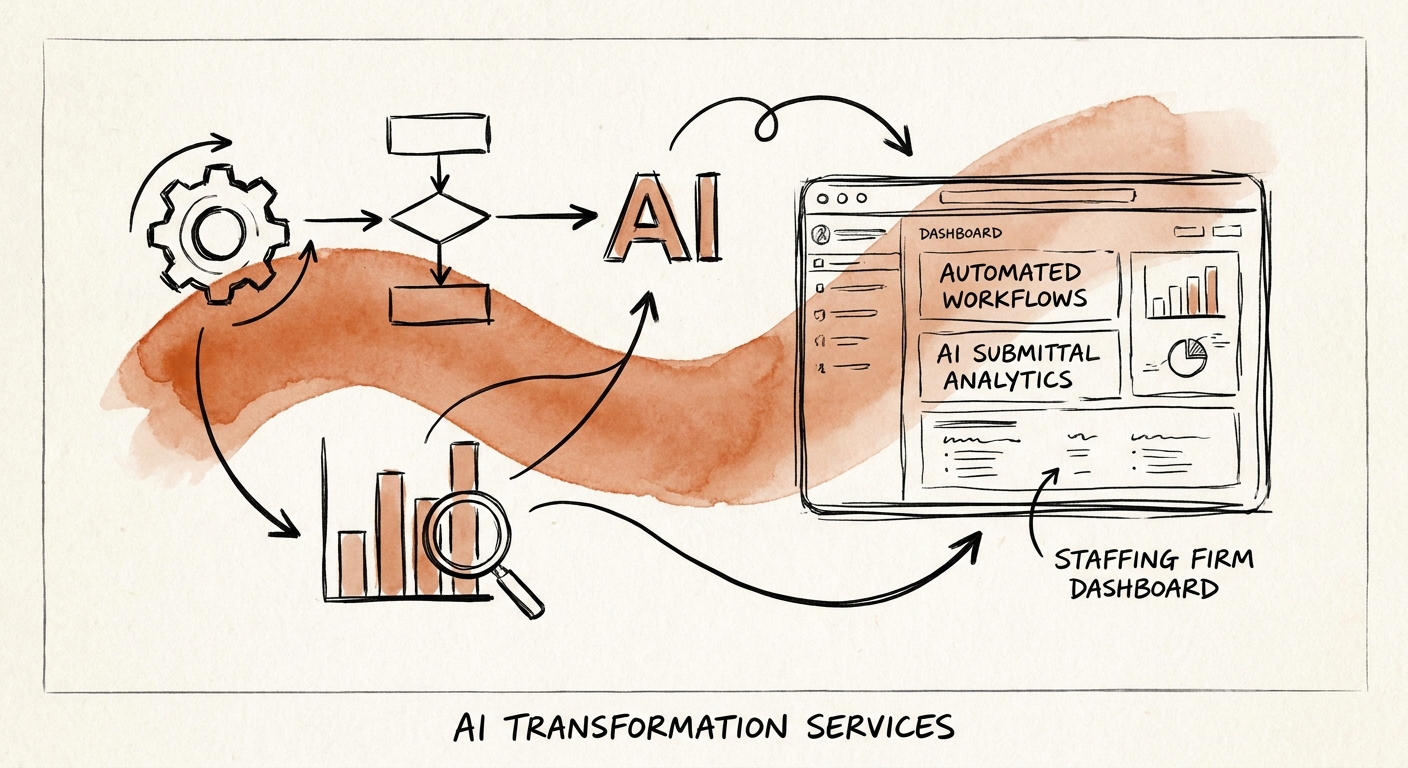
So before you license a single tool, name the redeployment trigger. The McKinsey State of AI 2025 finding that matters here is blunt: value shows up when you redesign the workflow, not when you bolt an assistant onto the old one. For staffing, redesign means the assignment end date stops being a field someone checks and becomes an event that fires — pulling the contractor's skills, surfacing matching open reqs, and drafting the redeployment outreach while the recruiter is still finishing yesterday's submittals.
What you cannot automate without breaking trust
Here is the line that separates a staffing firm that scales AI from one that gets burned by it: a model can rank candidates, but it cannot be the reason a candidate didn't get submitted. The moment an inferred-skills score quietly filters someone out of a shortlist, you have a discrimination exposure and a candidate-trust problem you won't see until a recruiter or a regulator does. The NIST AI Risk Management Framework is the right scaffold precisely because staffing AI touches the highest-stakes data you hold — resumes, inferred skills, screening decisions, client submissions — and it forces the questions that matter: where can the model be wrong, who can override it, and can you reconstruct why a candidate was or wasn't put forward six months later when someone asks.
Practically, draw a hard boundary. AI drafts the candidate summary, proposes the match, ranks the bench against an open req — and a recruiter owns the submit decision and can see and edit the reasoning every time. That single rule keeps you on the right side of auditability and keeps your recruiters trusting the tool instead of working around it.
The unglamorous prerequisite is data hygiene, and staffing firms have a specific mess: candidate and client data scattered across ATS exports, email, Teams, recruiter spreadsheets, and shared drives — often with permissions nobody has reviewed since the firm was half its size. The Microsoft 365 Copilot data protection architecture makes the dependency concrete: an assistant inherits whatever access boundaries already exist. Point it at a shared drive where any recruiter can open any client's confidential rate card or another desk's candidate notes, and the assistant will happily surface all of it. Permission review and content-boundary cleanup is not a phase-two nicety here — it's the gate the assistant has to clear before it ever summarizes a candidate.
Pick one desk, prove the gap, then expand
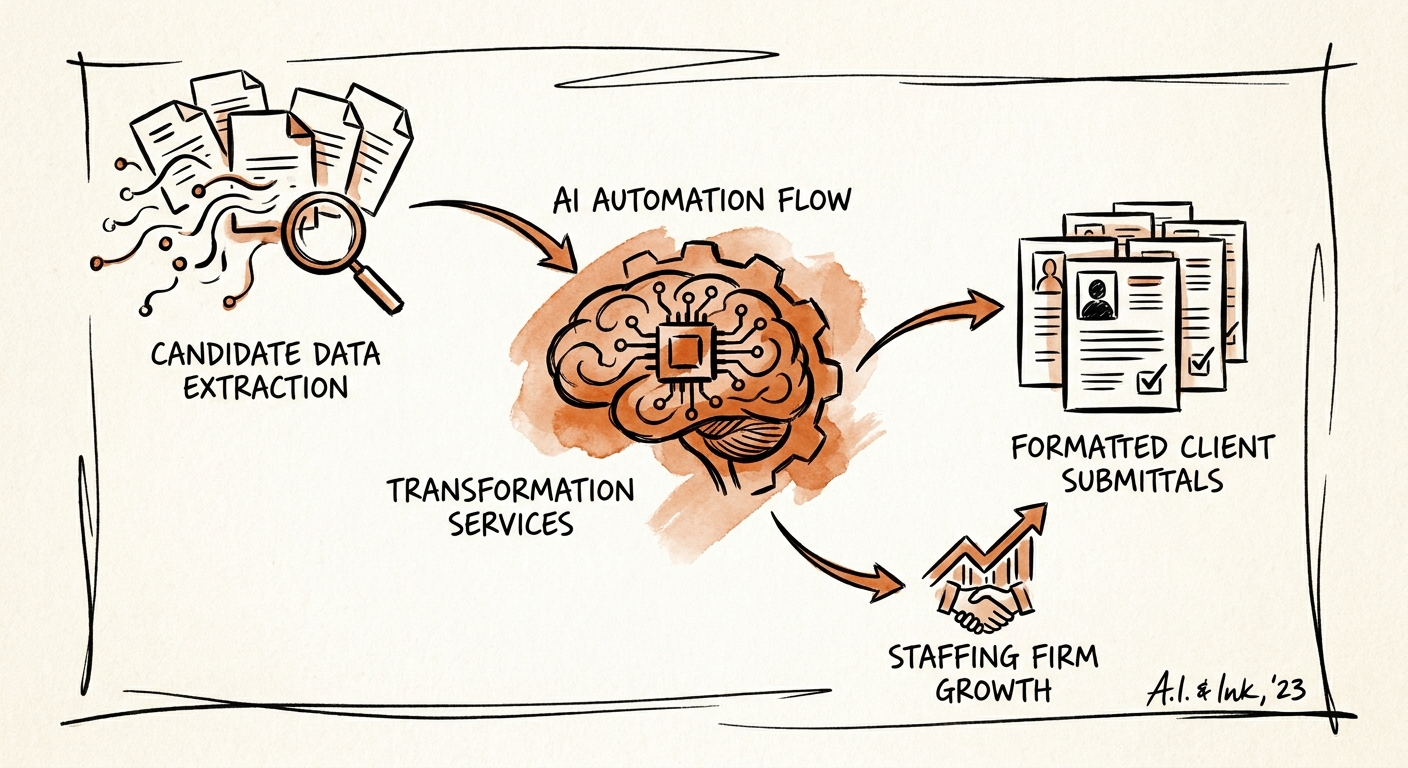
Don't transform the firm. Transform one desk. Take your highest-volume contract desk — the one with the most rolloffs and the thinnest bench discipline — and run a single proof for one quarter: every contractor with an assignment ending in the next two weeks gets an automated redeployment packet (their current skills, three to five matching open reqs, draft outreach) on a named recruiter's desk before they ask for it. Measure one number against the prior quarter: average days on bench between assignments. If that drops, you have the only ROI argument that lands with an owner — billable hours that would have evaporated, didn't.
The PwC 2025 Responsible AI survey reinforces why a single-desk proof beats a firm-wide rollout: responsible AI sticks when it's embedded inside how a real team makes decisions, with a human accountable for the call — not deployed as a layer everyone is told to use. One desk, one recruiter who owns the override, one metric. That's a result you can show the other desks instead of a mandate you have to enforce.
To rank which staffing workflow to attack first — redeployment, intake-to-shortlist quality, or candidate summaries — by value, risk, and how ready your data actually is, run the AI Opportunity Score and bring the output to Human Renaissance AI transformation services. You'll leave with a sequenced plan, not a tool you have to justify after the fact.