Your recruiters spend their morning fighting a Word document
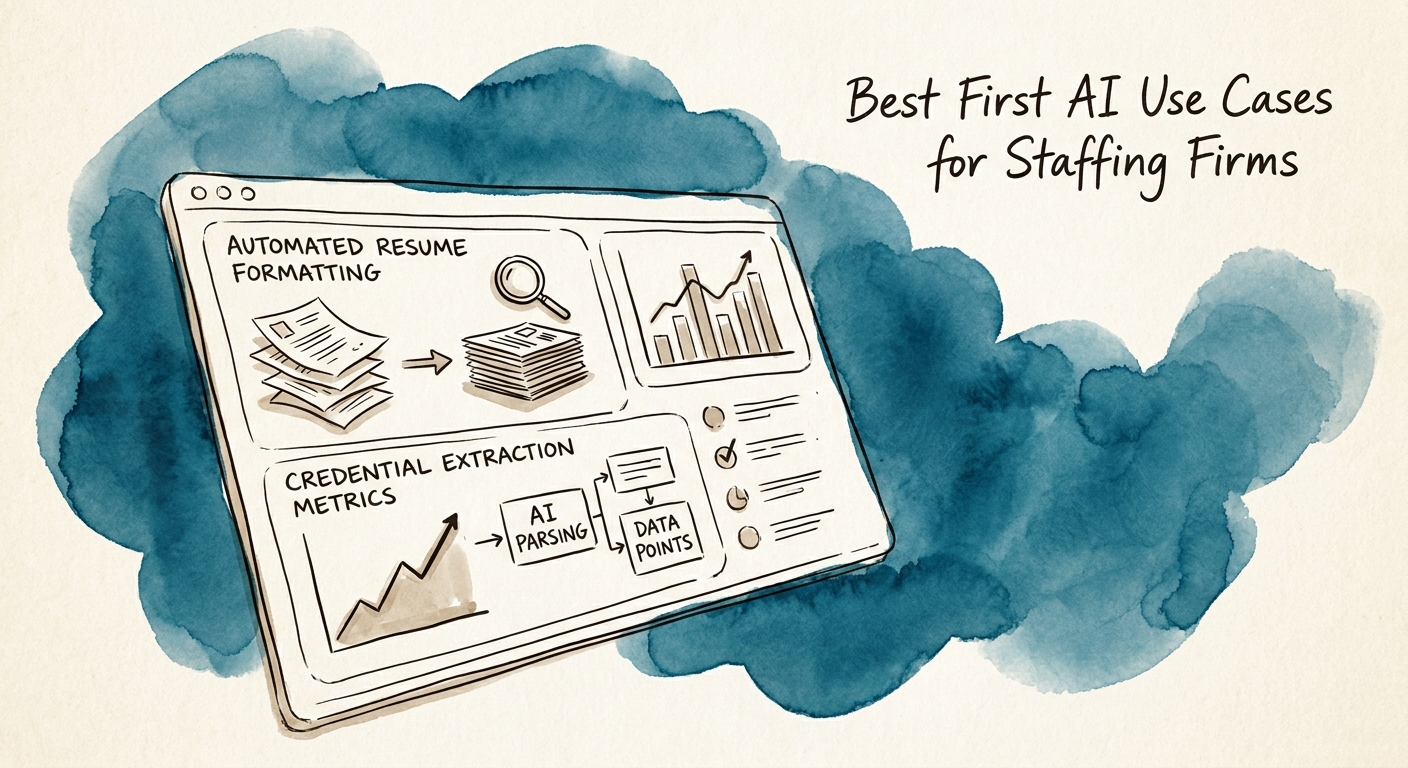
Picture a 60-recruiter healthcare staffing shop on a Tuesday. A travel nurse's resume comes in as a PDF from one source, a screenshot from another, and a half-finished VMS profile from a third. Before that candidate can go to the client, someone reformats the resume into the firm's submission template, retypes the RN license number and its expiration date into the ATS, confirms the BLS and ACLS certs haven't lapsed, and writes a two-line summary so the account manager doesn't have to read the whole file. That sequence happens dozens of times a day, and almost none of it is recruiting. It's transcription.
That is exactly where AI belongs first in a staffing firm: the document-heavy, high-repetition plumbing that sits between "candidate exists" and "candidate is in front of the client." Resume reformatting into your submission standard. Credential and license extraction into a reviewable checklist. Redeployment outreach to bench candidates whose assignments are ending. Recruiter-facing summaries built from notes the firm already owns. These workflows repeat constantly, run on source material you control, and have an obvious review standard. They also have a number attached: time-to-submit, the metric that decides whether your candidate or a competitor's lands the req.
The pressure most staffing operators feel comes from vendors selling end-to-end "automated sourcing and screening." That is the worst possible place to start, and not just because the demos overpromise. Staffing runs on candidate trust, client trust, and a regulatory surface that other industries don't carry. So you start at the opposite end — the manual work that delays submission — and you measure one thing honestly: did a high-volume workflow get faster, cleaner, and easier to supervise? Bullhorn's recruitment industry data consistently points to speed-to-submit as a primary driver of fill outcomes, which is why shaving the transcription tax beats a flashy candidate-scoring engine nobody can audit.
The line you do not cross: automating the no-hire decision
Here is the rule that separates a staffing firm using AI well from one walking into a lawsuit: the model can touch everything around the submission, and nothing inside the hire/no-hire decision. Do not let AI reject candidates, rank them for "culture fit," or assign a screen-out score that a recruiter then rubber-stamps. The moment a candidate gets filtered out and you cannot explain the source data, the logic, or the bias controls behind it, you have built what regulators now call an automated employment decision tool — and that is a category with teeth. Gartner's AI-in-HR guidance and the broader compliance landscape are converging on the same expectation: explainability and audit trails for anything affecting employment access. A staffing firm is the employer-adjacent party here. The exposure lands on you, not the vendor.
The reframe that keeps you safe and still fast: AI is an assistant to the recruiter, not a substitute for their judgment. It can flag that a candidate's profile is missing a pay preference or a shift availability. It can extract the expiration date off a certification so nobody submits a nurse with a lapsed license. It can draft the "your assignment ends in three weeks, here's what's open" email for a recruiter to approve. Every one of those gives the recruiter more time on the phone with candidates and clients — the part of the job that actually wins reqs. None of them decides who is qualified.
So before a single workflow goes live, write four sentences down. Which documents can the model read? Which fields can it write into the ATS or VMS? Which outputs require a recruiter to approve before they move? And what data — SSNs, full DOB, anything that could feed bias — never leaves your walls into a third-party tool? At Human Renaissance we treat this as operating design, not tool selection: find the choke point, clean the source data, set the review standard, then measure. AI earns the right to expand only after the first workflow proves out under that discipline.
Four builds, ranked by how fast they pay back
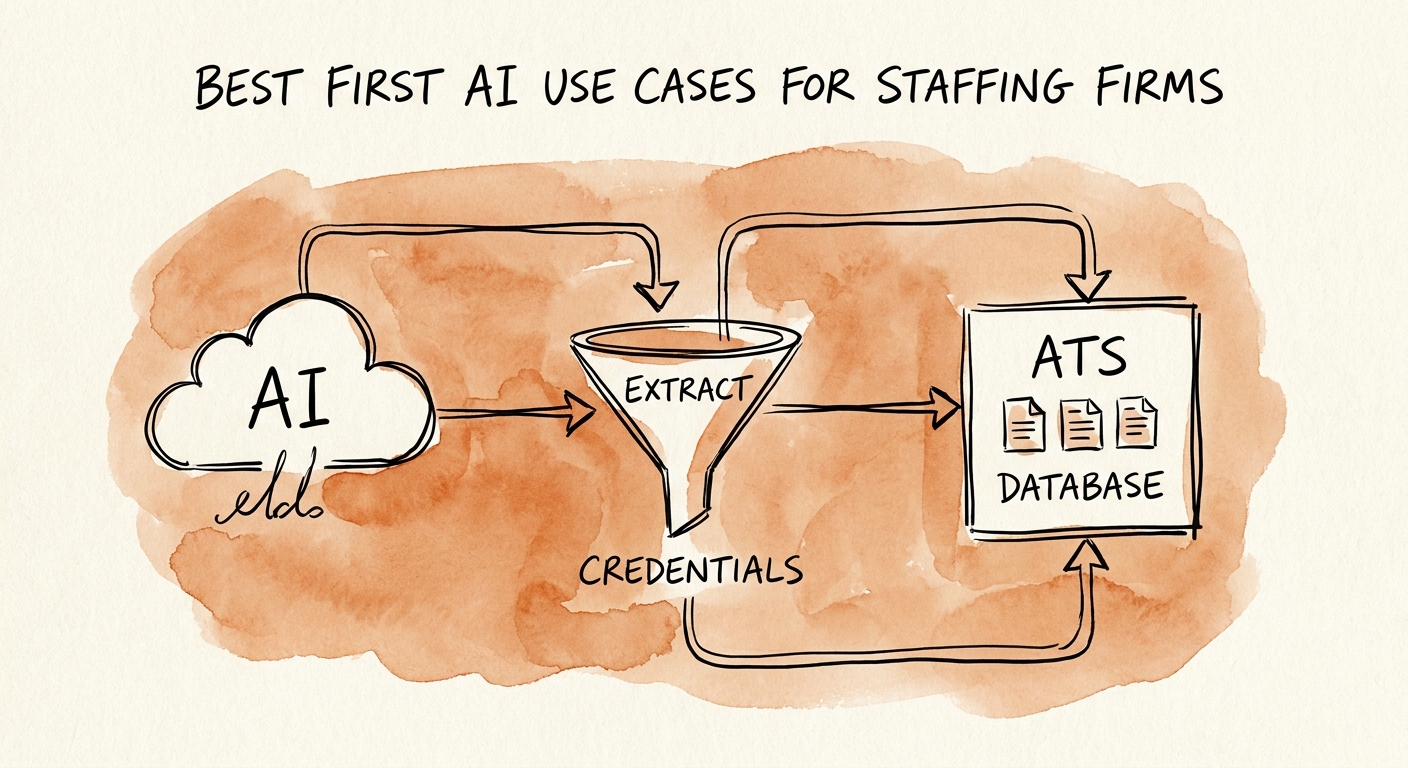
If you want a sequence to run, here it is in order of how quickly it returns value. One: resume and profile normalization. Convert inconsistent candidate documents into your approved submission format. This is the lowest-risk, highest-frequency build and it directly compresses time-to-submit. Two: credential extraction. Pull licenses, certifications, and — critically — expiration dates into a checklist a recruiter verifies. In healthcare, IT security, and skilled trades, a lapsed credential is a placement that blows up at the worst moment. Three: redeployment and follow-up drafting. Prepare bench-candidate outreach and client status notes from approved context; redeployment is the cheapest fill you'll ever make. Four: recruiter knowledge retrieval. Let teams query approved role requirements, client submission rules, and pay bands instead of digging through scattered notes and old Slack threads.
Every one of these needs a baseline before you turn it on. Capture today's cycle time, error rate, rework volume, missing-field rate, and time-to-client-ready submission. The goal is not to convert every saved minute into a dollar on a slide. It's to prove your operation can absorb more quality submissions without scaling administrative headcount one-for-one — which is the entire economic argument for AI in a margin-thin staffing business. McKinsey's research on generative AI puts the largest near-term gains exactly here, in repetitive knowledge work, and Staffing Industry Analysts and PwC's HR technology work point to the same operational layer.
Two practical detours. If your first workflow keeps choking on dirty data, fix that before you automate on top of it — see CRM cleanup before automating the workflow. If leadership is debating which of the four to start with, run them through the AI use-case scoring model so the call is made on evidence, not the loudest vendor. And if you just want a fast read on where you'd get the most leverage Monday morning, take the AI Opportunity Score. Automate the document handling, the credential checks, and the follow-up. Keep the assessment, the client relationship, and the final placement call human-owned. That is how a staffing firm buys operating leverage without spending its trust to get it.