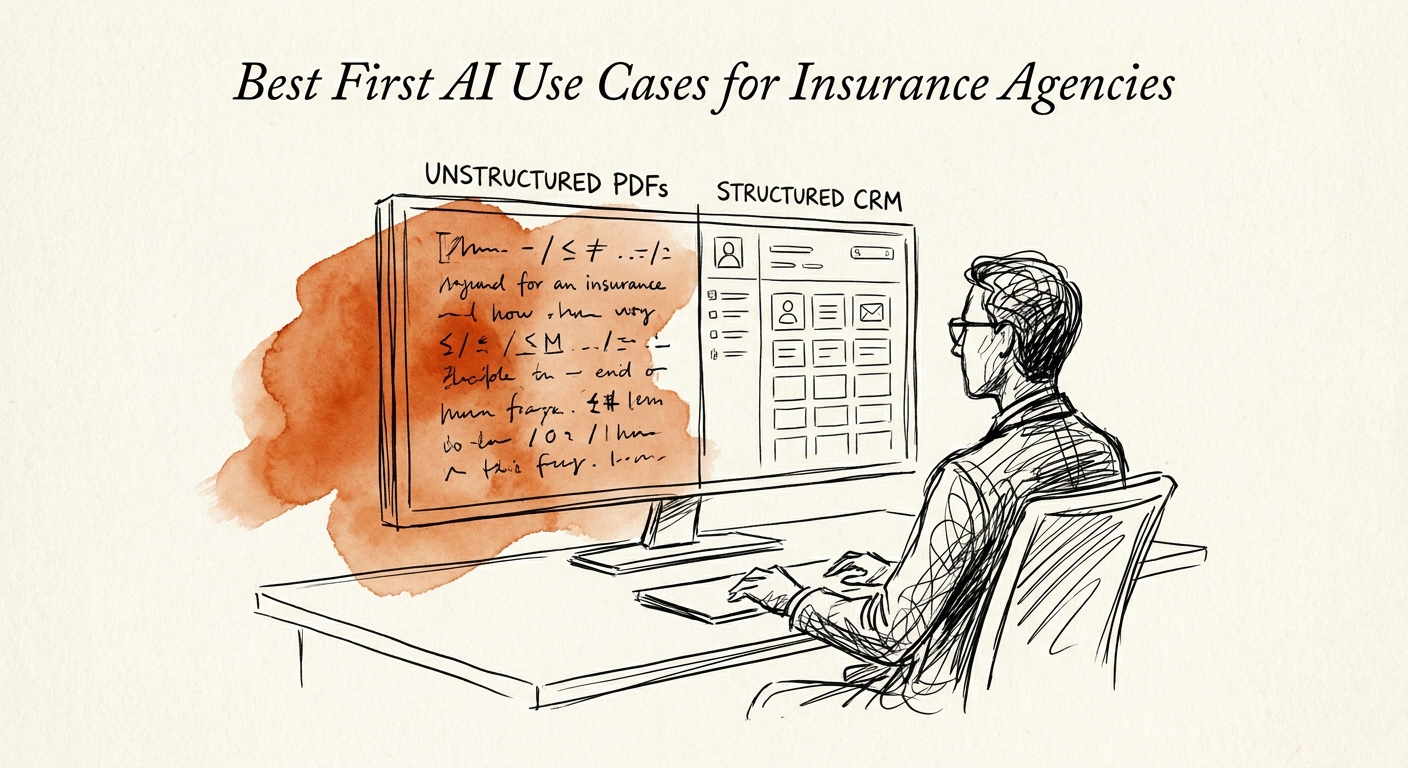
Look at the desk of your busiest account manager
By the second week of the month, a commercial-lines account manager is sitting on a renewal stack: a 38-page expiring policy, three years of loss runs from two different carriers, a half-finished ACORD 125, and an email thread where the insured mentioned they added a box truck and nobody updated the schedule. None of that is glamorous AI work. All of it is exactly where an agency should start.
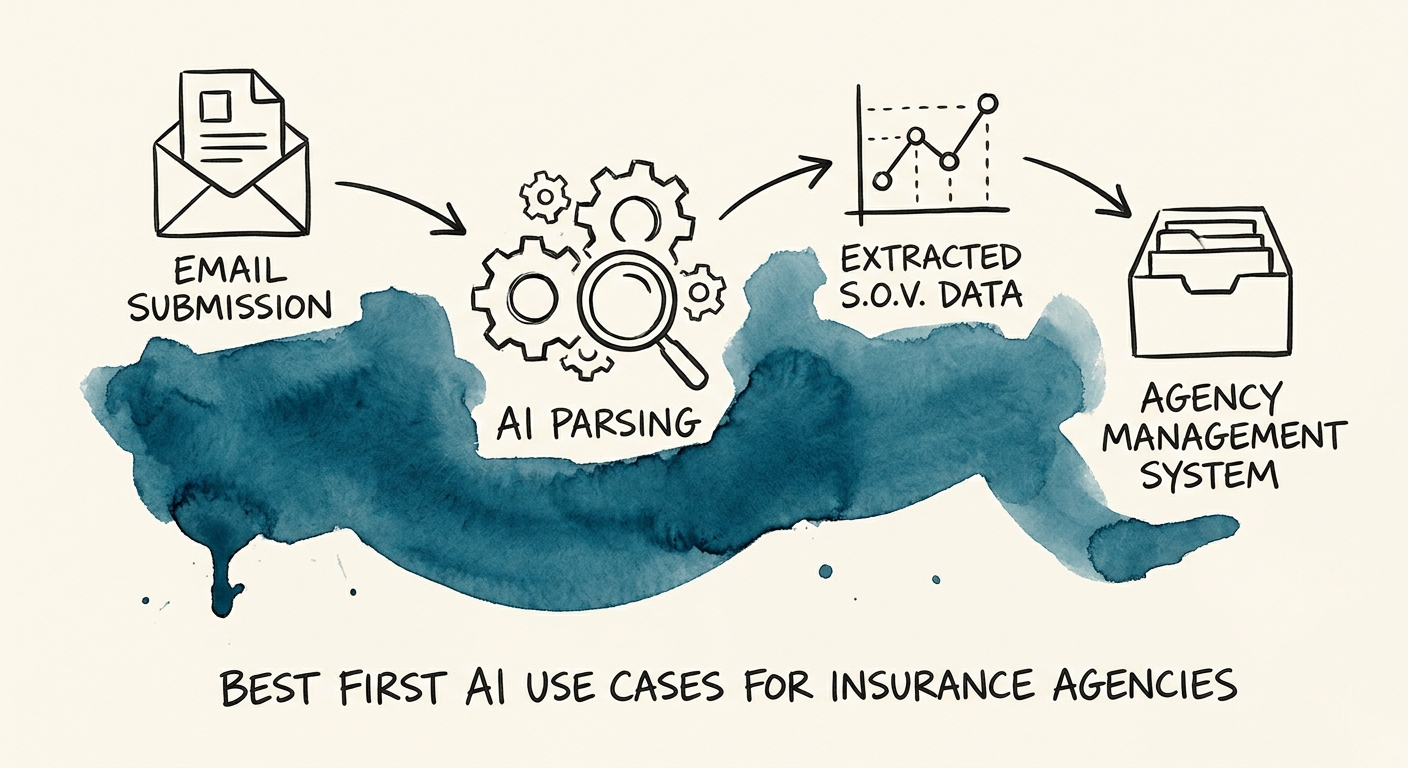
The mistake most agencies make is reaching for the dramatic use case first — an AI that "recommends coverage" or talks to clients. That is the one workflow where a wrong answer is an E&O claim. Start instead with the document-heavy preparation that eats your team's hours and carries no coverage opinion: submission intake, loss-run summarization, renewal packet assembly, policy-to-policy comparison, and producer follow-up. Each has a clear source document and a clear human owner. AI extracts and organizes; the licensed producer still makes every coverage-sensitive call.
Broad research backs the sequencing. McKinsey finds value concentrates where AI augments existing workflows rather than replaces judgment; IBM ties returns to deployment discipline; and PwC shows governance is the lever that separates pilots that scale from ones that quietly die.
The loss-run summary is your test case — and your trap
Pick one workflow to prove the model before you trust it anywhere near a client. Loss runs are the best candidate: a 40-person agency processes dozens a week, the format varies wildly by carrier, and the work is pure extraction — claim dates, paid vs. reserved, claim status, frequency by line. Have the AI produce a one-page summary with a loss ratio trend the producer can scan in thirty seconds instead of squinting at a PDF for ten minutes.
Here is the non-negotiable design rule, and the one that separates a tool you can defend from one you cannot: the summary must cite its own evidence. Every figure links back to the source document and page. Where a field is missing or two carriers' loss runs conflict, the AI flags it as a gap — it does not quietly average them or guess. The NAIC artificial intelligence guidance and the NIST AI Risk Management Framework both point the same direction: transparency, traceability, and a documented human checkpoint before anything touches a coverage decision or a client.
So the first pilot prepares a review packet. It does not send advice, bind anything, or email the insured. It hands a licensed human a faster, cleaner stack and a list of what is missing. That distinction is what makes this safe to run in a regulated book of business. When you are ready to wire that pattern across account service and producer support, AI Workflow Automation is the governed path to do it.
Measure rework, not enthusiasm
An agency pilot that "feels faster" tells you nothing. Track the numbers that move money and E&O exposure: submission intake completeness, renewal-prep time per account, missing-document rate caught before the producer's review, and — the one that matters most — the rework rate, meaning how often a human has to redo or heavily correct the AI's packet. If rework is high, the tool is shifting work, not removing it. Bain makes the case bluntly: the agencies that win are the ones that instrument the workflow, not the ones that buy the most ambitious system.
Stay narrow. Run it on one line of business — say, commercial property renewals — or one carrier's loss-run format, until the citations are reliable and your account managers trust the output enough to stop double-checking every field. Expansion is earned by a clean rework number, not by a roadmap.
Monday move: list every workflow that touches a document but not a coverage opinion, then rank them by hours-per-week. Run the AI Opportunity Score to compare those candidates head-to-head, and when you extend into client-facing account support, do it through Customer Service AI that keeps a licensed human in the approval loop.