The submittal that took 40 minutes and should have taken 5
Picture a recruiter at a 25-desk staffing firm on a Tuesday afternoon. They've got a candidate they like for a controller role. Before that person can go to the client, the recruiter has to: strip the candidate's name and photo for a blind submittal, retype the work history into the agency's house format, summarize the screening call from three pages of scrawled notes, pull the must-haves out of the job order to confirm fit, and update the ATS so the next teammate doesn't double-submit. Forty minutes of formatting and transcription wrapped around about four minutes of actual recruiting judgment.
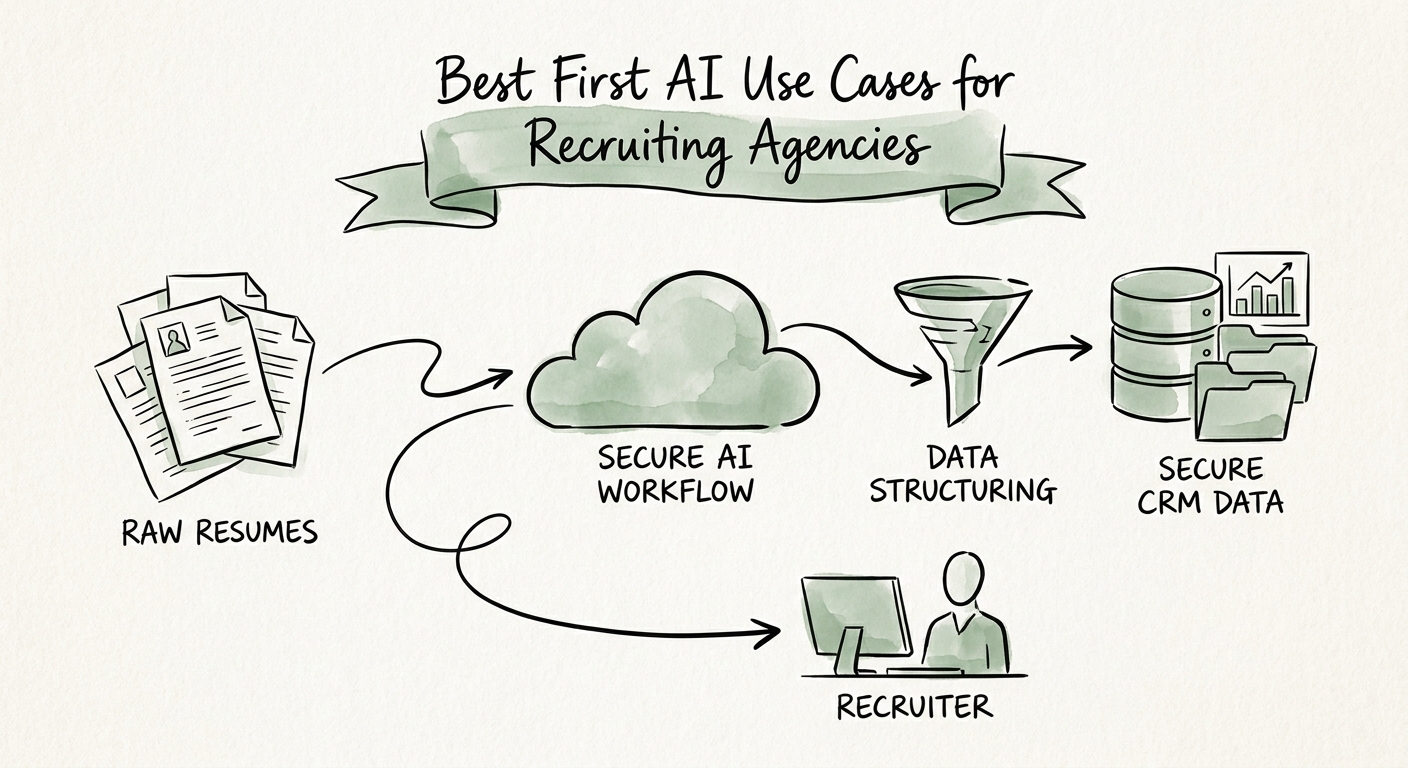
That 40-minute wrapper is where AI belongs first. Not the decision about whether this controller is the right hire. The clerical sediment around it: resume normalization, blind-profile drafting, interview-note synthesis, requirement extraction, CRM hygiene. These jobs are narrow enough to put guardrails on, sit close enough to a placement to move revenue, and produce an output you can hold up against a known standard and grade.
The pressure forcing the question is real. Application volume is up, AI-polished resumes make screening harder, and candidate data is scattered across job boards, the ATS, email, and a recruiter's own notes. Research from Korn Ferry on the rising cost of hiring and Staffing Industry Analysts' finding that firms using automation are roughly twice as likely to grow revenue point the same direction: the firms that win aren't the ones throwing more bodies at sourcing, they're the ones that move information faster. AI helps when it's bolted to a named workflow with a human reading the output. It hurts the moment it starts deciding who gets rejected.
Summarize, don't screen out
The single highest-value job for AI in an agency is synthesis. A candidate's record lives in five places: the parsed resume in the ATS, the screening call you took notes on, the skills assessment the client sent back, the job order requirements, and the side conversation about comp expectations buried in your inbox. Pulling that into one tight recruiter review packet is exactly the kind of tedious assembly a model does well and a recruiter does slowly. The recruiter reads the packet against the sources, fixes what's wrong, and decides. That's the line: AI assembles the picture, the human draws the conclusion.
Why hold that line so hard? Because the other side of it is a liability. The moment a model is filtering or rejecting candidates on its own, you've imported bias exposure and a story you can't tell a client or a candidate's lawyer. Gartner's guidance on AI in HR and the Korn Ferry "human-AI power couple" framing both land on the same discipline: AI assists, people decide, and you keep a record of which is which. For an agency, that audit trail is part of the product. You should be able to say, in one sentence, what the model read, what it produced, who reviewed it, and what stayed a human call. Clients want speed. They will not forgive automated judgment dressed up as a clean summary.
So the safe starter menu is narrow on purpose: blind-profile drafting, screening-call summaries, interview-note cleanup, credential-checklist extraction from a resume against a job order, and ATS field hygiene. Every one of those has a recruiter checkpoint before it touches a candidate or a client, and every one gives you a number to grade against — minutes per submittal, rework rate, time-to-shortlist, data completeness in the ATS. Even McKinsey, which reports saving over a million hours with AI, is explicit that it can't replace the human skills at the core of the work. In recruiting, that core is the relationship and the judgment. The formatting around it is fair game.
Run it as a 90-day desk pilot, not a transformation
You don't need an AI program. You need one workflow, one small group of recruiters, and 90 days to find out if it actually moves a number. Days 1-30: write down how the chosen task works today, pick the single use case, define exactly which source data feeds it, and set the review rule. Days 31-60: run it live with two or three recruiters and let them mark up the output every time. Days 61-90: put the baseline next to the pilot and make a real decision — scale it, fix it, or kill it.
Choose a first workflow that already has a pass/fail standard, because that's what makes the result honest. A blind profile either matches your house format or it doesn't. A screening summary either captures the client's three must-haves or it dropped one. A credential checklist either reflects the resume or needs a correction. That binary clarity keeps you from the trap of counting "saved minutes" that never actually show up as another submittal or another placement. Measure the thing the desk feels, not the thing the vendor demos.
If you're still picking the first workflow, run your candidates through the AI use-case scoring model. If your ATS and CRM are a mess of dupes and half-filled fields, fix that before you automate on top of it — clean the data first. And if leadership wants a fast read on where to point the first dollar, the AI Opportunity Score will rank your candidate workflows in a few minutes. The aim isn't a smaller, more robotic desk. It's getting the recruiter off the keyboard and back on the phone with the candidate who's deciding between your offer and a counteroffer tonight.