The bot will narrate your worst process back to the customer
Picture a 60-seat support floor. Average handle time is creeping up, the queue spikes every Monday, and an executive has seen a competitor's slick chat widget. So the directive comes down: ship a customer-facing AI bot. Six weeks later the bot is live, and it's confidently telling callers things that are six months out of date — because the knowledge base it reads from was last cleaned up when someone had the time, which was never.
Here's what most leaders miss. A chatbot is not a shortcut around a messy operation; it's a megaphone for it. If your routing rules are fuzzy and nobody owns escalations, the bot doesn't hide that — it performs it, at scale, in front of the exact people you can least afford to confuse. The pattern across McKinsey's State of AI research, IBM's Institute for Business Value, and PwC's responsible AI work is consistent: the return comes from operating design, governance, and adoption — not from how visible the tool is.
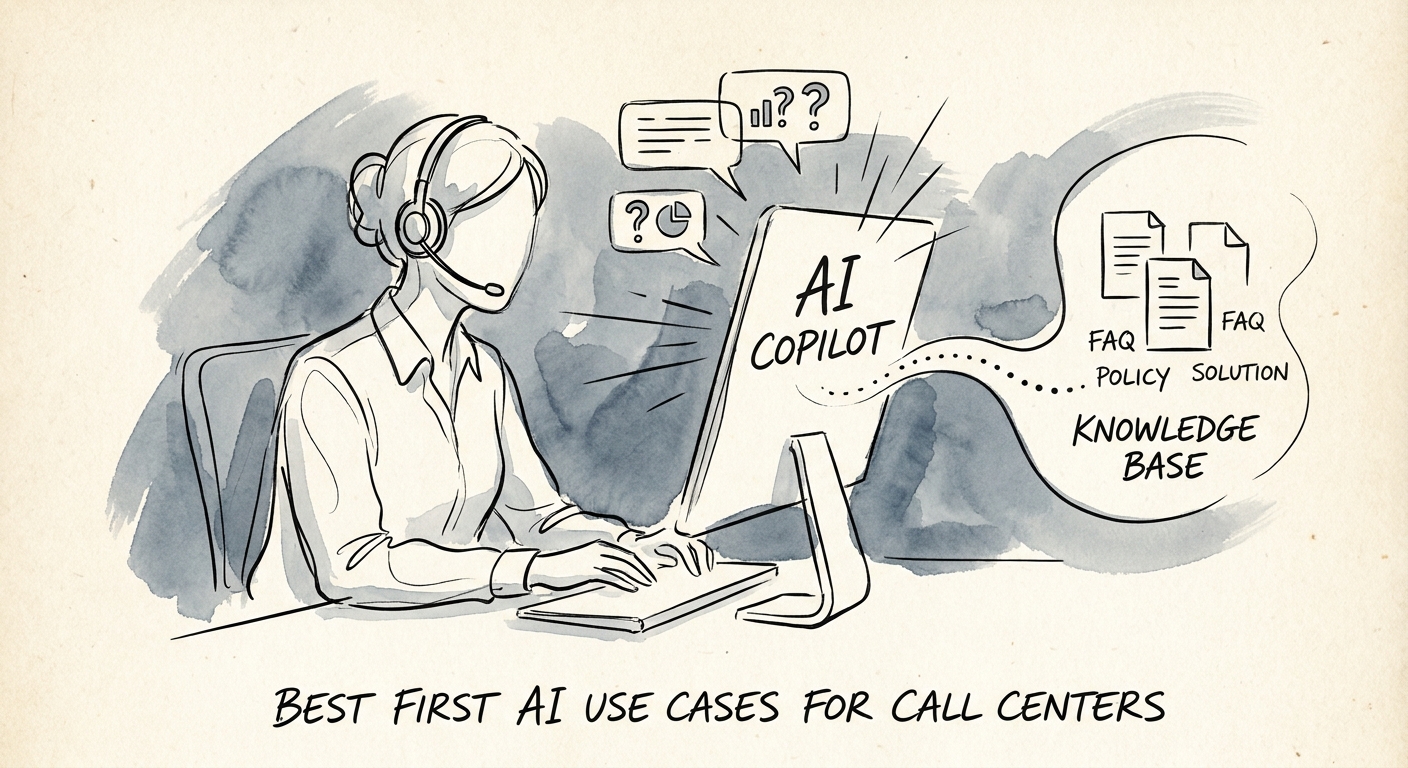
The better first move points the AI at your agents, not your callers. Same model class, same vendors, completely different risk profile. When an agent is in the loop, a wrong suggestion gets caught before it ever reaches a customer. You get the lift without betting your brand on a system that hasn't earned trust yet.
Four workflows that pay before you ever face the customer
If I'm scoping a first call center build, I want workflows that already have an owner, a number you can read today, and a human who signs off. Four clear the bar.
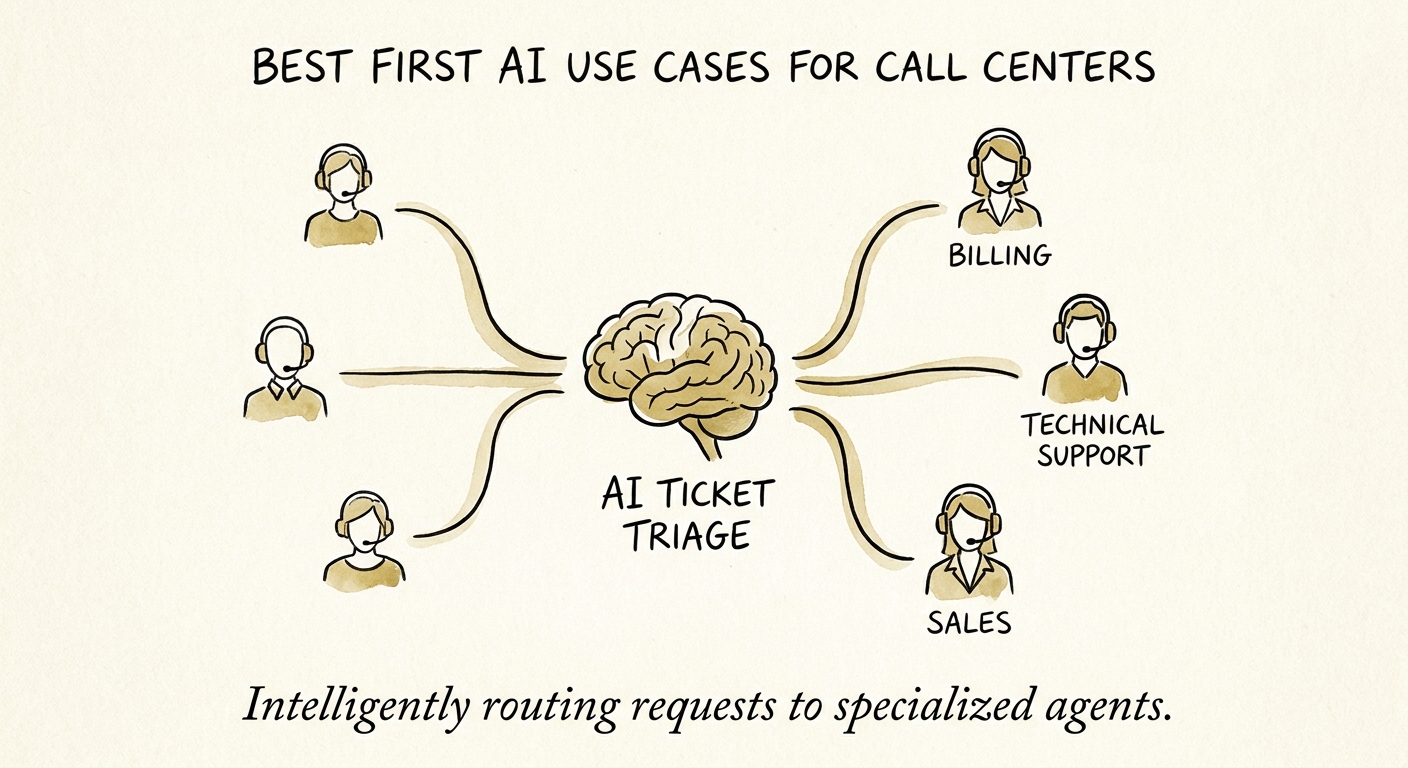
Triage. Inbound tickets land in the right queue with the context attached — account history, prior tickets, likely intent — instead of a tier-one agent reading cold and guessing where it belongs. Watch misroutes and time-to-first-touch.
Agent knowledge retrieval. This is the unglamorous one that moves the most. Right now your agent has the customer on the line and four tabs open, hunting for the current refund policy. Pull the approved answer to the agent's screen, with the source article linked, and dead air shrinks. The agent still decides — they're just not the search engine anymore.
After-call notes. The conversation becomes a structured wrap-up the agent edits and approves in seconds, not a three-line summary scribbled while the next call rings. Cleaner records feed everything downstream, including triage on the customer's next contact.
Quality review. Instead of QA listening to 2% of calls and extrapolating, the system flags patterns across the full volume — repeated knowledge gaps, compliance phrasing that slipped, escalations that should have happened sooner. Your QA lead reviews signal, not a random sample.
Notice these stack. A bot can't safely talk to customers until the underlying system can classify an issue, retrieve a trusted answer, and explain an exception. Nail those four and you've quietly built the spine a customer-facing layer needs. When that day comes, the Customer Service AI service path is where to take it.
Run the pilot on numbers your floor already lives by
Don't invent new "AI metrics." Your team already trusts time-to-route, handle effort, rework rate, escalation accuracy, QA review time, and how often a caller has to come back a second time. Baseline those for one workflow, change the workflow, and read the same dashboard. If after-call notes were eating four minutes a ticket and now cost forty seconds of editing, that's the entire argument — no slideshow required.
Governance isn't bureaucracy here; it's what keeps an agent from defending a bad answer they didn't make. Every AI suggestion should carry the source it used, a confidence signal, the recommended action, and a visible point where a human approves or overrides. That evidence trail is also how you improve the thing — when retrieval surfaces a stale article, you know exactly which one to fix.
Monday, do this: pick the single workflow where your team complains most about wasted time, and run it through the AI Opportunity Score to pressure-test value against readiness. If it scores, the 90-Day AI Implementation Sprint is the path to a governed, measured pilot — behind the agent, where the first win is supposed to be.