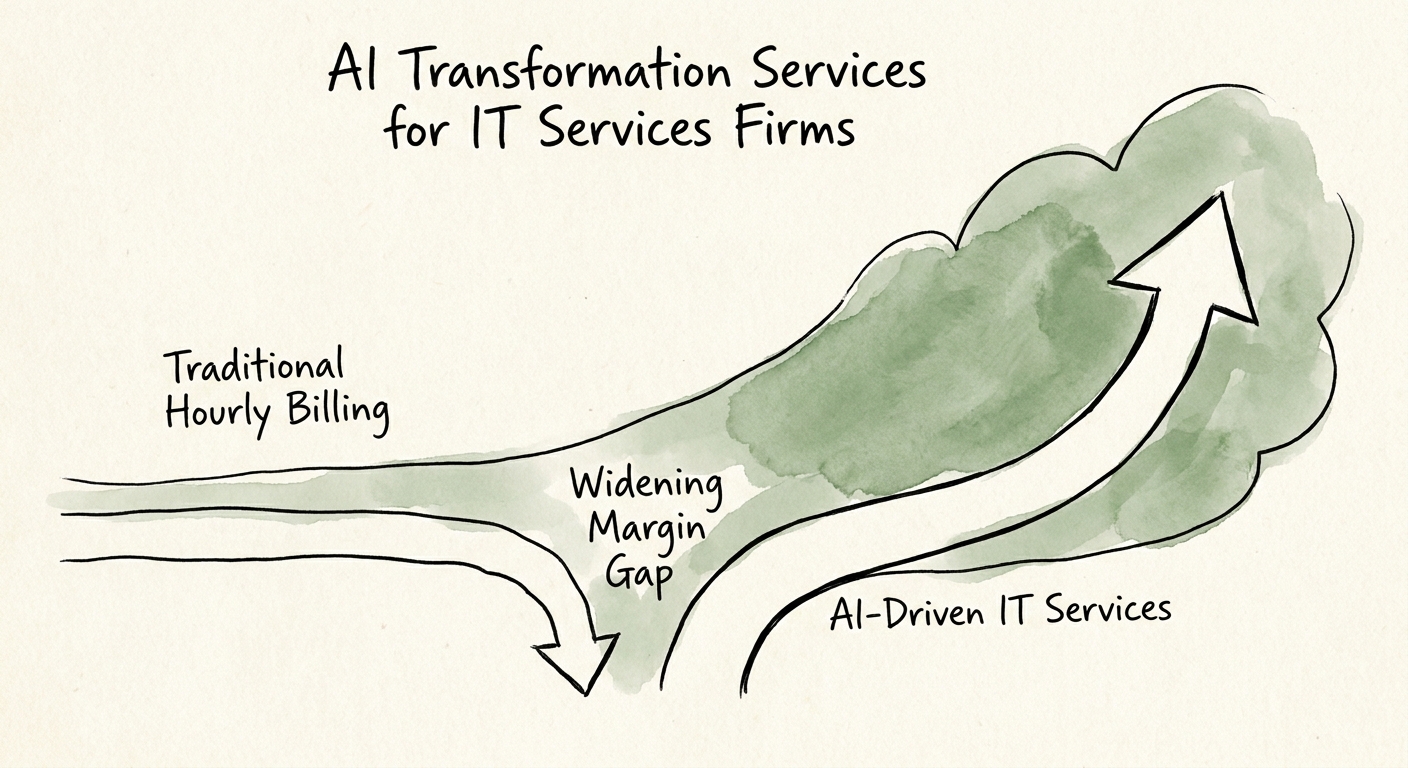
The firm that bills by the hour can't profit from making hours disappear
Picture a 60-person managed services and integration shop. An engineer who used to spend a full day writing a migration runbook now does it in ninety minutes with an assistant. Good news for the client. Quiet disaster for the P&L, because that firm prices the engagement at blended hourly rates and just deleted six billable hours from the invoice. The AI worked exactly as promised, and it shrank revenue.
This is the trap that's specific to IT services: you are one of the few business types whose core product is the same thing AI compresses fastest — documentation, ticket triage, test generation, status reporting, knowledge search, scoping. Every other industry buys AI to speed up an internal cost center. You're speeding up the thing you sell. So the first transformation decision is not "which copilot," it's "what happens to the invoice when delivery takes half the time."
Three answers are legitimate and each points a different direction. Hold price and absorb the speed as margin (fixed-fee or outcome work). Pass the speed to the client and win on retention and account growth (good for sticky MSP relationships). Or carve the freed capacity into a new advisory line you couldn't staff before. What's not legitimate is doing nothing and watching utilization-based pricing turn your own productivity into a discount you didn't mean to give.
Before you pick a tool, pick the workflow and the pricing model it lives inside. Start with how to find the manual work worth fixing — choose one internal delivery workflow, not ten.
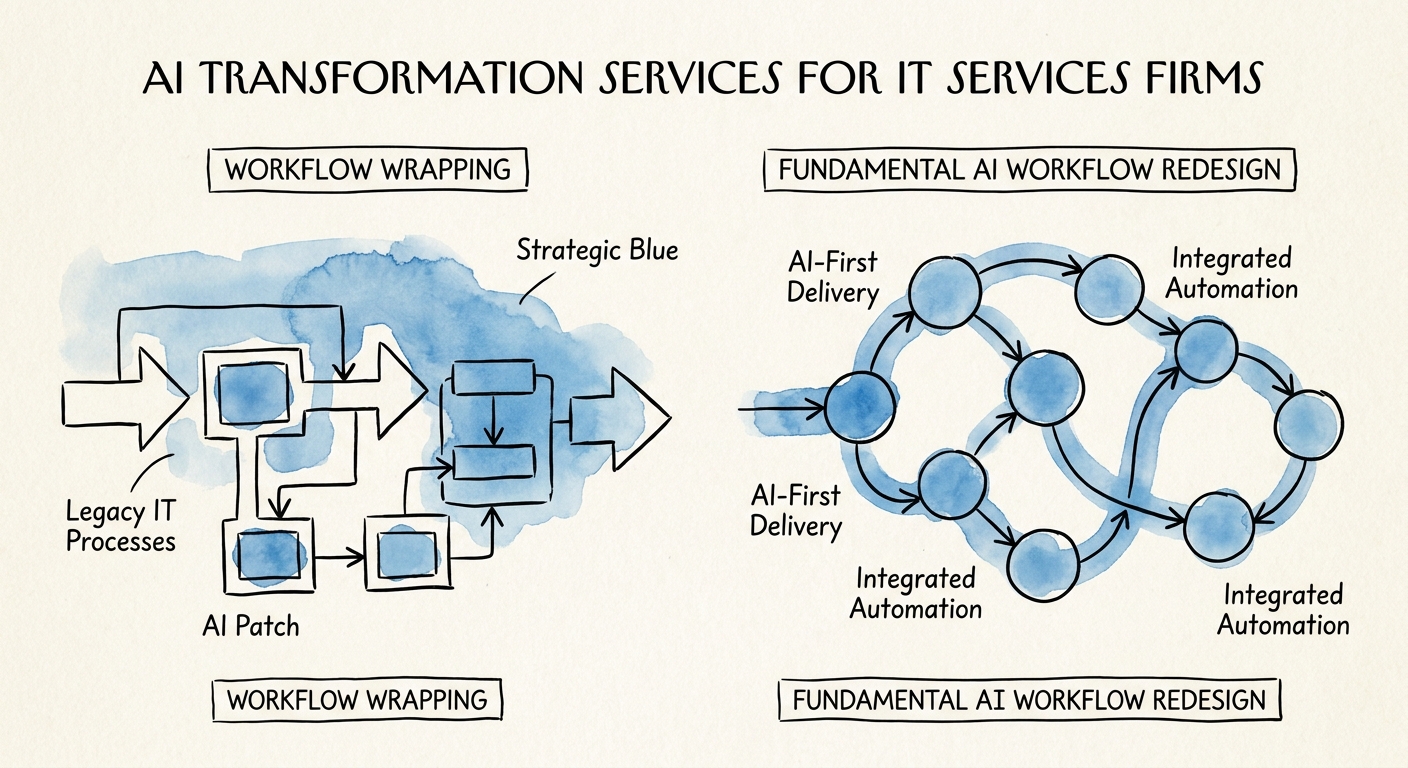
Wrapping AI around a process you can't already describe just makes the mess faster
The failure mode looks productive. A team bolts a summarizer onto support tickets — but the escalation rules live in three senior engineers' heads, so the AI confidently summarizes its way into the wrong queue. Another team adds a runbook drafter — but there was never a standard runbook format, so now there are forty AI-generated formats instead of forty human ones. You didn't fix variance. You industrialized it.
The order that actually works runs backward from where most firms start. First, can a new hire follow this delivery workflow from the written version alone? If not, the process isn't ready for AI; it's ready for documentation. Second, where exactly does a human review the AI's output, and what's the rule they apply? Third — only now — what's the quality threshold that lets work pass without review? The research consistently lands on the same point: value comes from redesigning the operating model, not from tool access. See McKinsey's State of AI, IBM on workflow automation, and Gartner's IT research. PwC's responsible-AI work adds the part IT firms feel acutely: when you handle client systems and data, the governance gap isn't a compliance footnote, it's the thing that ends contracts.
There's a sharper edge for IT services specifically. Your clients can smell tooling. If your account team starts saying "AI-assisted delivery" without being able to explain what the AI touches, what a human verifies, and where client data flows, you've handed a technical buyer a reason to doubt you. The firms that win the conversation are the ones that can draw the workflow on a whiteboard — input, AI step, human checkpoint, escalation path, measured outcome — because they've already run it on themselves.
Sell the transformation only after you've survived it
Here's the asset most IT services firms overlook: the scar tissue from your own rollout is the product. When you redesign one internal workflow — say, migration planning — you generate exactly what a client engagement needs. A use-case selection rationale. Governance rules. Data boundaries. A training and adoption cadence that accounts for the engineer who refused to use it for the first month. A before/after on cycle time and rework. That documented internal method is more credible than any deck, because you can say "we cut our own runbook time and here's where it broke and how we fixed it." MIT Sloan's AI coverage keeps returning to adoption and organizational change as the binding constraint — and a firm that's lived through its own adoption fight can guide a client through theirs.
Then make the first client offer narrow enough to sell and tight enough to repeat: a readiness diagnostic, a single workflow-automation sprint, a delivery knowledge-system build, or a governance roadmap. Each with a stated buyer problem, the steps, the measurable outcome, the risks, and what the client owner has to do. And build in the honesty that earns trust — say out loud which client workflows aren't ready, because the data is dirty or the decision rights are unclear or security review hasn't happened. The firm that names the limits beats the one that treats every problem as an agent waiting to be deployed.
This Monday: pick one internal delivery workflow, write down its current steps before any AI touches it, and run the AI ROI Calculator against the freed hours to see whether they become margin, client value, or a silent discount. When the internal method holds, use the 90-Day AI Implementation Sprint as the governed path to turn it into something you can sell.