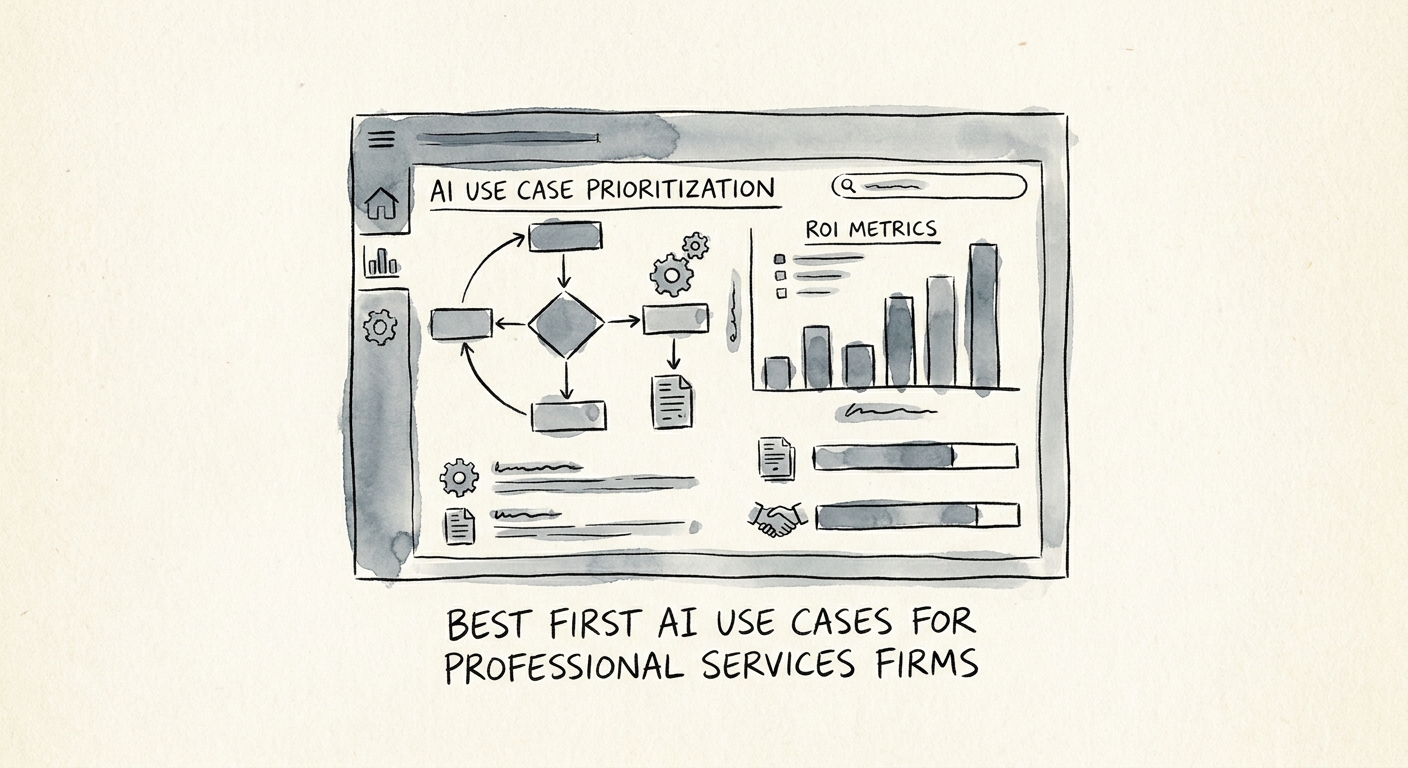
Watch a partner rebuild the same proposal at 9pm
A senior person at a 60-person firm is stitching together a statement of work the night before it's due. The relevant case study is in a deck from last March. The security questionnaire answers live in three different SharePoint folders. The pricing logic is in someone's head. Two of the consultant bios are out of date. None of this is the work the client is paying for — and all of it is being done by your most expensive people, after hours, from memory.
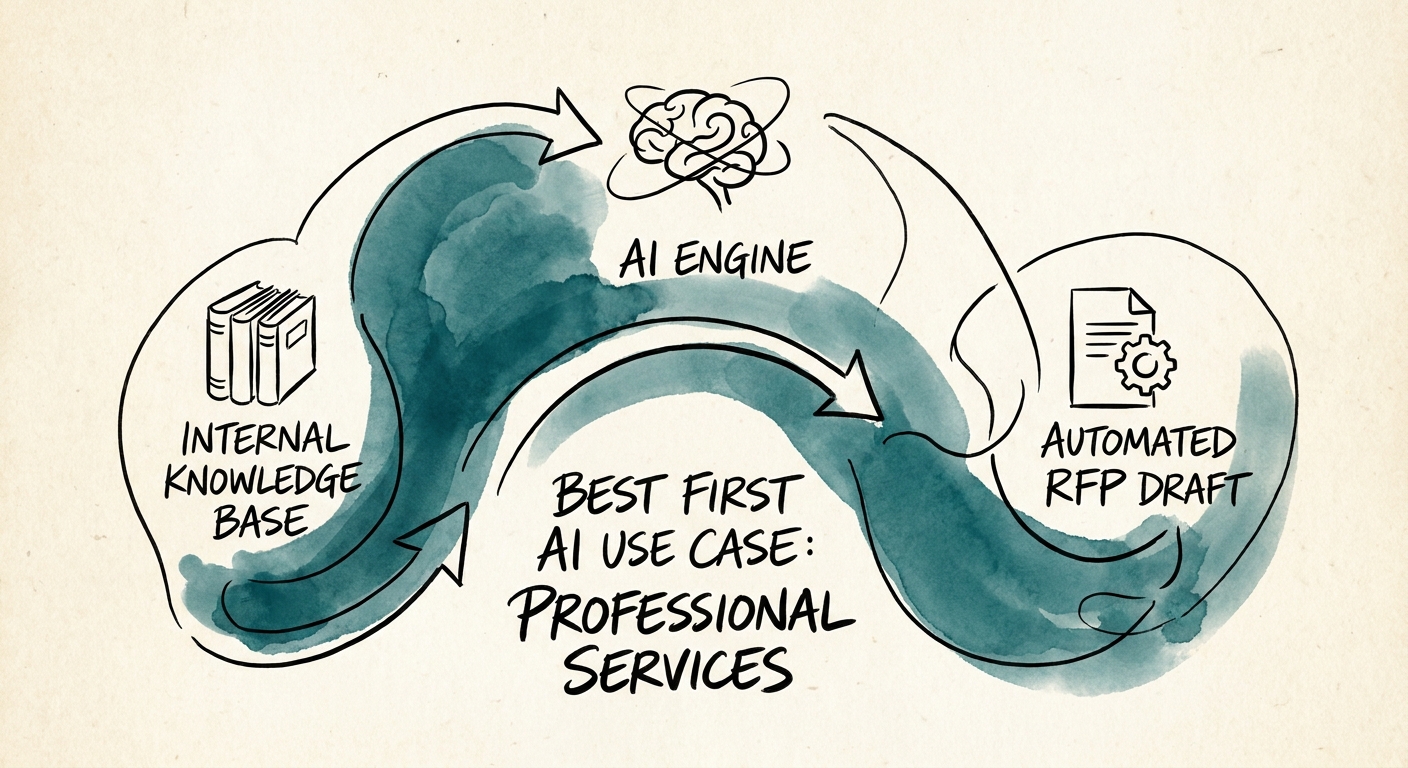
That scene is the single best place to point your first AI dollar. Not because proposals are glamorous, but because the firm already owns every input: approved service descriptions, prior SOWs, redacted case studies, resumes, rate cards, and a library of security and compliance answers. A governed assistant can assemble a first draft from that approved material in minutes, and a partner reviews scope and commercial commitments before it ever reaches the buyer. The expertise stays under expert control; the assembly stops eating evenings.
The reason to start internal rather than client-facing is margin, not caution for its own sake. Research from McKinsey operations insights, IBM workflow automation coverage, and Bain AI insights keeps landing on the same point: AI value shows up where there's a real process, a clear owner, and friction you can measure — not where there's a flashy demo. Before you scope anything, walk through how to find the manual work actually worth fixing.
Three workflows that share one trait: the firm already owns the inputs
Proposal and SOW drafting is usually the strongest opener because the payback is visible on the next deal. But two adjacent workflows have the same property — approved source material, a known reviewer, and a measurable choke point — which is exactly why they're safe seconds.
Document and matter intake. In most services firms, the gap between "signed" and "first billable hour" is where money quietly leaks. Engagement letters, onboarding packets, discovery notes, client-supplied data, and compliance docs pile up while someone manually classifies them and chases what's missing. AI can read the document, extract the fields, flag the gaps, and route exceptions to the right owner — so a week of intake limbo becomes a day, and you start the clock sooner. Accountability doesn't move; the waiting does. The document intake ROI guide models that gap-to-billing math.
Knowledge retrieval. The most underused asset in a services firm is its own past work. A secure internal assistant that surfaces prior deliverables, delivery playbooks, and lessons learned — with the source reference visible so the consultant can verify before reuse — turns tribal memory into something a second-year associate can query instead of interrupting a principal to ask. This is not a chatbot toy; it's faster access to the firm's operating memory. The knowledge-bot evaluation guide and the proposal drafting ROI guide go deeper on both.
What most firms get wrong: they start with a client-facing "AI advisor" because it sounds like the future, then discover they've put a model in the seat where professional judgment — the thing the client is actually buying — is supposed to sit. Start one layer back, where the firm owns the source and the stakes are operational.
The scorecard that tells you whether to expand or kill it
Write the scorecard before the pilot, not after. For a proposal workflow, that means: hours of partner time per SOW, number of review rounds, turnaround from RFP to submitted draft, and win rate on AI-assisted proposals versus the baseline. For intake, it's days from signed to first billable hour. The trap to watch for is the workflow that produces drafts faster but triples senior-review time — that's not a win, that's moving the bottleneck upstream and calling it progress. A real win shortens a handoff, tightens consistency, and leaves your experts approving rather than assembling.
Just as important is writing down what the model is forbidden to do. In a services firm that list is specific: it does not invent credentials or certifications, it does not cite a client result that didn't happen, it does not move pricing, it does not commit a delivery date, and it does not issue final advice without a named professional signing off. Say a 40-person advisory shop sets exactly those guardrails — the assistant can prep, organize, and draft all day, and a human still owns every commitment that leaves the building. That's the line that keeps quality and liability where they belong. PwC responsible AI research and MIT Sloan Management Review AI coverage both reinforce that adoption and accountability, not model choice, decide the outcome.
Once the first workflow earns its keep, expand to the workflow next door — one that shares inputs and review rules — so each new use case inherits the governance and the measurement discipline you already built. That's a far better path than a firmwide license rollout nobody adopts. Rank your candidates with the AI Opportunity Score, then pressure-test the numbers on your top pick with the AI ROI Calculator before you commit a dollar.
