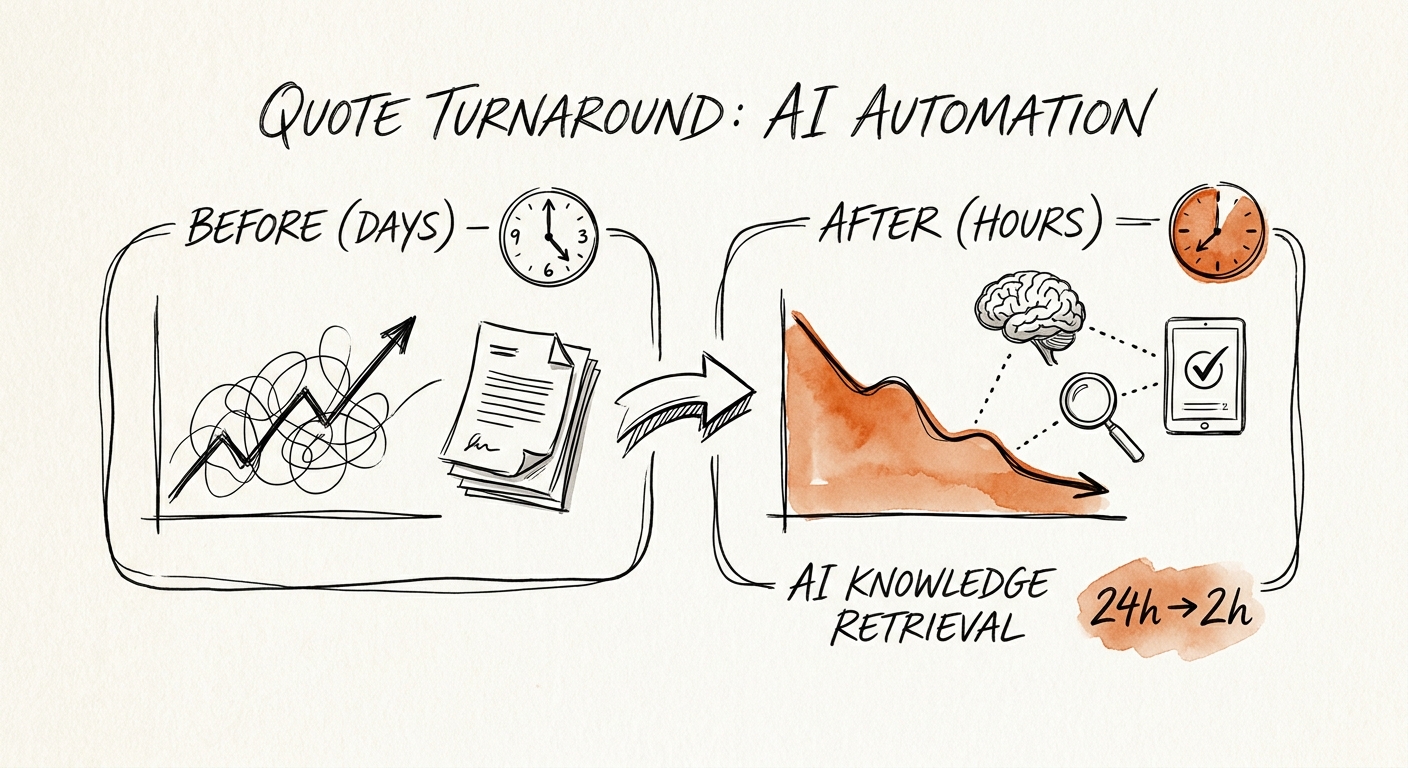
The four-hour quote is a content problem, not a speed problem
Picture a B2B tech-services shop where a rep gets a request for a 200-seat deployment with two add-on modules and a non-standard payment term. They open last quarter's proposal for a similar deal, copy the pricing, ping finance on Slack about the term, wait, guess on the module discount, and send it. Four hours later the quote goes out. Two weeks after that, delivery discovers the rep quoted a bundle price that was retired in March.
That is the workflow people want AI to fix. And it can — but notice that none of the four hours were spent typing. They were spent hunting for the authoritative answer. Salesforce State of Sales shows reps now expect AI support inside the selling motion, but a quote generated in eight seconds from a price book that contradicts itself just produces wrong answers faster.
This is why quote turnaround is one of the better first AI workflows in knowledge management — and also one of the easiest to botch. IBM Institute for Business Value AI capabilities research makes the operating-model point plainly: AI value rides on data, adoption, measurement, and governance. If your current pricing, discount tiers, and standard terms live across three spreadsheets, a CPQ tool nobody updates, and the tribal memory of one senior AE, your first project is not "AI quoting." It is making the price book the single source of truth. Do that, and the AI layer becomes almost trivial. Skip it, and you have automated your inconsistency.
Draw a hard line: AI prepares, humans approve
The cleanest design for a quote workflow gives the AI exactly one job — assemble a complete draft — and explicitly denies it the others. It should pull approved product descriptions, current list pricing, standard terms, and the relevant exception guidance, then hand back a quote packet that shows its work: here is the price, here is the source it came from, and here are the two line items that fall outside standard rules and need a human.
What it must never do: approve a discount, change a margin floor, or invent a customer-specific term because the prompt sounded confident. In a services business, a single fabricated "we'll waive the implementation fee" can erase the margin on the whole engagement. The NIST AI Risk Management Framework is the right lens here precisely because quoting touches revenue — you assign the risk controls before the model can influence what hits the deal, not after a botched quote teaches you why.
The unglamorous prerequisite is access hygiene. Quote knowledge in most mid-market firms is scattered across SharePoint folders, Teams threads, email history, and a graveyard of old proposals. Microsoft 365 Copilot data protection architecture spells out why this matters: an AI that can retrieve "the last proposal we sent this customer" will also happily surface the version with the confidential override pricing, or the discount you gave a different account, unless the access model is cleaned up first. Treat the access cleanup as part of the project, not a follow-up.
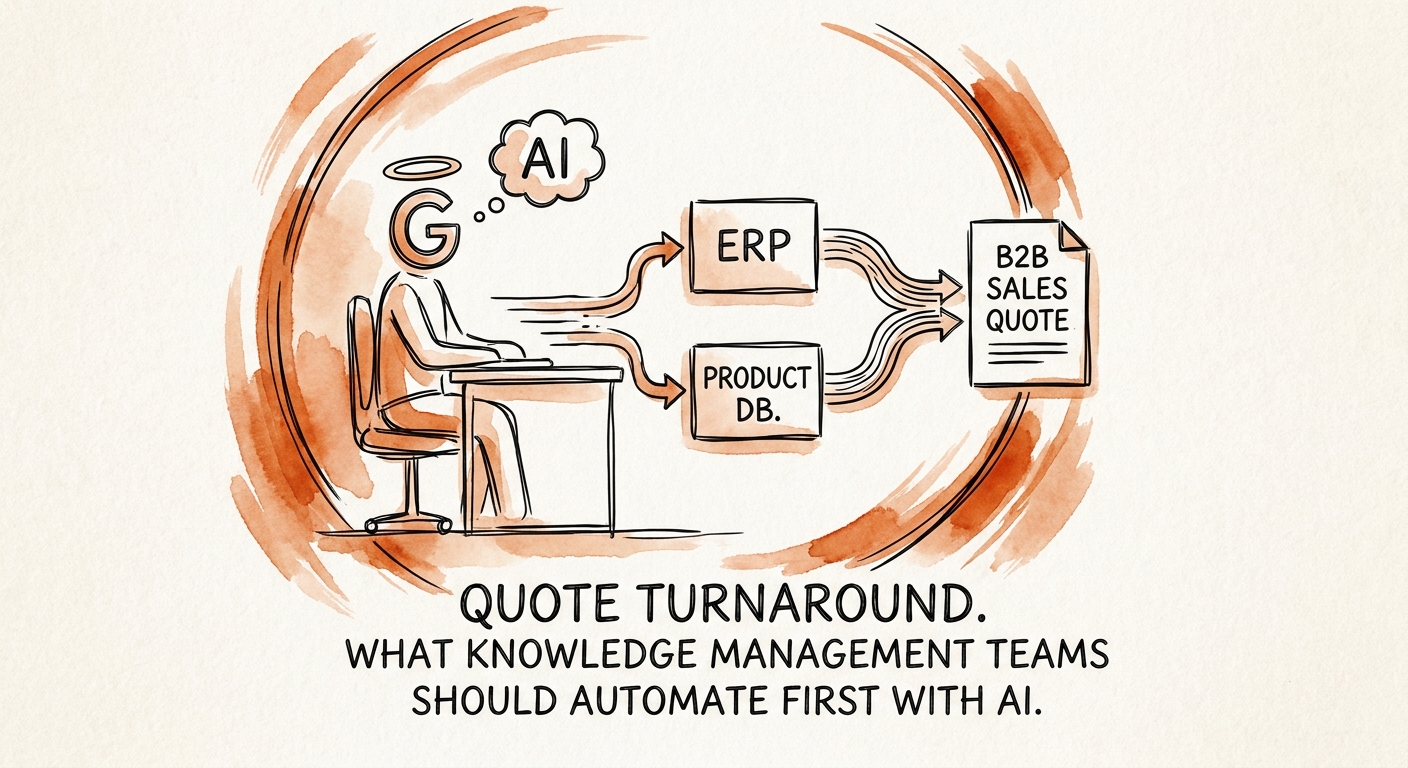
Measure exceptions, not just speed
Most teams instrument quote AI for one number — cycle time — and declare victory when it drops from four hours to twenty minutes. That is the least interesting metric. Track five instead: quote-cycle time, missing-source rate (how often the AI couldn't find an authoritative answer), approval rework (drafts the deal desk sent back), exception frequency, and margin leakage on the human-approved changes. The last one is the real prize. If reps keep overriding the AI's standard pricing and finance keeps approving it, you don't have an AI problem — you have a pricing-governance problem the AI just made visible.
The honest first win is not a fully autonomous quote. It is a complete draft that puts sales, finance, and delivery in front of the same facts at the same time, so the four-hour scramble and the retired-bundle surprise both stop happening. Autonomy comes later, after the exception rate proves the rules are tight enough to trust.
Before you green-light this, walk the other side of the line: read when not to automate quote turnaround with AI to see the failure modes up close, then run the numbers with the AI ROI Calculator to confirm your quote volume actually justifies building this at all.