The 47 minutes between a great call and a mediocre email
A rep just finished a strong discovery call. The buyer asked four specific things: how the product handles SSO, whether there's a SOC 2 report they can share with their security team, what a typical 30-person rollout looks like, and how the pricing compares to the incumbent they're already paying for. The rep knows all four answers exist. The SSO language is in a product one-pager. The SOC 2 report is in a folder someone shared last quarter. The rollout timeline lives in an old implementation deck. The pricing comparison was settled in a Slack thread back in March.
So the rep spends the next 47 minutes hunting, pings two colleagues, gives up on one answer, and sends a follow-up that's 70% complete. The buyer reads it that evening, notices the security answer is missing, and the deal cools by a degree. Multiply that across a quarter and you have a knowledge-management failure dressed up as a sales-velocity problem.
This is the cleanest possible first target for an AI knowledge system, and it's not because sales is glamorous. It's because the workflow is fully observable. There's a hard trigger (the call ends), a known audience (this one buyer), a measurable clock (time-to-send), and a binary outcome (did the email answer all four questions or not). The RSM middle-market AI survey shows adoption is already widespread, but adoption isn't leverage. Leverage comes from pointing the tool at a job where you can watch it work.
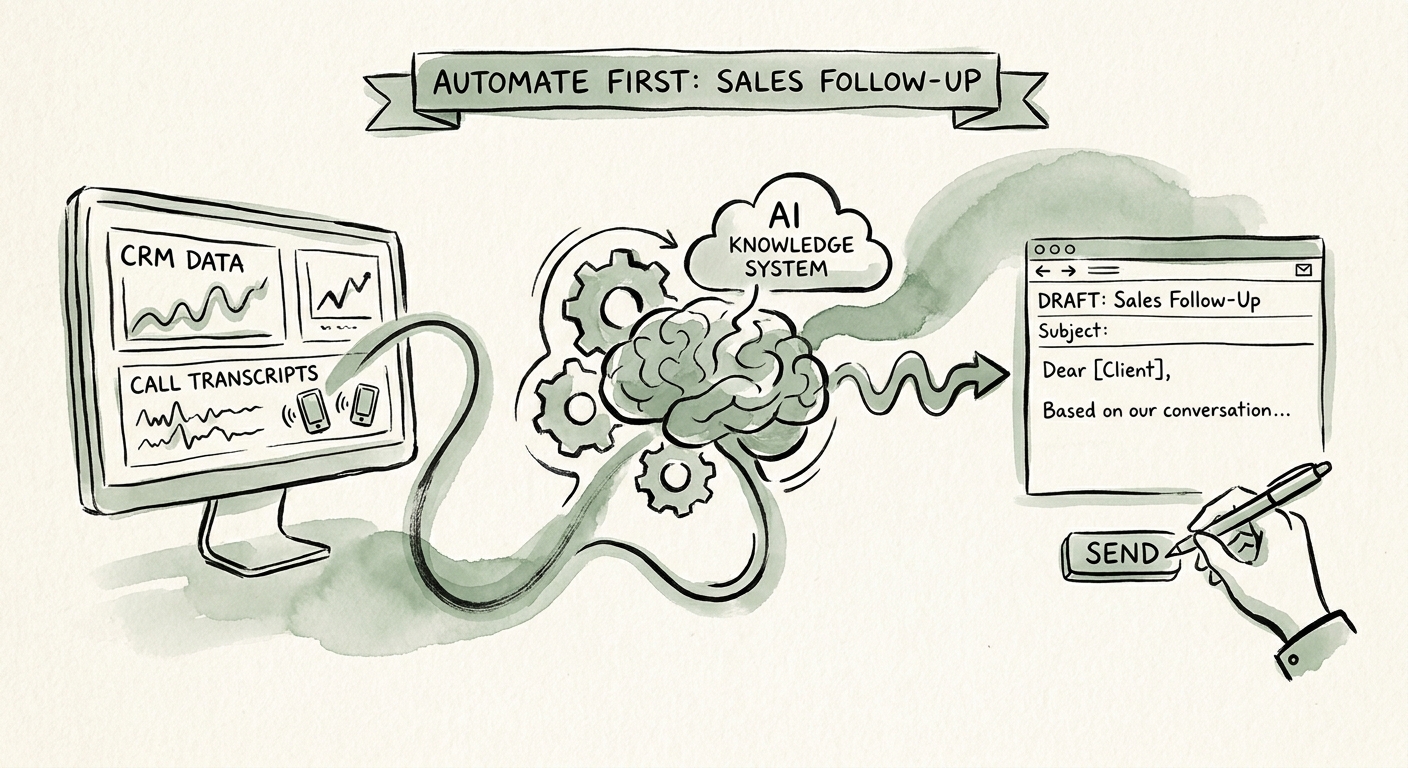
The point isn't to write the email for the rep. The point is to collapse those 47 minutes of scattered searching into a drafted, cited starting block that the rep edits and owns. The buyer's four questions are the spec. Approved source material is the answer key. Everything in between is the part you automate.
Index nine documents, not nine thousand
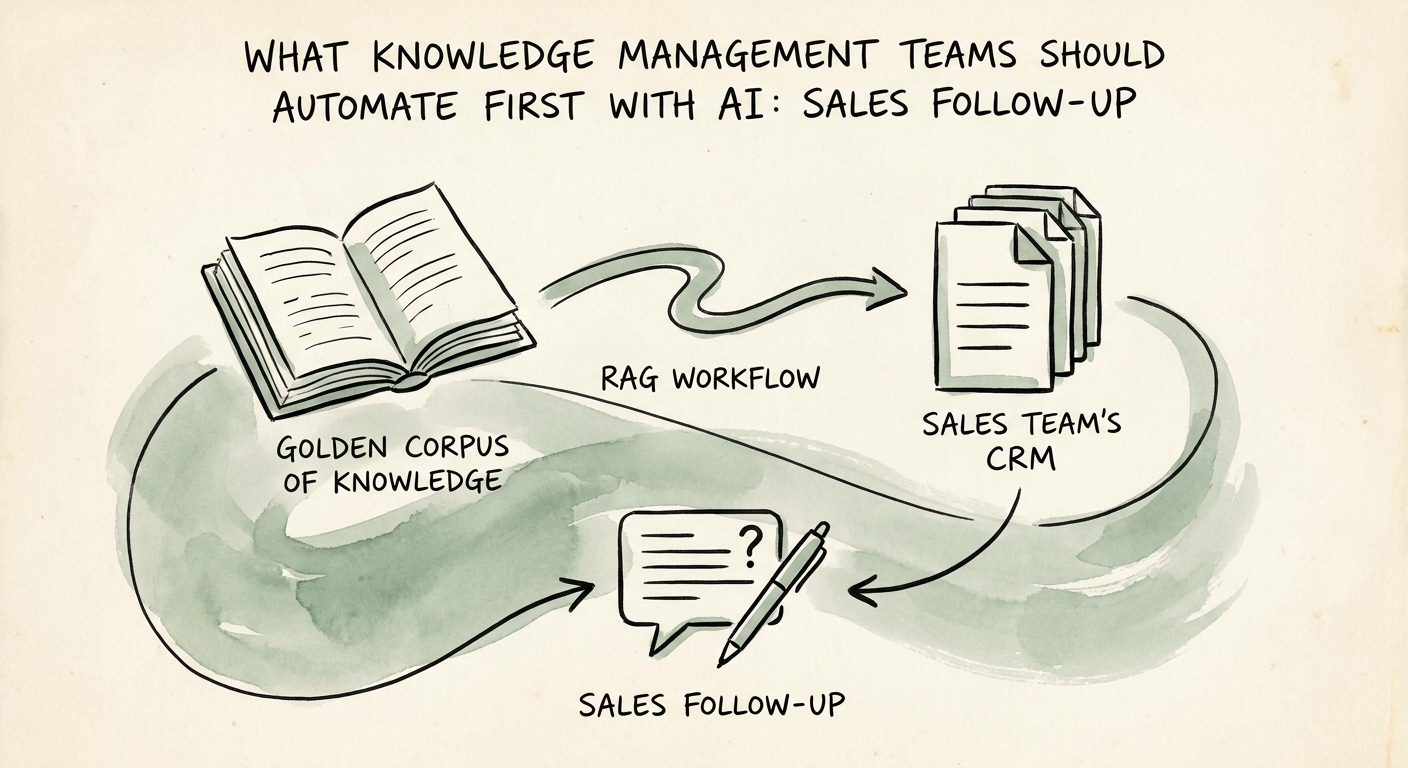
The mistake teams make is treating this as "give the AI access to our drive." That's how you get a confident assistant inventing a discount that never existed. The correct first move is almost insultingly small: assemble a tight, approved corpus and refuse to index anything outside it. For a B2B sales motion, that's roughly nine document types — the product one-pager, the security questionnaire answers, the SOC 2 summary, implementation requirements, integration notes, two or three reference examples, current objection handling, and the live pricing guidance. If a document isn't cleared for a buyer to see, it doesn't belong in the follow-up workflow at all.
The OECD SME AI adoption report draws a useful line between using AI casually and embedding it in a core business activity. A rep pasting a transcript into a chatbot to "draft something" is the casual version. A governed follow-up system — with a named owner, source hygiene, access rules, and a weekly review — is the embedded version. Only the second one compounds.
The mechanics are unfussy. The call transcript surfaces the buyer's actual questions. Retrieval searches only those nine approved sources. The assistant drafts a response with a citation under each claim, linking back to the source document. The rep edits and sends from the CRM. And critically, the system logs three things: which sources it used, what the rep changed, and which questions it couldn't answer at all.
That last log is the part most teams skip and the part that pays for the whole project. This is the same backbone as building an internal AI knowledge assistant, but sales gives it teeth. When the assistant whiffs on "what's your data residency policy" three times in a week, you've just discovered a missing source document — not in a quarterly content audit six months late, but the moment the field needed it. The follow-up queue becomes a live map of where your knowledge base is stale.
Measure the email, not the minutes
"It saves reps time" is a weak business case because nobody can prove it and nobody acts on it. Measure things you can defend: time from call-end to sent email, percentage of buyer questions the draft fully answered, how often reps reuse approved language versus rewriting it, the escalation rate to a human expert, and the buyer-facing correction rate — how often a rep had to send a "to clarify my earlier note" follow-up. The Deloitte State of AI report keeps making the same point: value comes from changing the process, not installing the tool. If the email reaching the buyer doesn't get faster, more complete, or more accurate, you bought an interface.
The guardrail is non-negotiable: the assistant must never invent a discount, a contractual commitment, a delivery date, or a technical guarantee. When it isn't certain, it flags the question for escalation instead of improvising — a wrong SSO answer in a follow-up email is worse than no answer, because now it's in writing. The Gartner agentic AI project forecast warns that a large share of agentic projects get canceled, and unmanaged scope is usually why. Sales follow-up survives precisely because you can keep it narrow: one rep in the loop, one buyer, sources you approved.
Here's the Monday version. Pull the last 30 follow-up emails your team sent. For each, list the questions the buyer actually asked and whether the answer came from an approved source or someone's memory. The questions that kept routing to a human expert are your build priority. The San Francisco Fed small-business AI analysis notes interest is rising fastest among smaller firms — which makes this kind of disciplined scoping the difference between a system and a science project.
Then ship something deliberately small: one sales team, one governed draft workflow, a weekly review of what the assistant got right and wrong, and a standing job to fill the source gaps it exposes. If you want to sanity-check this against your other candidate workflows first, run the AI Opportunity Score, then design the retrieval layer with AI Knowledge Systems and RAG. That cadence is what turns a knowledge base from a graveyard of files into something that actually shows up in the next email.