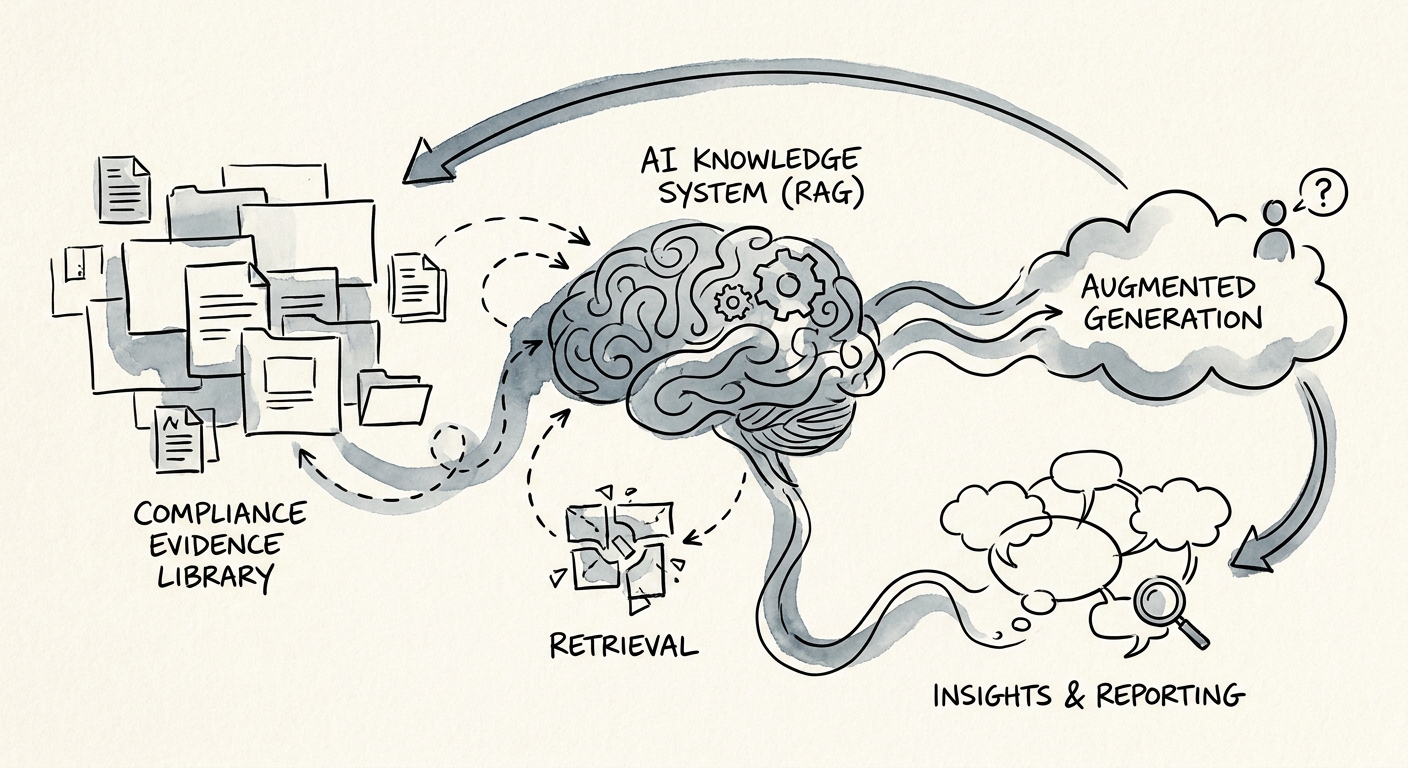
The 4:45 PM evidence request
A client's auditor emails your engagement lead at 4:45 on a Thursday: "Send us the approval trail and the control evidence for the work performed in Q2." Right now, somewhere in your firm, three people are about to open four versions of the same folder, ping a partner who's offline, and reconstruct a chain of approvals from memory and email threads. That scramble — not the technology gap — is the real problem an AI knowledge system for compliance evidence is supposed to solve.
So before anyone shops for an assistant, answer one question: when that request lands, where does the proof actually live, and who is allowed to hand it over? For a professional services firm, the source set isn't generic documents — it's engagement records, signed approval trails, client control requirements, vendor attestations, and the exception notes that explain why a step was skipped or overridden. If those live in scattered drives, half-duplicated and owned by no one, an AI layer on top will just retrieve the confusion faster and with more confidence. The RSM middle-market AI survey, the San Francisco Fed analysis of AI and small businesses, and the OECD report on AI adoption by small and medium-sized enterprises all land on the same point for firms your size: tie AI to one painful, specific workflow — not a broad rollout. The evidence request is that workflow.
What makes evidence different from "search"
A marketing team's knowledge base can tolerate a fuzzy answer. A compliance evidence library cannot, because the document you surface may end up attached to an audit response or a client deliverable. That raises the bar from "relevant" to "defensible," and it changes what you build first. Say a 60-person advisory firm wants this: the work isn't training a model, it's classifying the source library before any retrieval goes live — marking which engagement records are final versus draft, which approval trails are complete, and which exception notes are still open. The NIST AI Risk Management Framework gives leadership the language to map those risks, and because evidence libraries are saturated with client, contract, and security data, CISA AI Data Security Best Practices is the directly relevant playbook for permission boundaries.
Then comes the rule most teams skip and later regret: every answer must cite the specific approved document it came from, and confidential client material must never leave the approved environment. If you're using an enterprise assistant, hold its controls against Microsoft 365 Copilot privacy and data controls and OpenAI enterprise privacy commitments before a single client file is indexed. The acid test for any compliance retrieval system is one sentence: can you prove which document the answer used, who reviewed it, and that no privileged data crossed a boundary? If the answer is "probably," you're not ready to point it at a client engagement.
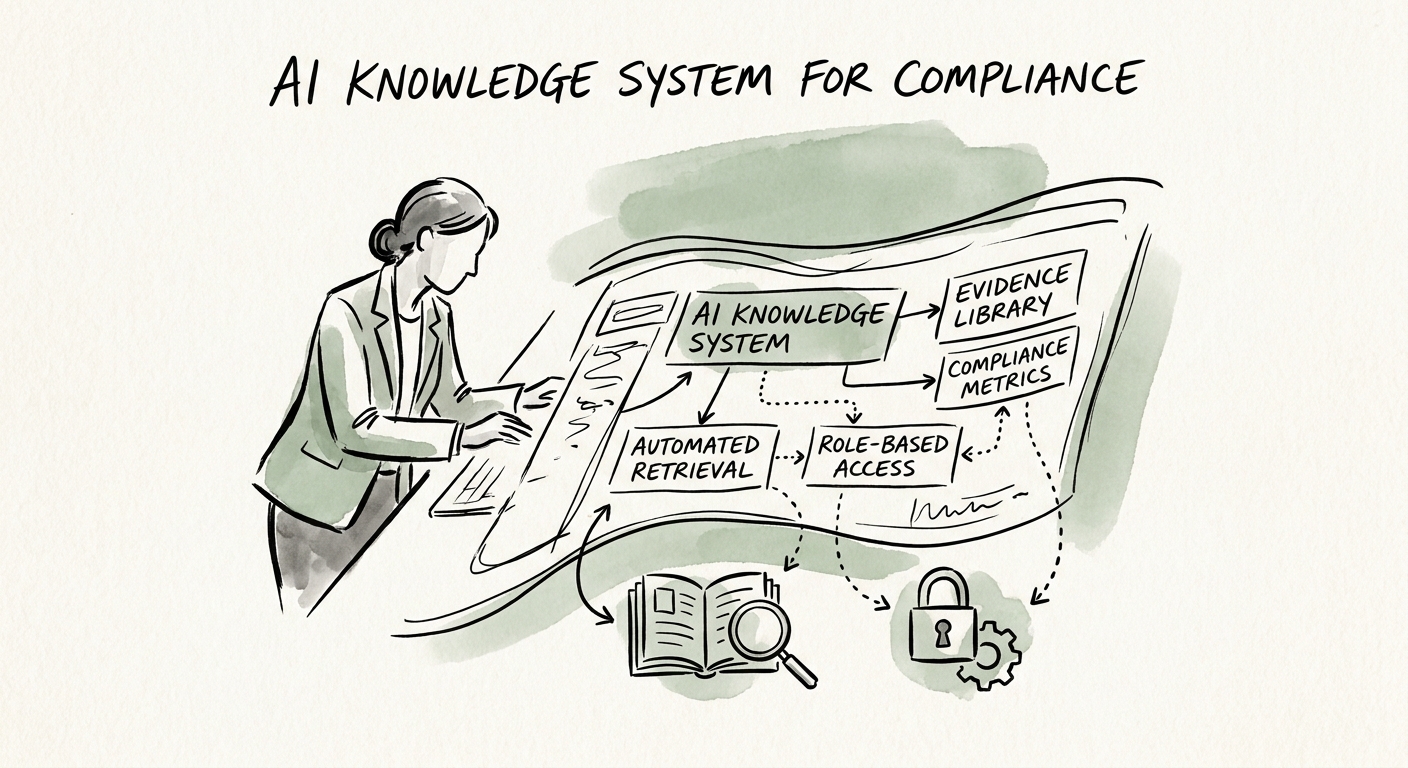
Ship one evidence path, measure the right five things
The version that survives contact with a real audit is smaller than the demo. Pick a single evidence path — "control evidence and approval trails for a recurring engagement type," for instance — connect only the approved, classified sources, force a citation into every draft answer, and route anything ambiguous to a named reviewer (a manager or partner who owns sign-off). That's the Monday-morning build: one path, sources locked, citations mandatory, one human accountable.
Then watch five numbers, not vanity metrics: retrieval accuracy (did it surface the right document?), reviewer edit rate (how often the human has to correct it), time-to-evidence on a request, the count of questions it couldn't answer, and — the most valuable output — the source gaps it exposes, like missing approvals or stale exception notes nobody had reconciled. That last one quietly turns your AI project into a compliance-hygiene audit you didn't have to schedule. Use the internal AI knowledge assistant guide to set the source boundaries and the SMB readiness assessment to confirm you actually have the ownership, permissions, and reviewer capacity to stand behind every answer the system gives a client.