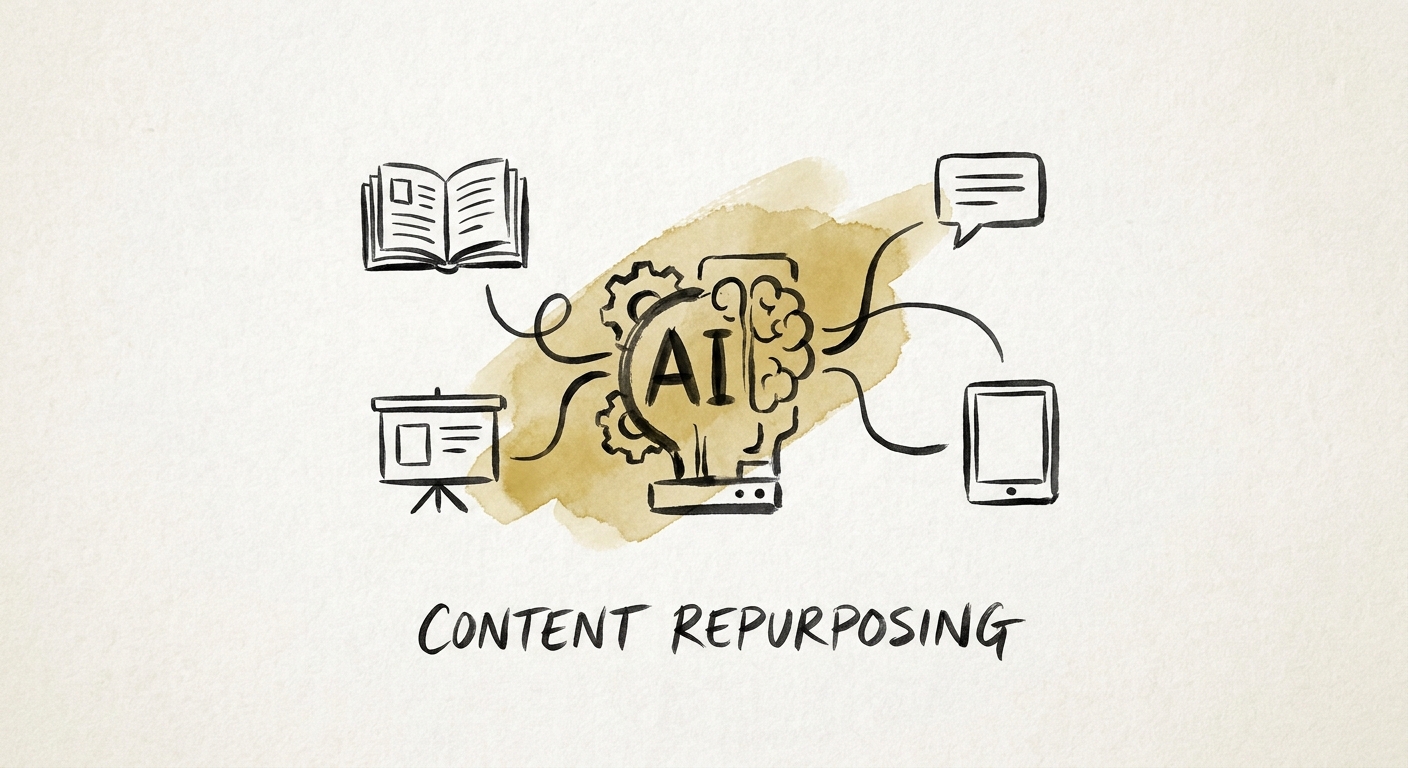
The 47-page report nobody reads twice
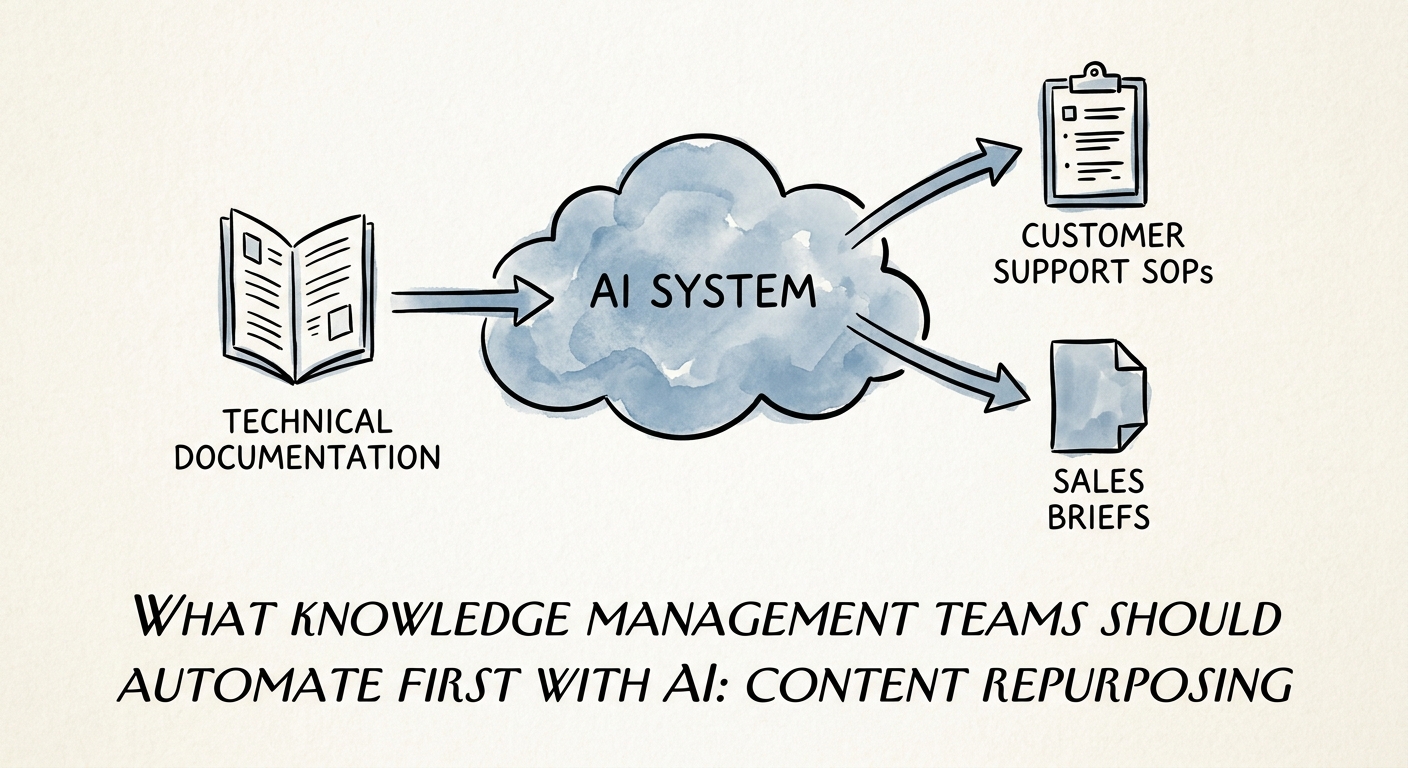
Picture the knowledge management lead at a 90-person professional services firm. A senior team just spent six weeks producing a client benchmarking report. It's excellent. It's also dead the moment it ships — because turning it into a one-page executive summary, three LinkedIn posts, a webinar abstract, and an internal training note means four more people re-reading 47 pages and starting from a blank page each time. So they don't. The insight stays trapped in a PDF, and the firm pays full research cost for a single use.
This is why content repurposing is one of the safest first AI workflows a knowledge team can pick. Unlike most automation, the source of truth already exists and a human already approved it. You're not asking the model to generate truth from nothing — you're asking it to reshape something that's already been signed off. That narrows the failure surface dramatically: the risk isn't a wrong claim, it's a faithful claim in the wrong format.
The timing matters too. The Census Bureau reported in May 2026 that 32% of firms with 100 to 249 employees have meaningful AI adoption — which means a mid-market professional services firm that still hand-redrafts every deliverable is now visibly slower than its peers, not just internally inefficient. The first use case you pick either builds operating confidence or burns it. Repurposing builds it, because the win is obvious and the blast radius is small.
What separates a demo from a workflow you'd trust with a client deliverable
Anyone can paste a report into a chatbot and get a passable summary. That's a demo. The reason it doesn't survive contact with a real knowledge team is governance — and the numbers bear it out. Deloitte's 2026 State of AI research found that only 25% of leaders moved 40% or more of their AI pilots into production. The gap is operating design, not model quality.
For repurposing specifically, three controls do most of the work. First, citation-back: every repurposed output must trace each claim to a line in the approved source, so a reviewer can verify a one-page summary in two minutes instead of re-reading the original. Second, a no-invention rule: the model reshapes what exists and flags anything it can't ground — it never fills a gap with a plausible-sounding statistic. Third, a named review owner per output type, because a LinkedIn post and a client-facing executive summary carry very different reputational risk and shouldn't share an approval bar.
Build a real test set before you trust it: take ten past reports, hand-write the ideal summary and social variants for each, then measure whether the system stays faithful, preserves caveats, and flags uncertainty. Map the workflow against the NIST AI Risk Management Framework so the controls are documented rather than improvised. And because professional services deliverables routinely contain client-confidential material, use CISA's AI data security guidance to set permission boundaries — and verify privacy, retention, and data-use commitments during procurement instead of assuming the default setting protects a client's name.
The 90 days that decide whether this becomes real
Days 1 to 30: instrument the manual reality. How many hours does it currently take to spin one report into its five downstream formats? How often does a repurposed piece get sent back for a tone or accuracy fix? Write those numbers down — without a baseline, you can't tell improvement from enthusiasm.
Days 31 to 60: run the workflow on real, already-published deliverables with a human reviewer and mandatory citation-back. Watch where it drops a caveat, flattens a nuance, or overstates a finding — those edits are your governance spec, not noise. Days 61 to 90: make a real decision. Either repurposing graduates to a supervised production workflow, stays a manual-assist tool for one output type, or gets shelved because the source content isn't clean enough to reshape. The Federal Reserve Bank of San Francisco's research on AI and small businesses shows adoption sticks when it's tied to a concrete operating need — and "stop re-reading 47-page reports" is about as concrete as it gets. The OECD's work on AI adoption by SMEs echoes it: the firms that win sequence one narrow workflow before broadening.
If it works, you now have a template: one approved input, many governed outputs, one named owner per format. That's the unit you scale. From there, the natural next steps are connecting it to internal knowledge search so people can find the source material, hardening your pilot-to-production controls, and mapping the broader sequence in the AI Transformation Blueprint.
